

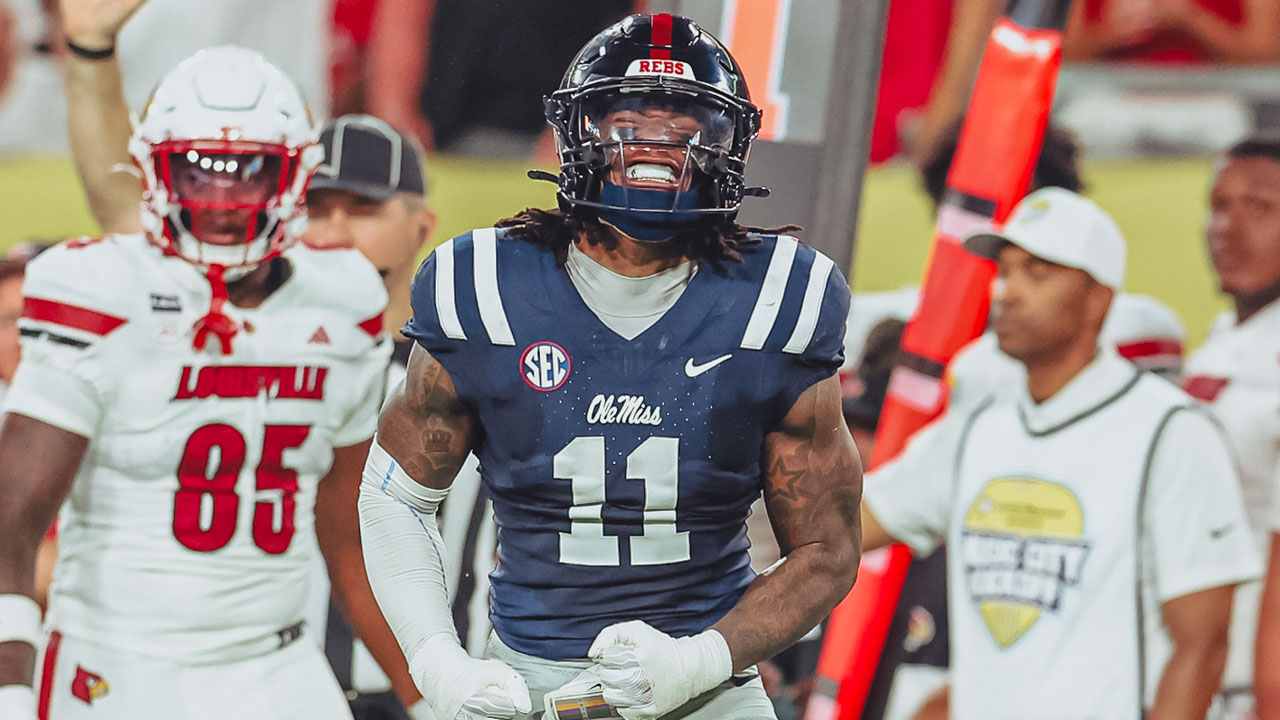
The storylines off the field continue to overshadow the on‑field storylines.
Whether it’s LSU’s Princewill Umanmielen getting served papers related to the lawsuit Ole Miss filed against him or LSU listing quarterback Sam Leavitt as doubtful, everything other than the X’s and O’s has dominated the conversation.
At some point those roles flip and an actual football game takes over. Saturday night should be a good one, too. Two top 10 teams with College Football Playoff aspirations, two strong defenses and two quarterbacks who can win games on their own. It’s hard to ask for more this early in the season.
So, what could actually decide the outcome and give one fan base the green light for an epically large victory lap on social media and message boards?
Here are three things that could shape Saturday night.
Can Ole Miss block LSU’s front seven?
Through two games, LSU’s defense has been the most impressive part of its team. Opponents have rushed 57 times for 36 yards. That’s 0.6 yards per carry. LSU has 23 tackles for loss, 12 sacks and has allowed just four third‑down conversions on 27 attempts.
Princewill Umanmielen has been the biggest problem. He’s the first defender Ole Miss has to account for on every snap. Through two games he has 11 tackles, 6.5 tackles for loss and five sacks. That’s an enormous early pace.
The issue for Ole Miss is that LSU isn’t built around one rusher. Jordan Ross has seven tackles, four tackles for loss, 1.5 sacks, an interception and a pick‑six. Deuce Geralds has five tackles, two tackles for loss, two sacks and a forced fumble. Slide protection toward Umanmielen and you’re inviting problems from the other side or inside.
Linebacker TJ Dottery leads LSU with 14 tackles and has forced two fumbles. Whit Weeks is right behind him with 12 tackles. That front‑plus‑linebacker combination explains the absurd rushing numbers. LSU hasn’t just limited explosive runs. Opponents haven’t been able to establish a conventional running game at all.
That makes the matchup with Kewan Lacy and the Ole Miss offensive line one of the most important battles of the night. LSU hasn’t faced anyone who can consistently move this front. Ole Miss has to be the first.
Can LSU protect Sam Leavitt when the pocket isn’t clean?
The 45‑14 score against Louisiana Tech hides how messy LSU looked for long stretches.
LSU committed four turnovers, including three Leavitt interceptions. One was returned 100 yards for a touchdown. Louisiana Tech had zero yards of offense at halftime and still trailed only 10‑7 because LSU kept shooting itself in the foot.
The offensive line allowed five sacks, and LSU committed 10 penalties for 101 yards. Through two games LSU already has 176 penalty yards. Clemson couldn’t make LSU uncomfortable. Louisiana Tech did, at least temporarily, with pressure and mistakes.
The line is experienced and talented, but the Tech game showed it’s not impenetrable. If Ole Miss can force Leavitt into the same kind of rushed decisions and off‑schedule throws, LSU’s offense becomes a very different unit.
Can LSU’s secondary slow down Ole Miss’ passing offense?
Opposing quarterbacks against LSU are 28‑of‑46 for 248 yards, one touchdown and two interceptions. That’s only 5.4 yards per attempt. And even those numbers are inflated by one play: Louisiana Tech hit a 67‑yard touchdown late in a blowout. Remove that and LSU has allowed just 181 passing yards on the other 45 attempts.
DJ Pickett has an interception, and Ross produced the pick‑six against Clemson. The regular secondary includes Pickett, PJ Woodland, Tamarcus Cooley, Ty Benefield and Dashawn Spears. They’ve been solid, but they haven’t been tested by a quarterback who can force them to defend for four quarters.
That’s the unanswered question. Clemson couldn’t do it. Louisiana Tech couldn’t do it. Trinidad Chambliss can.
Saturday night is loaded with off‑field drama, but the game itself has more than enough substance. LSU’s front seven, LSU’s protection issues and LSU’s secondary all face their toughest challenge yet. Ole Miss has the quarterback, the receivers and the home crowd to make those weaknesses matter.
For the first time in months, the football might actually be the biggest storyline between LSU and Ole Miss.