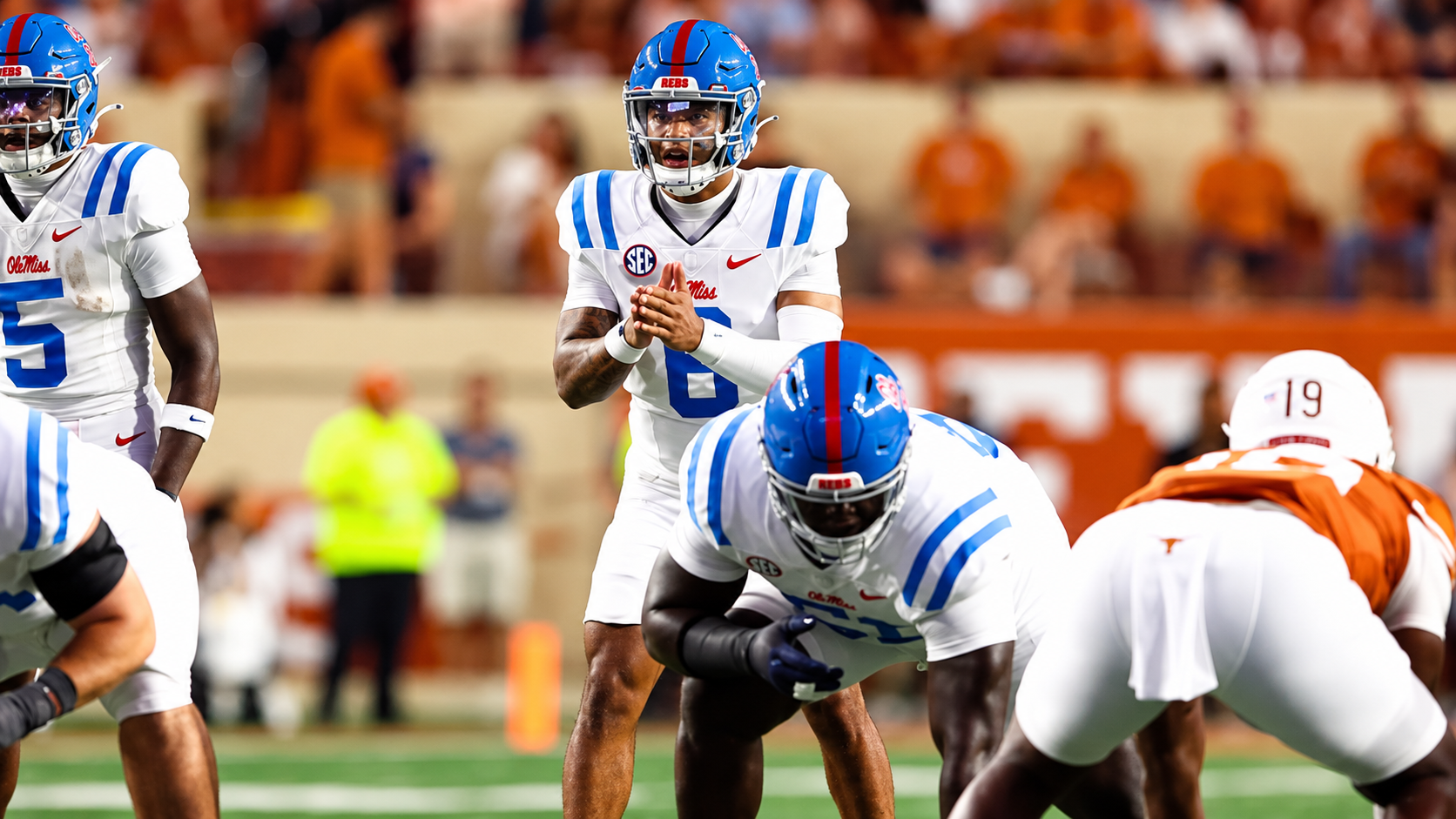
Trinidad Chambliss hasn’t suddenly forgotten he can hurt defenses with his legs. He’s just spent most of this season trying to beat them with his arm.
A year ago, Chambliss was one of the most dangerous dual-threat quarterbacks in college football, running for 527 yards and eight touchdowns on 133 carries while helping lead Ole Miss to the College Football Playoff. Through seven games this season, he’s rushed for just 134 yards on 41 carries. His rushing touchdowns are still there with six, but the explosive production hasn’t been.
And if Pete Golding’s comments Monday are any indication, that might not be by accident.
Part of it is natural quarterback development. As Chambliss has grown as a passer, Ole Miss has wanted him to stay in the pocket longer, work through progressions and trust what he sees through the air.
“I think part of developing as a quarterback and as a passer is making sure I’m going through the progressions and things as well,” Golding said Monday. “Also, I think after having the year that he had, there’s different plans in place for him this year and how to control him in the pocket and how to have a spy for him.”
Defenses deserve some credit, too. Chambliss isn’t catching anybody by surprise anymore.
After last season, every defensive coordinator on Ole Miss’ schedule spent the offseason looking for ways to keep him contained. Spies have become common. Lanes close faster. Defenses would rather force him to win from the pocket than watch him turn a broken play into a 25-yard gain.
Still, Golding sounded like a coach who wouldn’t mind seeing his quarterback trust his instincts a little more often.
“I think there’s some times where, all right, it’s not there. Man, let’s go be an athlete as well,” Golding said. “So that’s been talked about. I think there were some opportunities within that game, especially late, where we’re getting some two-man and all those. And there’s a spy, but I mean, you can outrun him.”
That comment stood out because it came less than 48 hours after Ole Miss’ loss to Texas.
Chambliss finished with just seven net rushing yards on five attempts while completing 25 of 52 passes for 250 yards, two touchdowns and three interceptions. Golding noted there were communication issues in the passing game, along with Texas repeatedly getting its hands into throwing lanes.
“A lot of them were just not on the same page,” Golding said. “Some of them were tipped balls, although they did a really good job. They had eight knockdown balls that I think could have been some explosive plays.”
Which raises an obvious question: If defenses are taking away those throwing windows and the passing game isn’t operating cleanly, why not lean a little more into what made Chambliss special in the first place?
Last season, some of his best plays came when the pocket told him no.
“There were a lot of times that the first three weren’t there last year, I’m gone, which is something that makes him who he is,” Golding said. “And so I think you’ll see a little more of that moving forward.”
The timing certainly makes sense.
Leading rusher Kewan Lacy has already been ruled out for Saturday’s game against Auburn with a shoulder injury, meaning Ole Miss will need to find rushing production elsewhere. Makhi Frazier is likely in line for a larger workload, while JT Lindsey, Joshua Dye and Shekai Mills-Knight could all see more opportunities.
But Golding may have hinted at another answer Monday.
The Rebels have spent much of this season encouraging Chambliss to become a more complete quarterback. Against Auburn, they may need him to become a little more of the quarterback he was last year.