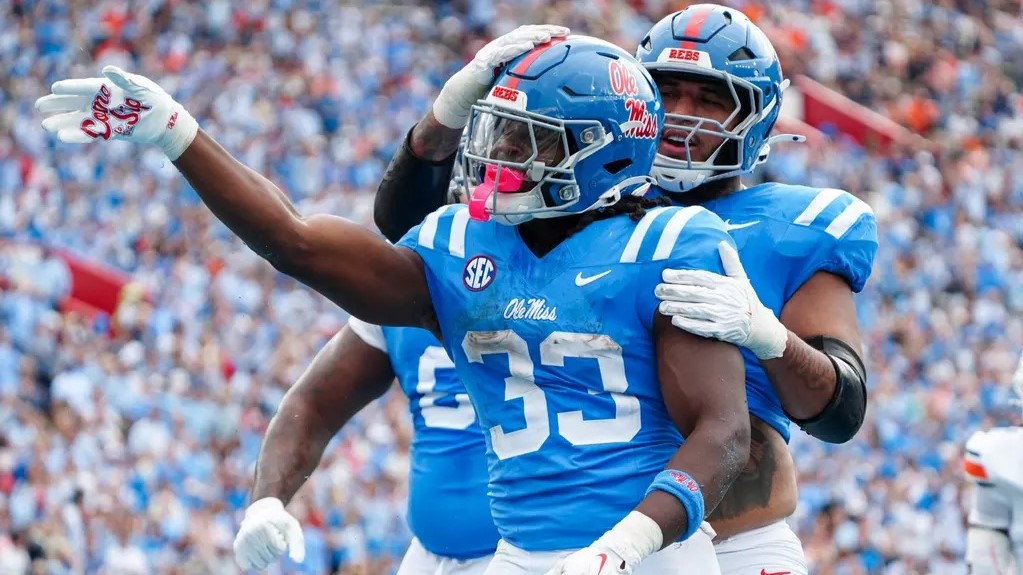
Ole Miss didn’t hide the fact it would be without star running back Kewan Lacy this week.
The All-American running back dislocated his shoulder against Texas last week and head coach Pete Golding didn’t hide his status or force anyone to play a guessing game about Lacy’s status.
He announced Monday that Lacy wouldn’t be available. Two days later, he tipped his hand as to how the Rebels would replace the missing rushing production.

“I think it’s time to get Shekai (Mills-Knight) going,” Golding said during his RebTalk Live appearance. “We’ve talked about that for a couple of weeks. He’s a size-speed guy.”
The sophomore running back delivered in a big way.
Mills-Knight rushed for a career-high 71 yards and a touchdown on 16 carries in Ole Miss’ 45-15 victory over Auburn.
If you're 𝐒𝐊ared, say you're 𝐒𝐊ared. 😮💨@sk_begreat x #HottyToddy pic.twitter.com/hi7pXqZk1v
— Ole Miss Football (@OleMissFB) October 31, 2026
To put that performance into perspective, the sophomore entered Saturday with just four carries for 42 yards and one touchdown in his entire college career.
However, the more interesting part of Mills-Knight’s story isn’t necessarily what he did against Auburn. It’s everything he did while waiting for the opportunity.
And perhaps more importantly, why he decided to stick around and wait for it.
“I just fell in love with the ‘Sip since I was a recruit,” Mills-Knight said after Saturday’s win. “I stayed true to it, and I knew my time would come, so I just kept working.”
That isn’t always the easiest approach in today’s college football landscape, where the transfer portal offers players an opportunity to look elsewhere when playing time is limited.
Mills-Knight had plenty of reasons to wonder when his opportunity would arrive.
Kewan Lacy was already established as one of the nation’s top running backs. Ole Miss added Makhi Frazier and JT Lindsey to an already crowded running back room.
Rather than getting frustrated, Mills-Knight tried to learn from the players ahead of him.
“I knew we had the best running back in the nation, so it was just like watching greatness,” Mills-Knight said. “I wasn’t too mad. I just stayed ready. I learned from what (Lacy) did, added it to my game and stayed patient.”
Of course, staying ready meant doing a lot of work the public doesn’t get to see.
Mills-Knight spent time on the scout team, giving the Ole Miss defense a chance to prepare for opposing running backs.
And according to linebacker Keaton Thomas, he wasn’t exactly taking it easy on his teammates.
“At the beginning of the year, Shekai was actually doing some scout-team stuff for us, some scout-team reps,” Thomas said. “He was running through jokers.”
Thomas said he repeatedly encouraged Mills-Knight to keep working because his opportunity would eventually come.
That work paid off when Lacy’s shoulder injury forced Ole Miss to lean more heavily on its other running backs.
Mills-Knight made the most of it, leading the Rebels in rushing and scoring on a 1-yard run in the second quarter that gave Ole Miss a 14-6 lead.
His performance also offered another reminder that development isn’t always something that shows up in the box score.
Golding explained afterward that Mills-Knight’s biggest improvements have come in areas beyond carrying the football.
“There’s so much more to it than just running the football,” Golding said. “We always knew he could run the football. But his development and understanding of the offense, allowing (Trinidad Chambliss)and the other guys to trust him to be out there and do what he’s supposed to do, I’m super proud of him for that.”
That’s an important distinction.
At 6-foot-3 and 235 pounds, Mills-Knight has the physical tools to be an effective running back. But being trusted to stay on the field requires considerably more than running through defenders.
With Lacy’s availability uncertain moving forward, there could be more opportunities coming.
Saturday didn’t suddenly make Mills-Knight the next Lacy. One productive afternoon isn’t enough to make that declaration.
But it did show why Golding believed it was time to get him going.
And for a player who spent so much time waiting for his opportunity, it was a pretty good reminder that patience can still pay off in college football.