

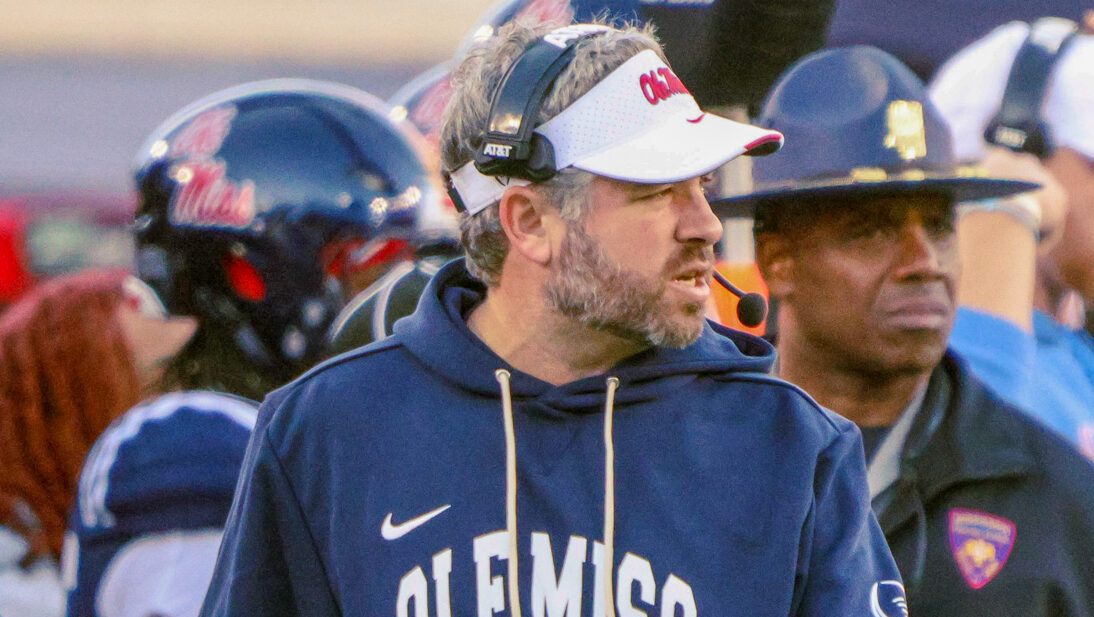
Pete Golding didn’t need much prompting to explain what makes Ole Miss different.
Near the end of his recent interview on the Talk of Champions podcast, after talking recruiting, depth and the challenge of opening with Louisville, Golding shifted into something that wasn’t about personnel or scheme.
It was about alignment. And for Golding, that alignment is the reason Ole Miss feels less like a football operation and more like a family business.
“When you’re an assistant for so long, you really don’t think about it,” Golding said. “You’re where your feet are, you do your job and the next job is going to come.”
That changed when he became the head coach at Ole Miss. Golding has coached at plenty of places, but he hasn’t had this. He hasn’t had a program where the chancellor, the athletic director and a large portion of the staff all share the same alma mater and the same investment.
“The appreciation I have for the vertical alignment at Ole Miss is different,” Golding said. “Glenn Boyce being the chancellor and having gone there, Keith Carter having gone there, his leadership, and the staff we’ve been able to put together that made it at Ole Miss and graduated from Ole Miss, it’s a different feel.”
That alignment matters. When the people making decisions have worn the same jersey and walked the same campus, the conversations change. The priorities change. The support changes. It’s not just about winning games. It’s about elevating a place they already care about.
Golding sees it in recruiting. He talked openly about how Ole Miss can now keep Mississippi’s best players home because the program is competing for SEC titles, producing first‑round picks and making playoff runs. That wasn’t always the case.
“When I was at another school recruiting this state, I felt like at that point they had to go out of state to compete for SEC championships, compete for national championships and become first‑round draft picks,” Golding said. “Now, we’re doing all of that at Ole Miss. That’s something they don’t have to leave to get anymore.”
That shift doesn’t happen without alignment. It doesn’t happen without resources. And it doesn’t happen without a staff that feels empowered to build relationships instead of scrambling to fill holes.
Retention is part of it too.
Golding said it’s easier to keep players when they come from high school, grow in the same system and want to be at Ole Miss for reasons beyond football. That’s culture. And culture is easier to maintain when the people running the program aren’t pulling in different directions.
“It’s easier to retain guys when you’ve developed that relationship with them sooner,” Golding said. “They come out of high school, stay in the same system and want to be there for a reason.”
The difference between Ole Miss and Golding’s previous stops is subtle but important.
At other places, players sometimes felt they needed to leave the state to chase championships or NFL futures. Coaches sometimes felt they needed to leave to climb the ladder. At Ole Miss, the ladder runs through Oxford. The program’s success is tied to the school’s identity, and the school’s identity is tied to the people who stayed.
Golding fits that mold. He’s not an Ole Miss graduate, but he’s a Mississippi coach through and through. His dad was a high school coach. He’s recruited the state for two decades. He understands how much it matters when the flagship program feels stable, aligned and invested.
“It’s a very family business,” Golding said. “The investment is completely different.”
That’s why Ole Miss feels the way it does to him. It’s not a slogan. It’s not a recruiting pitch. It’s the reality of a program where the chancellor, the athletic director and the head coach all see the same picture and push toward the same goal.
And for a team trying to build on a playoff run, that kind of alignment might be the most valuable resource they have.