Florida’s defense looks different this season, and it’s not just because it has an entirely new coaching staff.
First-year defensive coordinator Brad White was hired by John Sumrall from Kentucky, where he ran a multi-front system. The stated goal of the defense is simple, too: generate more quarterback pressure than Florida had in recent years.
Through three games, that ambition finally showed up in a major way.
Against Auburn, Florida recorded seven sacks for 35 yards, including four in the fourth quarter. Auburn managed only 102 rushing yards on 31 attempts. It wasn’t a dominant performance in every category, but it was the first time Florida’s pressure packages looked fully alive.
The centerpiece of that front is sophomore edge defender Jayden Woods. He’s Florida’s premier front‑seven player, and Auburn was his breakout moment.
Woods had six tackles, 3.5 tackles for loss and 2.5 sacks. He’s 6‑foot‑3, 245 pounds and athletic enough that Florida can move him around instead of parking him on one tackle all night. That flexibility forces offenses to account for him on every snap.
The problem for opponents is that focusing on Woods doesn’t solve everything. Emmanuel Oyebadejo added 2.5 sacks against Auburn, giving Florida another legitimate threat off the edge. If you slide protection toward Woods, Oyebadejo can win his matchup. If you try to play it straight, both can get home.
Florida’s linebacker group is the most experienced unit on the roster. Myles Graham, Aaron Chiles and Jaden Robinson all played extensively last season.
Graham led the team with 76 tackles in 2025, and Chiles and Robinson combined for another 102. Nearly 98 percent of Florida’s linebacker snaps returned. Graham is the centerpiece, athletic enough to cover and experienced enough to diagnose the run. Robinson added one of Florida’s seven sacks against Auburn.
Pete Golding has plenty of respect for what White does schematically.
“They’re very, very sound in the back end,” he said at his weekly Monday press conference. “They’re multiple in coverage, with a lot of weak‑side insert and some weak‑hook things that affect the three player. There are a lot of odd structures in the front that make the ball go east and west. They leverage the ball really well, and his teams have always tackled really well in space. They’re very disciplined and have really good eye control, which is a big piece of stopping this type of offense as well.”
Florida also has intriguing corner talent. Ben Hanks III and Cormani McClain give the Gators length and athleticism on the perimeter, while Bryce Thornton provides experience at safety. McClain intercepted Auburn quarterback Byrum Brown on the Tigers’ third offensive play, setting up Florida’s opening touchdown.
But here’s the part Ole Miss should pay attention to: Florida has still surrendered passing production.
FAU threw for 276 yards. Auburn threw for 271 yards and three touchdowns. Auburn receivers Keshaun Singleton and Chas Nimrod combined for 194 yards.
Some of that is game situation. Some is volume. But it’s also the area where opponents have had more success than trying to pound Florida on the ground.
White’s defense wants to create negative plays. The seven sacks against Auburn showed what happens when the pressure hits. But the vulnerable area is pass defense, particularly explosive plays.
Auburn hit completions of 48, 35 and 25 yards. Florida’s corners are talented, but the Gators haven’t shown that opponents must abandon throwing downfield.
That’s where Ole Miss comes in.
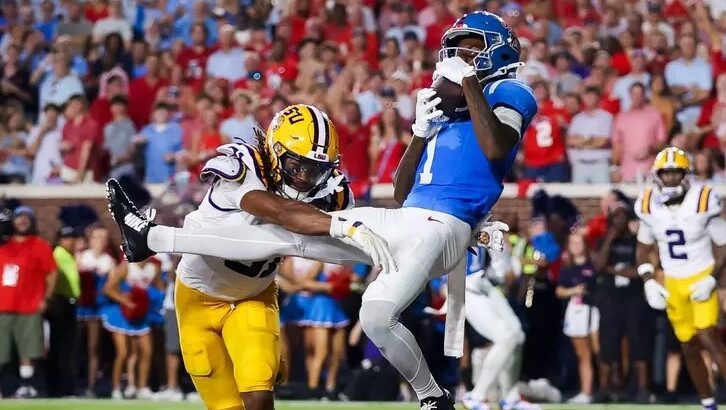
The Rebels can attack with several different types of receivers. Deuce Alexander can win vertically. Traylon Ray can win underneath and after the catch. Caleb Odom can stress safeties and linebackers. Ole Miss doesn’t have to rely on one matchup. It can force Florida’s secondary to cover in space, communicate through motions and handle tempo.
Florida’s run defense is excellent. Its pass defense has been more vulnerable.
And Ole Miss has the receivers to make that matter.
If the Rebels want to find their edge Saturday, it might come from letting their deep group of pass catchers expose a Florida secondary that hasn’t proven it can consistently hold up.