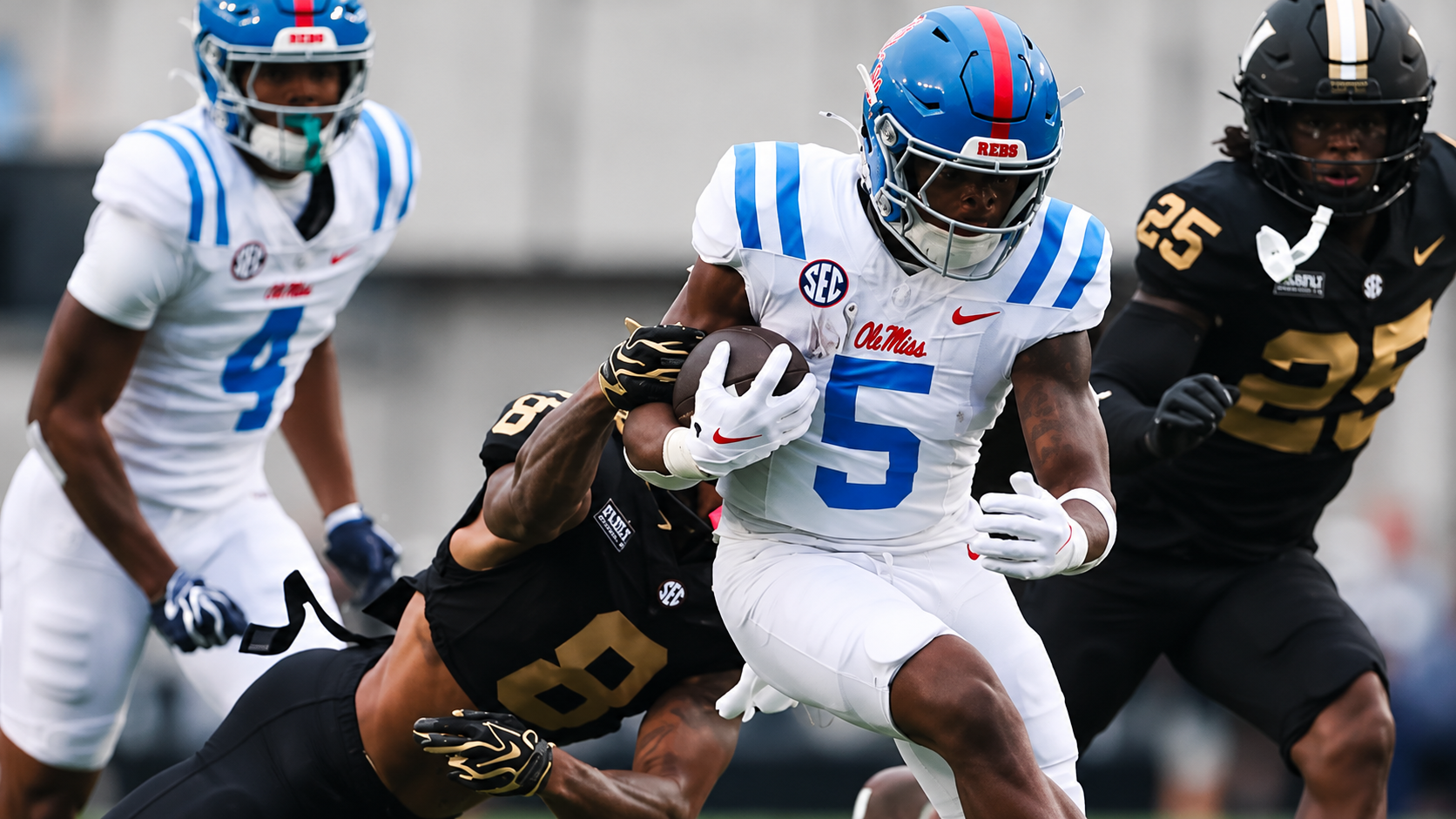
Ole Miss entered Saturday’s game against Vanderbilt with uncertainty surrounding Kewan Lacy’s availability and questions about the run game’s ability to make an impact without him.
The Rebels provided positive answers about both in a 52-17 victory against the Commodores. Most importantly, they showed evidence that their rushing attack can remain productive without leaning heavily on their star running back.
Lacy played, scored a touchdown and finished with 39 yards on seven carries. But he wasn’t the Rebels’ leading rusher, nor was he the player who handled most of the work out of the backfield.
That distinction belonged to Makhi Frazier.
Frazier carried 13 times for 73 yards, averaging 5.6 yards per attempt. He didn’t score a touchdown or break off a spectacular run that inflated his final numbers. His longest carry went for 16 yards.
“We got him through practice this week, and it was going to be a game-time decision based on how he felt coming out of pregame,” head coach Pete Golding said after the game. “He came out and said, ‘Coach, I’m good. I’m ready to go.’ So it gives us a different spark, obviously. When he’s back there, from a defensive standpoint, that’s a different concern.”
Instead, Frazier provided something Ole Miss needed: consistent production.
And importantly, much of that production came before the outcome was decided.
During a 15-play, 63-yard touchdown drive that extended from the end of the first quarter into the second, Frazier became a central part of the offense.
He carried six times on that possession, helping the Rebels move methodically downfield before Trinidad Chambliss connected with Jamarious Brown for a 2-yard touchdown.
It wasn’t the kind of offensive possession that generates much attention in a 35-point victory. But it might have been one of the most encouraging developments of the afternoon for Ole Miss’ running game.
“I thought the other guys, Makhi came in and ran well,” Golding said. “(Shekai Mills-Knight) came in and got a big run. I thought other guys are still improving at the position, which they’re going to have to.”
The Rebels weren’t relying entirely on Chambliss to create opportunities, and they weren’t asking Lacy to carry the rushing attack while dealing with questions about his health.
They had another running back capable of moving the chains.
That became even more apparent when examining the final numbers.
Ole Miss rushed for 196 yards on 35 carries, averaging 5.6 yards per attempt. Lacy accounted for just 39 of those yards.
The Rebels’ other six ball carriers combined for 157 yards on 28 attempts, also averaging approximately 5.6 yards per carry.
If the focus is narrowed to the other running backs, Frazier, Shekai Mills-Knight and JT Lindsey combined for 122 yards on 19 carries, averaging 6.4 yards per attempt.
Those numbers require some context.
Mills-Knight finished with 42 yards on four carries, including a 35-yard touchdown run in the fourth quarter when the Rebels already held a commanding lead. Lindsey contributed seven yards on two attempts.
Both contributed to the final rushing total, but their performances weren’t necessarily evidence that Ole Miss could replicate its offensive success against a competitive opponent without Lacy. After all that came late in the game when the outcome was already decided.
Frazier’s performance was different.
He was productive during the first half, when Vanderbilt still had opportunities to work its way back into the game. He handled more carries than Lacy and finished with nearly twice as many rushing yards.
Lacy, meanwhile, recorded his final rushing attempt during the second quarter. Whether his limited workload was predetermined, related to his health or simply a product of the game’s increasingly lopsided score remains unclear.
What isn’t unclear is that Ole Miss didn’t need to increase his workload to maintain an effective rushing attack.
That’s an important development considering what happened two weeks earlier against Florida.
The Rebels’ problems in Gainesville raised questions about their ability to establish a consistent running game and play with the physicality necessary to compete against SEC defenses.
Saturday wasn’t a perfect test of whether those issues have been resolved. Vanderbilt struggled defensively, and the Rebels benefited from favorable circumstances as the game progressed.
But there is a meaningful difference between accumulating rushing yards after a game has been decided and establishing a productive alternative to your starting running back while the outcome is still in question.
Frazier accomplished the latter.
Lacy remains one of Ole Miss’ most important offensive weapons, and nothing about Saturday changes that.
What Saturday potentially changes is how much the Rebels need to depend on him.
For an offense with postseason ambitions, discovering that kind of depth could prove nearly as important as the victory itself.