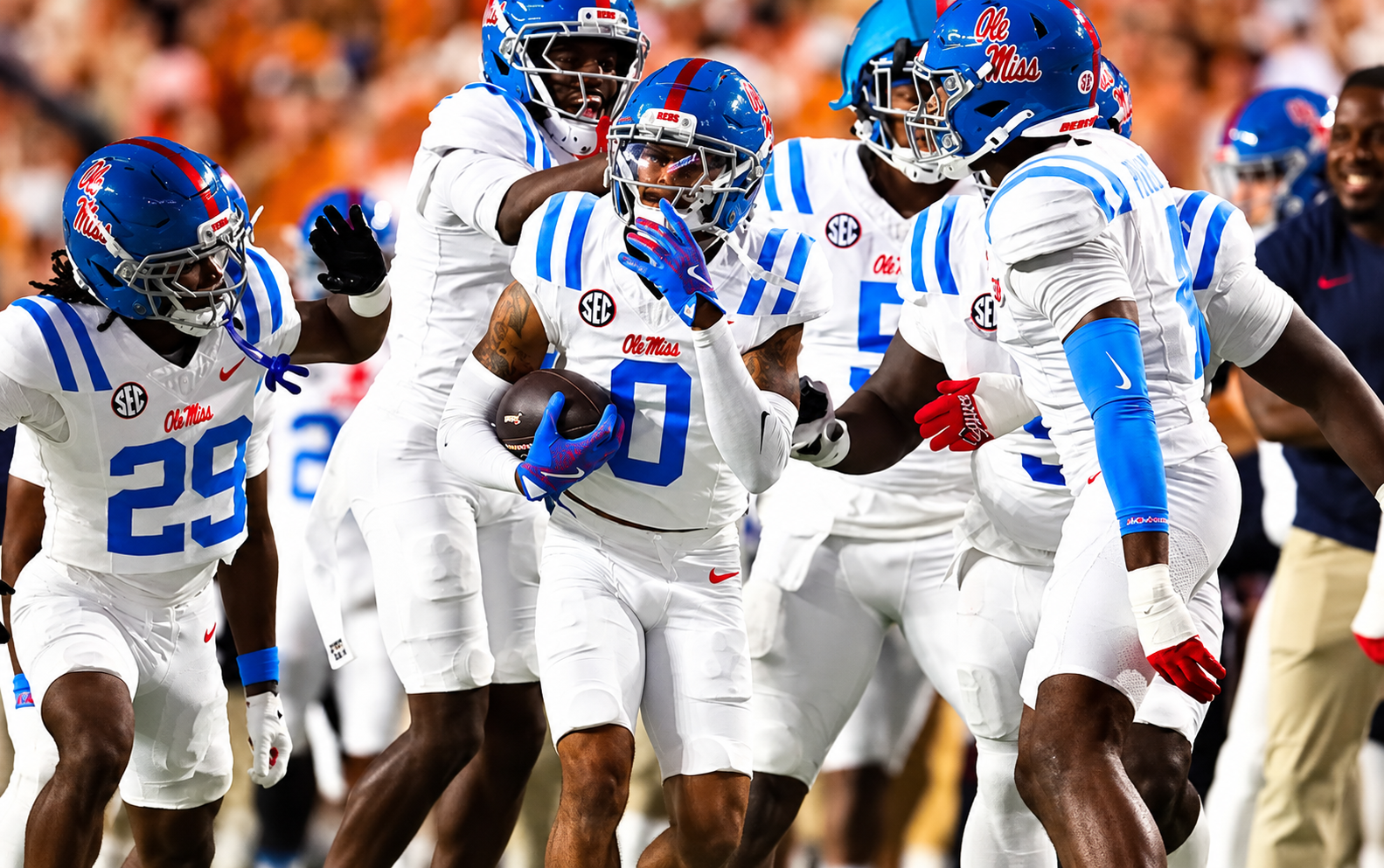
Saturday night’s 34-27 loss to No. 19 Texas will sit with No. 7 Ole Miss for a while.
Despite being in a 21-point hole at halftime, the Rebels mounted a comeback that had the game tied at 24-24 just 60 seconds into the fourth quarter.
But they couldn’t keep that momentum going and failed to capitalize on a number of chances Texas had given them.
Games like this never come down to just one play, but here are four stats that help explain how and why the longhorns held on to the win against Ole Miss.
121
That’s how many rushing yards Texas had in the fourth quarter Saturday night.
The Longhorns rushed for 87 yards in the first half and actually finished the third quarter with minus-1 rushing yard. Through three quarters, Texas had just 86 yards on 30 carries.
But after Ole Miss tied the game at 24-24 early in the fourth quarter, the Longhorns eventually figured out how to run the football.
Arch Manning threw his second interception of the game on Texas’ next possession, but Ole Miss couldn’t take advantage of the turnover.
When the Longhorns got the ball back, they took the passing game out of the equation entirely.
Texas answered with a six-play, 80-yard touchdown drive that didn’t include a single pass attempt.
In the fourth quarter alone, Raleek Brown ran seven times for 87 yards (12.4 yards per carry), including a 47-yard run that put the Longhorns deep into Ole Miss territory.
For some perspective, Ole Miss had allowed just 142 combined rushing yards against Vanderbilt and Missouri in its previous two games.
Texas nearly matched that total in one quarter.
It was the biggest step backward for the Rebels’ run defense since allowing 302 rushing yards against Florida a month ago, and the timing couldn’t have been much worse.
3
That’s how many interceptions Trinidad Chambliss threw in the loss.
One came on the final play of the game, a Hail Mary attempt into the end zone. The other two, though, were passes Chambliss would certainly like to have back.
The first came on the very first play after Ole Miss’ defense had intercepted Manning in the first quarter.
With the game tied 3-3, Jalyn Crawford perfectly jumped a comeback route and picked off Manning’s pass, giving Ole Miss the ball at the Texas 32-yard line.
The Rebels were in excellent position to come away with at least three points. Instead, Chambliss threw a pass that Justin Cryer easily intercepted.
Texas didn’t turn that interception into points, but more importantly, Ole Miss missed an opportunity to score.
Then, in the final minutes of the first half, Chambliss threw another interception on fourth-and-goal from the Texas 2-yard line.
Looking at how the rest of the game played out, those missed scoring opportunities become even more frustrating.
A touchdown or even a field goal on that late second-quarter drive would’ve made a difference when Ole Miss eventually tied the game early in the fourth.
And considering how much pressure Texas was facing, both from the Rebels and its own fans, who knows how the fourth quarter might have played out?
14
That’s how many penalties Texas committed in Saturday night’s win.
The Longhorns were flagged for 121 yards, and those penalties played a major role in helping Ole Miss mount its comeback.
Six of the Rebels’ 24 first downs came courtesy of Texas penalties.
The third-quarter touchdown drive is especially revealing.
Ole Miss covered 80 yards in 10 plays for its first offensive touchdown of the game. However, 40 of those 80 yards came on three Texas defensive penalties: two pass-interference calls and a roughing-the-passer penalty.
The Rebels’ next touchdown drive, which tied the game at 24 early in the fourth quarter, covered 71 yards and included another 15-yard Texas pass-interference penalty.
That means Texas defensive penalties accounted for 55 of the 151 yards advanced on those two touchdown drives.
That doesn’t take away from the plays Ole Miss made during its comeback, particularly Chambliss’ two touchdown passes to Horatio Fields.
But it does show just how much help the Rebels received from Texas while getting back into the game.
3.9
That’s how many yards per carry Ole Miss averaged against Texas.
Frankly, that number is a little misleading. Without two big runs, it would’ve been much lower.
Makhi Frazier led Ole Miss with 47 rushing yards and averaged 7.8 yards per carry. But he only had six carries, and most of his production came on a 34-yard run late in the second quarter.
His other five carries produced just 13 yards.
Kewan Lacy, meanwhile, missed much of the second half with an injury and finished with 36 yards on 16 carries. His longest run was just six yards.
And the Rebels’ second-longest run of the night didn’t even come from an offensive player.
Punter Oscar Bird’s improvised fake punt gained 17 yards, helping inflate Ole Miss’ overall rushing average.
Remove Frazier’s 34-yard run and Bird’s 17-yarder, and Ole Miss had just 63 rushing yards on 27 carries.
That’s 2.3 yards per carry.
With so little production on the ground and a 21-point halftime deficit to overcome, Ole Miss ended up relying heavily on Chambliss and the passing game.
He attempted 52 passes, a difficult formula against a Texas secondary capable of creating turnovers.