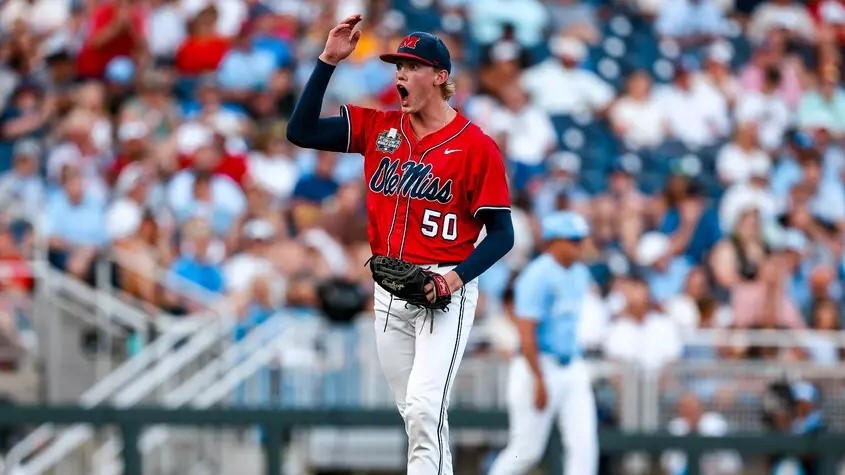
All postseason, Ole Miss has leaned on its bullpen to settle games down and finish them off.
Friday night in Omaha, that identity slipped, and North Carolina needed only a handful of free passes to turn a tight game into a 6-2 loss that pushed the Rebels into the loser’s bracket.
This wasn’t a meltdown. It wasn’t a team overwhelmed by the stage. It was something much simpler and much more frustrating.
Ole Miss walked six hitters, hit another, and watched a patient North Carolina lineup turn every extra baserunner into leverage. In a ballpark where runs are hard to come by, the Rebels gave away too many.
Taylor Rabe felt it early. He wasn’t bad. He just wasn’t as sharp as he’s been for most of the last two months. Four walks in 5.2 innings is out of character for him (he hadn’t allowed more than in one outing this season), and he said as much.
HYPE. HIM. UP. 😤
📺 ESPN#MCWS x @OleMissBSB pic.twitter.com/Vm2D1t5aRf
— NCAA Baseball (@NCAABaseball) June 13, 2026
He talked about being a little out of sync, about deep counts, about two-strike pitches that kept getting spoiled.
“I was a little out of sync with the four walks, and that’s something you can’t do against this team,” Rabe said in the post-game press conference. “They do a really good job of taking advantage of free bases.”
North Carolina didn’t chase. It didn’t expand. It made him work for everything.
When Ole Miss turned to the bullpen, the problem didn’t go away. It grew.
Hudson Calhoun walked the leadoff man in the seventh. A wild pitch moved that runner up. Another walk followed. Walker Hooks added more traffic. By the time the inning ended, the Rebels had handed North Carolina the momentum and the scoreboard.
Seven free baserunners. Six runs allowed. A 2-1 lead gone in a matter of minutes.
“I thought they weren’t an overly aggressive team. They did a good job of making me get into deep counts and elevating my pitch count early,” Rabe said. “I felt like I was getting to two strikes, and with two strikes, I was making some good pitches, but they were fouling them off. I think that’s one of their strengths as a team and part of their offensive approach. They did a really good job of that.”
This is the part that stings because Ole Miss has built its postseason confidence on the idea that if it gets the ball to the bullpen with a lead, the game is in good hands. That has been the formula. That has been the reason this team looked like it could make a real run in Omaha.
Friday night, that formula broke down.
Mike Bianco didn’t try to soften it. He pointed straight at the walks and the deep counts and the foul-ball battles that kept extending innings. He credited North Carolina for grinding out at-bats, but he also made it clear that Ole Miss didn’t do enough to finish the game the way it usually does.
“You can’t give them free baserunners,” he said. “We’ve got to attack more. But some of that was their doing, being able to foul balls off and grind out at-bats. They lengthened the at-bat until they ended up winning a final 3-2 pitch.
“Again, we have to be better than that. We’ve got to make them hit the ball somewhere. On this field, when it’s blowing in, you’ve got to make them hit the ball.”
The good news for Ole Miss is that nothing about this loss suggests the team is outmatched or out of answers. It played clean defense. It got a big hit from Judd Utermark. It held a lead into the late innings.
The structure of the game looked familiar. The execution did not.
Now the Rebels have to respond. They have to get back to the version of themselves that attacks the zone, forces contact, and makes teams earn their way on. They don’t need a new plan. They don’t need a new identity. They just need the bullpen that carried them here to look like itself again.
Bianco said the message after the game was simple. “We handle hard.”
Well, here it is. Hard. The kind of hard that defines how long a season lasts.
Ole Miss’ bullpen slipped at the worst time. Now the season depends on how quickly it steadies itself.