Before anyone gets into the weeds about tempo, matchups or how No. 9 Ole Miss wants to use its backs and tight ends, Sunday’s season opener really comes down to one thing.
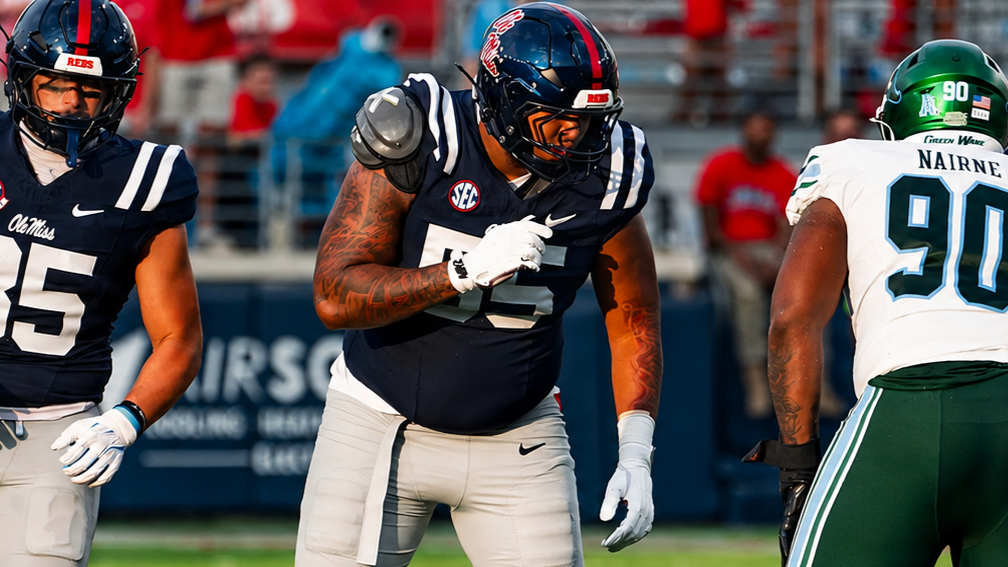
If the Rebels want to beat Louisville, their offensive line has to win the day.
Not survive it. Win it. Because the fastest way for this game to go south for the Rebels is if No. 24 Louisville’s defensive front starts touching Trinidad Chambliss.
And Louisville touches quarterbacks. A lot.
The Cardinals bring back two of the most disruptive edge rushers Ole Miss will see all season.
Clev Lubin had 8.5 sacks and 13.5 tackles for loss last year. AJ Green added six sacks and 31 tackles and looks like the kind of long, explosive edge rusher NFL scouts circle early. He’s 6-6, 250 pounds, with a first step that jumps off the screen. Put them together, and Louisville has a pair of bookends who can wreck a game plan before it ever gets comfortable.
That’s the challenge waiting for new starting tackles Terez Davis and Tommy Kinsler, or whoever ends up at right tackle when the lineup becomes official. It’s a tough assignment for a pair of first-time starters. It’s a tougher one for a line still settling into its identity.
Pete Golding didn’t hide what worries him most.
“No. 1 is the way they affect the quarterback,” he said. “They’re really athletic and long on the edges. Both of those guys coming back combined for double-digit sacks last year. They play the game really violently.”
That’s not coach‑speak. That’s a warning.
Louisville didn’t just rush the passer well last season. It led the ACC in pass defense, allowing only 188.8 yards per game. Only five teams even cracked 200 yards against them. When opponents completed fewer than 61 percent of their throws, Louisville went 8-0.
That’s what happens when your edges squeeze the pocket and your secondary gets to play aggressive, confident football behind them.
And it wasn’t just the pass defense. Louisville finished 23rd nationally in rushing defense, giving up only 114.3 yards per game and 3.48 yards per carry. This is a front that plays fast, plays physical and plays with discipline. Golding sees it clearly.
“We have to protect the football,” he said. “With their edges, both in the run game and passing game, we have to control the edges. We have to get the ball in space to our guys, but we also have to slow the game down and run the football effectively when we need to.”
That’s the blueprint. Control the edges. Limit the chaos. Keep Chambliss clean long enough for the offense to function the way it’s designed.
Ole Miss doesn’t need perfection up front, but it needs stability. It needs Davis and Kinsler to hold their ground. It needs the interior to stay firm against run pressures. It needs the tackles to avoid the one thing Louisville thrives on: free shots at the quarterback.
Because if Louisville’s front starts dictating the game, everything else becomes harder. The run game shrinks. The passing windows tighten. The offense loses rhythm. And Chambliss ends up playing from a place no quarterback wants to live.
Golding said Louisville looks like an SEC defense. He meant it. They’re long, fast, violent and experienced. They challenge you with structure and speed. They don’t give you easy answers.
So the answer for Ole Miss is simple, even if the job isn’t.
Win up front. Keep Chambliss upright. Make Louisville’s edge rushers work for everything. If the Rebels do that, they’ll have every chance to open the season with a win.
If they don’t, Louisville’s defense will put a damper on the Rebels’ preseason hype.