

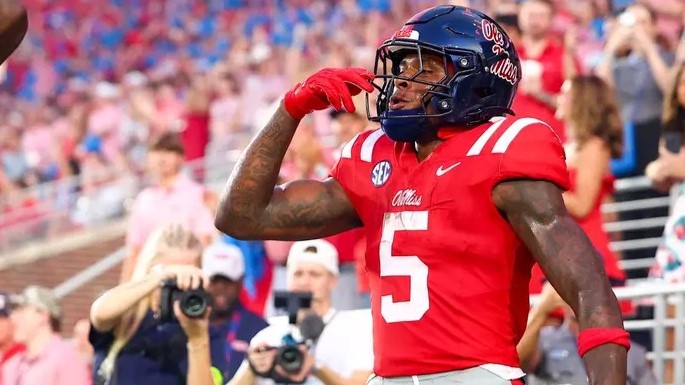
Football is full of clichés, the most common being that defense wins championships.
Another is you have to run the ball to win. On Saturday night at Vaught-Hemingway, that isn’t just a cliché. It’s a fact.
If No. 8 Ole Miss wants to win the biggest game of the season against No. 7 LSU and its former coach, the Rebels will have to run the ball well.
If they do that and avoid a lot of obvious passing situations, the Rebels can avoid LSU’s deadly pass rush that already has 12 sacks this season. But if the Rebels can’t run the ball and are forced to throw more, Terez Davis at left tackle and whoever starts at right tackle will be tested. So, will Trinidad Chambliss’ escape and scramble ability.
Ole Miss rushing through two games
Ole Miss hasn’t exactly run over its first two opponents. With 279 rushing yards on 65 attempts against then-No. 24 Louisville and Charlotte. That’s 139.5 yards per game and 4.3 yards per carry.
Not terrible numbers, but not elite.
Star running back Kewan Lacy is only averaging 4.9 yards per carry (30 runs, 148 yards) and three touchdowns. Most of that production came against Charlotte when Lacy had 187 yards and two touchdowns while averaging 5.3 yards per carry.
That’s productive. It’s not yet the type of dominant start where he’s routinely creating 10-, 15- and 20-yard runs.
Lacy isn’t the only Rebel that LSU will need to worry about running the ball. Chambliss has 62 net rushing yards and a touchdown. Most of that came against Louisville, which was a close fought game and Lacy had just two carries in the second half.
LSU run defense through two games
The stats through two games for the Tigers’ run defense looks like something out of EA College Football 27.
They’ve faced 57 run attempts and have allowed 36 rushing yards. That’s 18 per game, 0.6 yards per carry and good enough to be ranked the No. 2 rush defense in the nation.
The Tigers also have 23 tackles for a loss, which has helped keep those rushing stats very low. There’s just one caveat to all of this.
The major difference
LSU has played Clemson and Louisiana Tech. Those aren’t teams concerned as much about making the playoff as they are just having a winning season. Clemson had 145 rushing yards in its 51-10 loss and Louisiana Tech was to none in the first half of its 45-14 loss.
How the rushing defense made games harder for Clemson and Louisiana Tech was what Ole Miss wants to avoid. Neither team could gain meaningful yards on early downs and faced a lot of third-and-longs. In those two games, LSU’s defense has allowed just 4-of-27 third attempts to be converted.
But Ole Miss can do something neither Clemson or Louisiana Tech can do: present a formidable passing attack.
Chambliss is completing 71% of his passes for 561 yards and five touchdowns, while Deuce Alexander already has 235 receiving yards. That creates a much different box-count problem.
If LSU wants to play with an extra defender near the line of scrimmage to suffocate Lacy, Ole Miss has already demonstrated that Chambliss can punish single coverage outside.
And if LSU backs the safeties off because of Alexander, Horatio Fields, Caleb Cunningham and the rest of that receiving group, Lacy gets a lighter box than Clemson or Louisiana Tech may have been able to create.
That’s the most important chess match of the entire game.