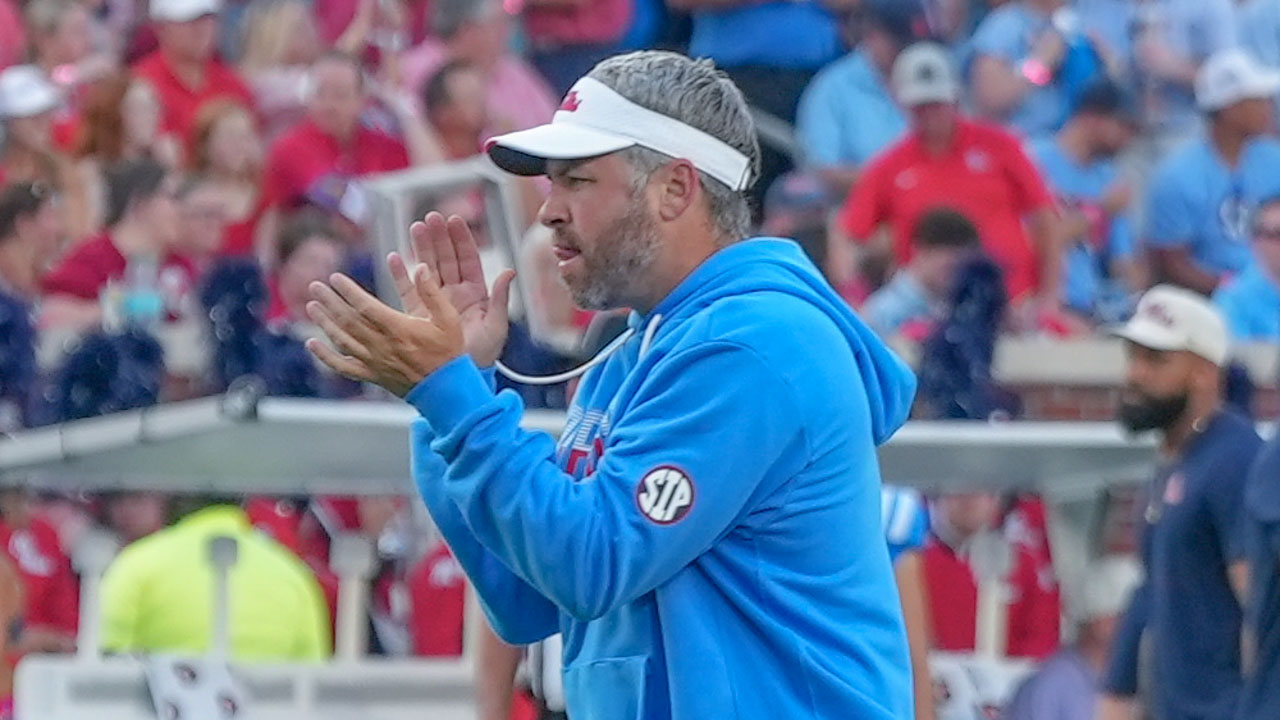
After one of the most lopsided losses of the season, Pete Golding’s Monday press conference centered on accountability and moving forward.
The Ole Miss head coach addressed injuries, personnel updates and what went wrong in the 42-7 loss to Georgia, while also looking ahead to a challenging matchup with Oklahoma.
Golding stressed the need for better execution from both players and coaches, saying the Rebels have to quickly turn the page while learning from the mistakes that led to last week’s result.
Here’s everything he said Monday.
Pete Golding, Head coach
On team’s injury status…
Golding: Not that are season-ending. Kutas got banged up pretty good, so we will not have Patrick this week. There will be some moving parts to that, looking at some guys bumping inside. We’ll be rotating some guys anyway, but he’s the only one right now that we know for sure won’t be available on Saturday.
On Trinidad Chambliss’ nine interceptions…
Golding: I think it’s a combination of everything you just said. A couple of them are end-of-game plays. Two of them are at the end of the game, one being a Hail Mary and the other being a situation where he’s giving it a chance on fourth down. A couple of them are batted balls, one being a dropped ball. So those aren’t on him. I know it goes on his stats. A couple of them are probably forcing some throws. I think some of that is from the pressure that’s been created and not setting his feet. So I think it’s a combination of several of those things.
On Oklahoma’s blitz concepts…
Golding: Well, I think the defensive concepts, with both being defensive head coaches as well, it’s like, “OK, how do I shrink the game?” Number one, when you’re playing an explosive offense, that’s by controlling the football and being able to establish the run game, which both those guys believe in. I think being defensive guys, they know what creates issues on defense. Alternative formations. You saw that with Florida last week. There were 10 snaps of unbalanced, plus-one run game. I think they’re getting the quarterback going in the run game as well to make you account for all 11. And then, from a defensive standpoint, creating negative-yardage plays. Very aggressive. Venables’ defense is very much like what you saw on Saturday. That was probably one of their higher-pressure games, Georgia, with a lot of seven-up looks and things like that. So I just think, from a philosophy standpoint, they believe in establishing the run on offense, controlling the clock and taking care of the football. I think when you look at both teams and the turnover margin, like we talked about last week going into Georgia, if you don’t win that turnover battle, it’s going to be tough. We didn’t. It was 2-0. Wasn’t close. We talked about establishing the run game. Georgia is 63-1 when they hold opponents to less than 100 yards rushing. We couldn’t get that run game going, and then on the other side, we didn’t stop it. We never kept them off balance. So I think it’s the same thing this week. If you come out on defense and don’t create negative-yardage plays early, get them behind the chains, get them in obvious passing downs and get them off rhythm, it’s going to be tough. I think that’s the one thing when you look at last Saturday. We could never get them out of rhythm. You could never get the momentum in either phase, offense or defense. Oklahoma plays good football. They beat two teams we’ve lost to. You go back and watch the tape against Florida and Texas. When they’re on, they’re hard to defend. You’ve got to account for the quarterback’s legs, and then they create a lot of problems on defense.
On Oklahoma under a new offensive play caller…
Golding: I think some of the post-snap RPO game has been eliminated a little bit, some of that decision-making process for the quarterback. They still have RPOs. I think a lot of them are pre-snap, box-generated based on numbers and free access and things like that. I think a lot of the run schemes are similar and the same. I think they’re trying to get the quarterback’s legs going a little more than before. They’ve always had some quarterback-designed runs, but it felt like that was more of an emphasis in the Florida game. Obviously, with Witten being a tight end, the tight end is going to be a piece of the package, and they’ve got some good tight ends. No. 81 is a really good player. But I think they’re taking more off the quarterback as far as progressions and reads post-snap and being a little more specific in the run game based on formation. They’re a little more alternative with shifts and motions, which has kind of been the theme against us anyway. So I think they’re simplifying it within reason and making you account for the quarterback.
On Caleb Cunningham and Deuce Alexander’s lack of production…
Golding: Starting with Deuce first, if you rewatch the first offensive play, it’s a pull throw. It’s a bust in coverage. We’ve got him on the RPO, and there’s indecision with the back, and he clamps. So I don’t think we got him going early. There were some opportunities there that we really missed that I think could’ve made things look different. And then he got banged up as well in the game. He was really kind of unable to come back and finish. He should be fine for this week. We’ll manage him this week, but he did get banged up late. Some missed opportunities early, to be honest with you, I think really impacted what the rest of the game looked like. As far as Caleb, I base receivers on how many targets they get. And I think sometimes what they’re doing defensively takes certain things away. He’s not part of the progression, and the ball is going other places. So we’ve got to find more ways to get him involved, for sure.
On Kewan Lacy’s availability this week…
Golding: No, he will not be playing this week.
On team’s attitude and response to Georgia loss…
Golding: Obviously, there’s a feeling of disappointment, regardless of how many losses it is. They put a lot into this, and they want to put their focus on their preparation and playing really well. And we didn’t play well. We didn’t coach well. We didn’t play well, and that’s the outcome you’re going to get when you do that. But I think they did a really good job last night of focusing on the why, both from a coaching standpoint and a playing standpoint. We’ve just got to focus on what we can control. And the bottom line is we’re not executing the way we need to. There are times, from a calling standpoint, that we need to put them in better positions. There are times that we need to have better answers as well. But I felt like there was ownership last night. It was about, “All right, let’s fix the issues and the mistakes.” And then today, let’s move forward to Oklahoma. I think there’s a fine line. You don’t want to move beyond it too quickly, and that’s why you have Sundays, because those issues could come back up. There’s got to be an understanding of why. Why did it look that way, and what do we need to do to fix it? And then today, you’ve got to be able to turn that page. You can’t have that guilt from the past clutter your mind when you need to focus on a really good Oklahoma team. If our attention is not on Oklahoma and preparing really well and practicing really well, then you’re going to get the same results. So I thought they were all in last night as far as focusing on what they could do better. And I thought, as a staff, we focused on what we could do better. We own that one. You don’t get beat 42-7 and it’s one side of the ball, or it’s just players, or it’s just coaches. That’s a collective effort to get your ass whooped like that. So we’ve all got to own that. We’ve all got to do a better job.
On differences in run defense performances in games…
Golding: I think it’s a combination, too. But go back and watch the first play on both sides of the ball and the lack of execution on the very first play of the game. It’s a zone cut, just an easy concept we worked on all week, and it’s a misfit. We don’t execute. Then we have a missed tackle at the second level. So going into that, we talked about how you’ve got to limit the explosive plays versus Georgia’s offense. You have to make them drive the field. We didn’t do that. They had 11 explosive plays for 299 yards. Some of them are balls up, and we mistime a pick. Now it goes from a pick to a touchdown. You’re going to have some of those. But the layups, where we had a lack of execution versus a really, really good football team that’s the No. 2 team in the country, but probably No. 1 this week, you can’t do that. And so that was kind of the focus last night. They owned it. There are several things as a staff, like I said, that we owned. We’ve got to have better plans, put them in better positions and make sure we’re using all the pieces that we have effectively. But there were just too many times that we weren’t focused on doing our job. That’s why I said I was a little surprised Saturday after the game, because I thought there was a focus last week in our preparation and practice on the attention to detail, making sure we’re doing things right. Really good football teams are going to take advantage when you don’t do things right. It was just a combination, on both sides of the ball, where there was a lack of focus when they needed to be focused and locked in on doing their job. Because they’re going to make enough plays. They’ve got good players, to your point. You can’t help them out. And we just did, both as players and coaches.
On CFP expanding to 24 teams…
Golding: I know we’ve talked about it before. I was a D-II, I-AA boy, like we talked about before, so I was used to that system. But I also had the opportunity to go play in that SEC Championship Game three times, go win that, and knew the experience of what that was, how that felt, how exciting that game was and what it had done for this conference for so long. But then having a home playoff game last year and seeing what that could do for the community, our team, our fans, our students and everything else like that, I think by expanding it, you’re going to get that opportunity as well. So you’re taking away that one piece of Atlanta that’s been a big piece of our conference and was awesome for me and my family and all those types of things. But what it does, being able to have some more home games in that playoff system, I think is valuable as well. So we go by the rules in place, and we’re excited to obviously expand. You’ve got more guys who have the ability to compete for a championship.
On difficulty is keeping players focused…
Golding: I think it’s not, because I think it’s all about what you emphasize from the very beginning. We don’t control who the playoff committee selects, just like we didn’t control that last year. And if our focus starts getting into the future, that’s where the fear component comes from. To me, that’s happening some in games. We’re worried about what the outcome is. That’s the future. You don’t have control over that. You’ve got control over your focus and your mindset on doing your job. The only thing that we can control right now is coming in and preparing for a really good Oklahoma team. And I can assure you, if you go get your ass beat again, there damn sure ain’t no shot. So I think that’s the big piece, but that’s been all year. That’s nothing new. I think it’s very important from a leadership standpoint. How do you start? It’s our responsibility to recruit really good players, get them to play to their potential and hold them accountable. Whatever that looks like, there are going to be some seasons where you’ve got some injuries. Sometimes the ball doesn’t bounce your way. You’re not really in control of the outcome of things, and that’s when that fear piece starts setting in your mind. You’re worried about the wrong things, and you’re not focused on the attention to detail and doing your job. So that whole 1-0 that you’ve always heard at a lot of different places, that’s a mindset. It really isn’t about what the score is at the end. It’s about how you prepare and how you play. Do you have attention to detail and focus on doing your job? There’s a lot of value that this team can create, not only for themselves but for us as a team. I’ve said this multiple weeks ago to our team. I don’t care if you’re a freshman or a senior, if you’re trying to improve your draft status to be a first-round draft pick or a third-round draft pick, or if you’re trying to be retained here or you’re trying to transfer somewhere else. Everybody benefits by you going and putting a really good product on tape and playing really well. You’re either going to come back, and now you’re going to be negotiating more money when you’re coming back, or you’re going to play really well and everybody’s going to want you. It’s going to drive the market up. Or you’re going to put a really good product on tape, and you’re going to go from the third round to the second round. Everybody benefits from working extremely hard and playing really well. Everybody does. So I don’t understand, as a competitor, regardless of your record, how you can come into a game and not want to prepare really well and go play really well, because you’re going to benefit from it.