

Sometimes, the difference between pulling off an upset and coming painfully close comes down to a few fortunate breaks.
Auburn certainly got a few of those against Georgia.
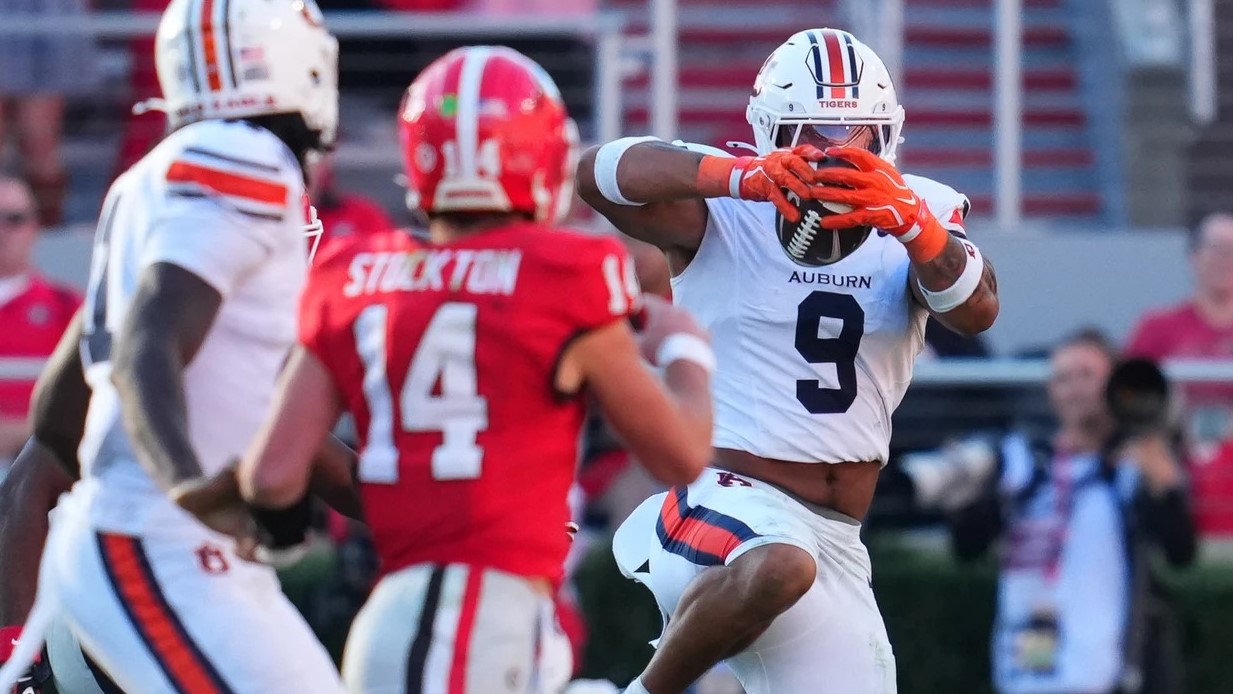
Two weeks ago, the Tigers walked into Athens and handed the nation’s No. 1 team its first loss, winning 27-24 on a field goal as time expired.

It was easily the biggest victory of first-year coach Alex Golesh’s young Auburn tenure. And with the Tigers visiting Ole Miss on Saturday, it’s a reminder of what they’re capable of accomplishing.
But exactly how impressive was that victory?
Let’s start with the statistics.
Georgia outgained Auburn 440-366 in total yards, averaged 6.8 yards per play compared to Auburn’s 4.9 and threw for 327 yards.
Those numbers suggest Georgia was the more productive offensive team.
But another statistical category helps explain why the Bulldogs lost: turnovers.
Georgia committed three. Auburn didn’t commit any.
While turnovers aren’t necessarily a matter of luck, their timing certainly worked in Auburn’s favor.
The most consequential came with less than a minute remaining.
After rallying from a 24-14 fourth-quarter deficit, Georgia had tied the game and was driving for a potential winning score when quarterback Gunner Stockton fumbled near midfield.
Auburn’s Cody Sigler forced the fumble, and Sylvester Smith-Reed recovered it with 58 seconds remaining.
Suddenly, Auburn had an opportunity to win a game that Georgia appeared positioned to win itself.
And the Bulldogs weren’t finished helping.
After Byrum Brown moved Auburn into long field-goal range, a roughing-the-passer penalty gave the Tigers another 15 yards, helping set up Alex McPherson’s game-winning 34-yard field goal.
Earlier, two Georgia penalties totaling 30 yards helped Auburn score a third-quarter touchdown.
That’s 45 yards of Georgia penalties on two possessions that produced 10 points in a three-point game.
But here’s where the distinction between luck and execution becomes important.
Auburn didn’t simply wait for Georgia to hand it the game.
The Tigers trailed 14-0 before scoring 24 consecutive points. Brown rushed for 115 yards and a touchdown, helping Auburn outrush Georgia 192-113.
The defense forced three turnovers, blocked a field goal and held Georgia scoreless in the second and third quarters.
Those were legitimate accomplishments against an excellent team.
Still, the difference between winning and losing was incredibly small, and several important moments broke Auburn’s way.
The following week provided another reason to question whether the upset represented the Tigers’ true level of play.
Auburn returned home and lost 38-17 to LSU, surrendering 552 yards while managing just 67 rushing yards. Brown, so effective against Georgia, finished with 21 net rushing yards.
That brings us to Saturday’s matchup with Ole Miss.
Should the Rebels be concerned about playing a team that beat Georgia? Absolutely.
But they shouldn’t confuse Auburn’s best performance with its typical performance.
The Georgia game demonstrated Auburn can beat an elite opponent when Brown gets going, its defense creates turnovers and the Tigers capitalize on opportunities.
It also demonstrated how much has to go right for that to happen.
Auburn earned its victory. But there’s a difference between being good enough to beat Georgia once and playing that well every Saturday.
Now Ole Miss gets to find out which version shows up in Oxford.