By Jake Camp and Bailey Baudier
UM Honors College Students
*Editor’s Note: These features were produced as a “Profiles in Courage” series by Mark K. Dolan’s freshmen seminar class in the honors college at the University of Mississippi. They were originally published in Circle and Square magazine, produced by Samir “Mr. Magazine™” Husni’s Magazine Innovation Center students.
Around every corner comes change, every vine-choked tree and sunken concrete bunker an enemy crouching. That’s the mantra 18-year-old Tommy Huckabee repeated from the moment he set foot in Vietnam. He could only plot his future a few yards ahead, looking back and forth, over his shoulders.
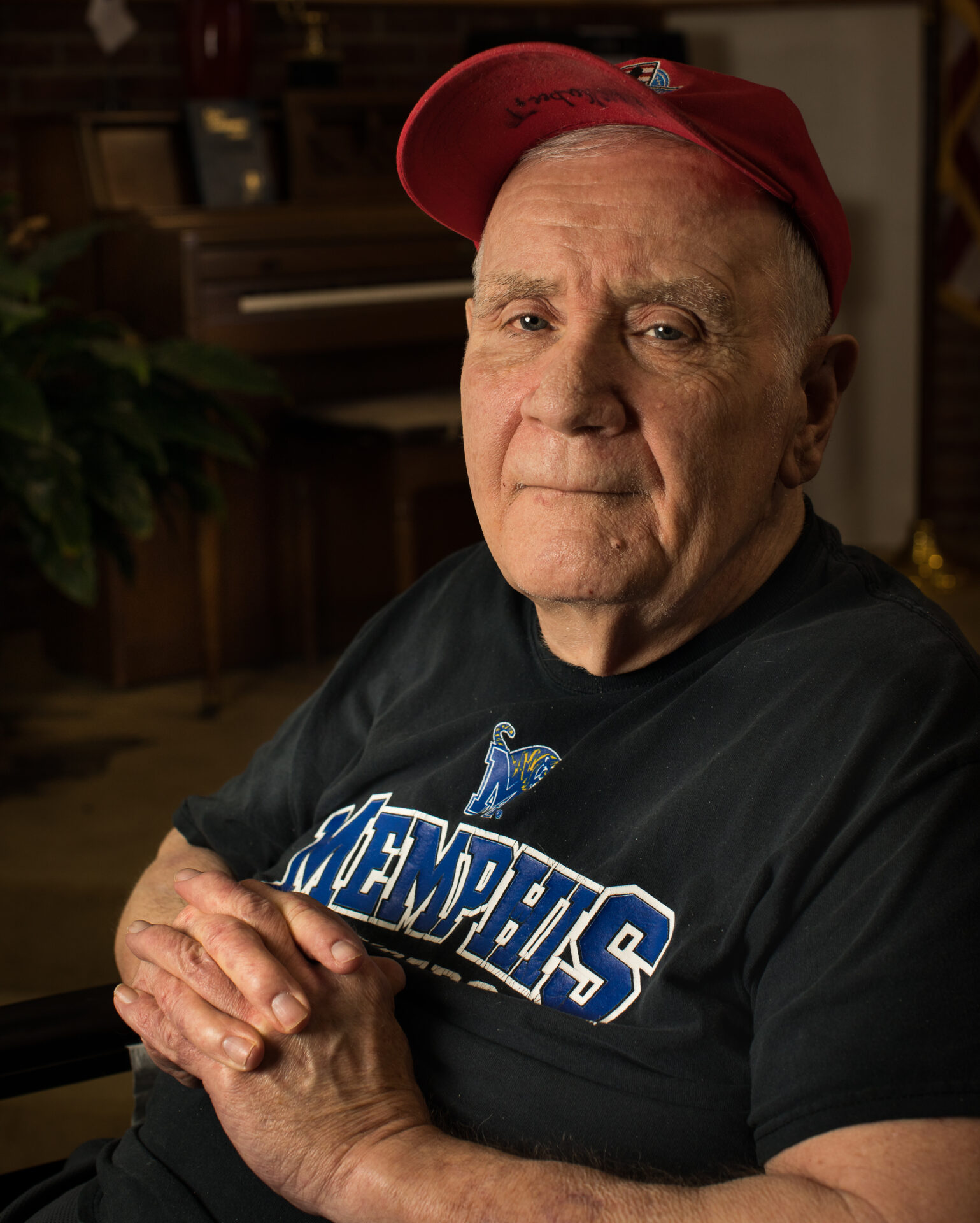
Huckabee grew up in a military family, on bases in Germany and Japan, attending 13 different schools in 12 years. He was a proud military son. His father, a WWII veteran and POW, teased his son about serving in ROTC while in school. “I told him where he can shove his Army ROTC. He got the last laugh though.”
The reasons for the United States involvement in Vietnam felt a little less clear, and like many young men during the 1960s, Huckabee left his family longing for him to return as soon as conditions allowed. He lost his father around his time of first deployment. “I think he would have been proud of me,” he says.
Sitting in a recreation lounge at the veterans home, surrounded by board games and shelves of DVD movies, some on VHS, a television drones on.
“Well, I cried,” he recalls of the night before he was to leave. “The night before I shipped over there, I cried like a baby.” He wears a favorite red baseball cap, with his name written under the brim so nobody else will wear it by mistake.
“Why me,” he asked himself, staring at the impersonal draft notice countless men received in the mail, news which had suddenly gotten ominously personal. Huckabee, “Huck,” as he’s called, left behind a wife and unborn daughter.
Huck was the oldest soldier in his outfit when he turned 19, a natural leader who wasn’t afraid. “We sucked it up,” he says of the fear. He spent 18 months in Vietnam, battling that fear, as his outfit fought an enemy, often in jungle combat.
A close encounter with two enemy soldiers who crawled into his bunker left him lucky to be alive. “I could feel the presence of another person in the bunker with me,” he explains of the men who carried explosives in their satchels. Tommy Huckabee was the only survivor. “I was the only one that came out of that bunker alive that night,” he recalls of killing the men.
“It was hot, then it was cold. I once saw it snow in Vietnam,” he recalls, of the weather nearer to North Vietnam, where his outfit would be fighting. “When I got off the airplane in Cam Ranh Bay, they said get back on the airplane you’re going north. What do you mean I’m going north, I said, there’s nothing up there but North Vietnamese.”
Surviving meant adapting, and adapting was necessary. Nature was as potentially lethal as any attack form the North. He saw typhoons, soldiers pelted with stones by rock apes, the mysterious and some say mythical jungle creatures reportedly seen by soldiers in the Vietnam, even a tiger dragging a young soldier out of his foxhole.
Huck described a cold night in the compound when he suddenly heard screaming. He rose up to see an 18-year-old solider being clawed by a tiger. Huck yelled for him to grab his M16, but the soldier couldn’t reach it. “All I have are my grenades in my jacket,” the soldier desperately shouted. “Just hit him in the head with it,” Huck bellowed back. So the soldier did and managed to save himself before more help arrived.
Whether from nature or the North Vietnamese, the dangers of the war crept in the shadows, only at times showing their faces. The jungle itself was an enemy. He rose in rank from private E-1, the lowest private, to captain 0-3, similar to a lieutenant in the Navy.
Uncertainty was the only certainty. Back home, reunited with his wife and family who were living in Tennessee then, Huck finally held his daughter, who he had only known in photographs.
Huck continued to serve his country for years to come, as a member of Psychological Operations, where he traveled East Asia and the Pacific spreading messages of hope to those under dictatorial regimes. “Every time I hear the National Anthem play, I am so proud to be an American,” says Huck, eyes twinkling.