There’s an old rule in the SEC that if you’re not being talked about, you’re probably not winning enough.
By that measure, Ole Miss must be doing something right because Clemson coach Dabo Swinney can’t seem to stop talking about the Rebels.
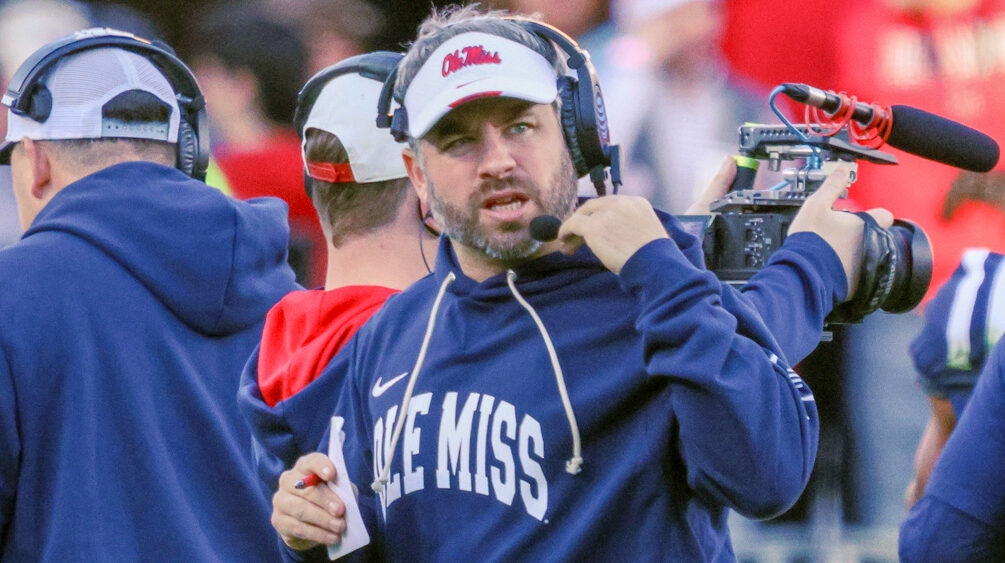
The latest round came when Swinney was asked whether he’d heard from Rebels coach Pete Golding since publicly accusing Ole Miss of tampering with linebacker Luke Ferrelli.
His answer didn’t take long.
“No, I don’t know him,” Swinney said.
That’s about as neighborly as this storyline has gotten.
For the Rebs, this offseason conversation wasn’t exactly on the spring practice wish list. Instead of breaking down defensive schemes or talking roster depth, Ole Miss has been mentioned in connection with Swinney’s very public frustration over the transfer portal.
The issue centers on Ferrelli, who transferred from Cal to Clemson, enrolled in classes and began working out with the Tigers. Then he re-entered the NCAA transfer portal and ultimately landed in Oxford.
That’s when Swinney went from mildly irritated to fully ticked-off.
“There’s tampering, and then there’s blatant tampering,” Swinney said, laying out what sounded more like a syllabus than a soundbite. He described what he called “Tampering 101,” “Tampering 201,” and “Tampering 301,” suggesting the highest level involves contact with a player already enrolled at another school.
According to Swinney, the Rebels sent Ferrelli an image of a one-year, $1 million contract offer. He said that later turned into a proposed two-year deal worth $2 million. In Swinney’s telling, that crossed from casual recruiting chatter into something far more direct.
“I am not going to let someone flat out tamper with my program,” Swinney said. “If you tamper with my players, I’m going to turn you in. There’s a lot more I can say, but I’m going to let the NCAA do its job.”
For Ole Miss, that quote echoed across the college football landscape like a starter pistol.
Rebels Stay Quiet While NCAA Watches
Here’s what’s notable from the Ole Miss side: there hasn’t been much public noise. That probably shouldn’t be surprising in this day and age because rules are mostly suggestions.
Golding hasn’t traded words through microphones. The Rebels haven’t issued lengthy rebuttals. Instead, there’s been something close to radio silence.
Sometimes silence speaks louder than a podium speech.
The NCAA has acknowledged it plans to take tampering allegations more seriously in this new era of player movement and NIL contracts. Jonathan Duncan, the NCAA’s vice president of enforcement, has outlined efforts to speed up the infractions process and address what many coaches say is a gray area in the rules.
But as of now, there’s been no public ruling tied specifically to this situation.
That leaves Ole Miss in a familiar spot for modern college football programs: mentioned often, charged publicly, but waiting on official word.
From the Rebels’ perspective, the transfer portal has become as routine as spring drills. Players move. Rosters shift.
NIL numbers get tossed around in conversations and screenshots. The difference here is that one coach decided to narrate the experience in real time.
Swinney has said he hasn’t heard from Golding. That detail may matter to Clemson fans. In Oxford, it likely matters less than whether the defense is ready for September.
Still, perception has a way of hanging around.
The Rebs have built their recent identity on aggressive roster construction and savvy use of the portal. That’s not a secret. It’s a strategy. But when a high-profile coach like Swinney frames a transfer as “blatant tampering,” the narrative shifts from competitive to controversial.
And that’s not always fair — but it’s always loud.
Portal Era Reality Check
For Ole Miss, this episode underscores how thin the line has become between recruiting and tampering in the portal era. If a player enters the system, interest follows. When money is discussed, eyebrows rise. And if a coach goes public, headlines multiply.
What hasn’t happened — at least publicly — is a direct response from Golding. No counter-lecture. No breakdown of “Tampering 102.”
Just business as usual. That’s the way it should be handled.
That doesn’t mean the situation lacks weight. If the NCAA eventually determines rules were broken, consequences would follow. But until then, the Rebels exist in the space between accusation and adjudication.
That’s an awkward space.
Swinney said he’ll “let the NCAA do its job.” For Ole Miss, that’s probably the preferred path as well. Let the process unfold. Let the facts settle. Keep preparing.
Because in today’s college football landscape, attention is a constant. One week it’s about recruiting rankings. The next, it’s about contracts. The week after that, it might be about something entirely different.
Right now, the spotlight happens to be fixed on Oxford.
Whether Golding is living rent-free in Clemson’s thoughts — or simply serving as a convenient example in a broader portal debate — depends on perspective.
What’s clear is that Ole Miss didn’t start this public exchange. But it’s undeniably part of it now.
And until the NCAA says otherwise, the Rebels will keep lining up for practice, building their roster, and letting the chatter swirl around them like late-summer humidity.