

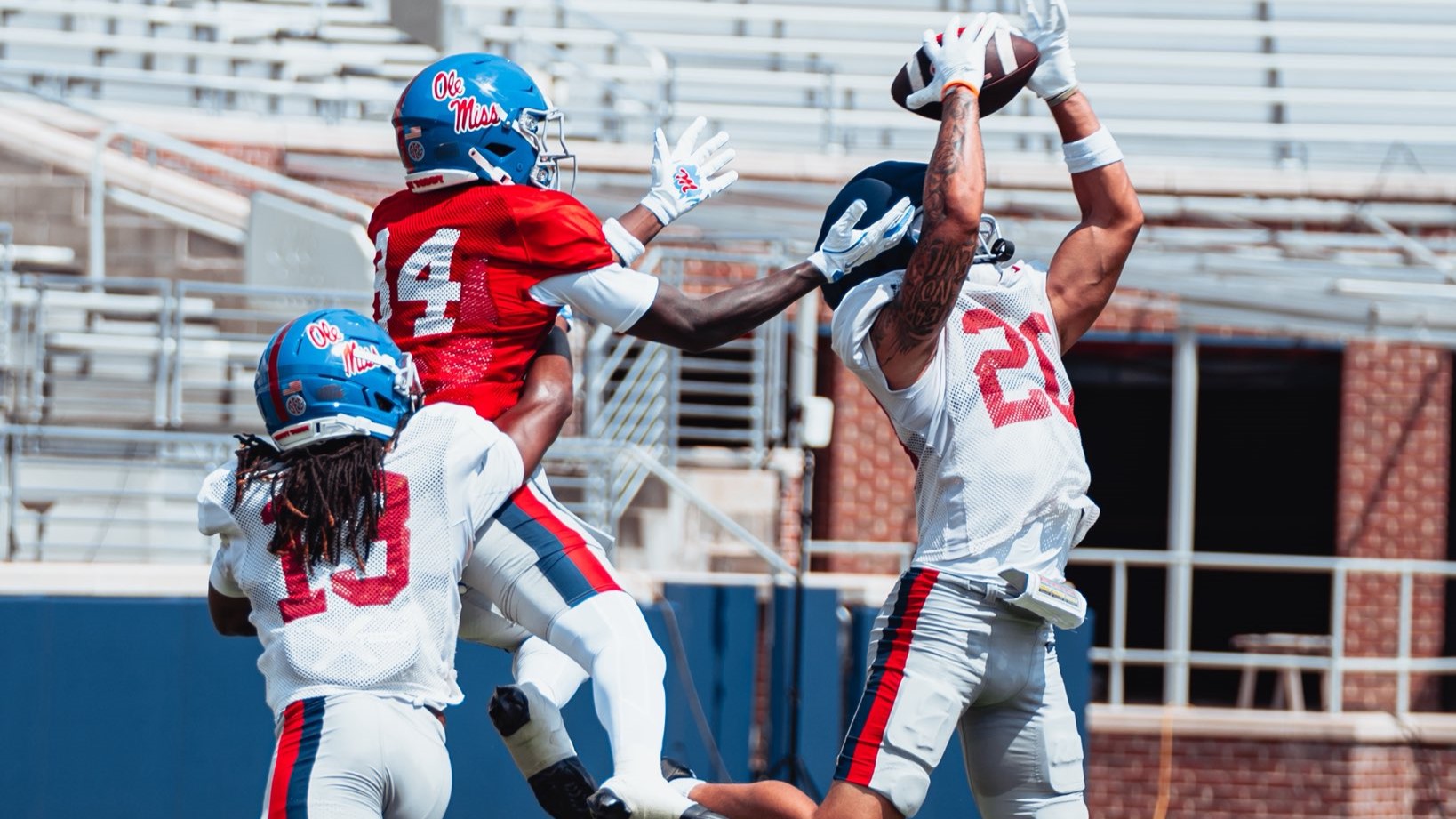
If you spent last season watching Ole Miss football, you know the defense had two very different problems.
The run game was the bigger issue, but the pass defense wasn’t exactly airtight either. It wasn’t disastrous, but it wasn’t where Pete Golding wanted it. Too many busts. Too many moments where communication broke down. Too many snaps where the secondary looked like four or five players seeing the game in four or five different ways.
This offseason has been about fixing that. Not just with new bodies, but with new flexibility.
Golding has talked for weeks about how much positional versatility matters in his scheme. The way he sees it, the more spots a defensive back can play, the better he understands the entire picture. And the better he understands the picture, the better he communicates.
That’s the part Ole Miss is betting on.
Learning the whole defense, not just a position
Golding didn’t mince words when he explained why he’s been shuffling players all over the secondary.
“Versatility is huge, but understanding things conceptually is even more important,” he said. “Guys normally don’t communicate when they don’t know what to do.”
So he’s forcing them to learn it all. Lion, Free, Ram — interchangeable. If you’re in the safety room, you’re learning every spot. And if you’re Edwin Joseph, you’re learning even more.
“With the lack of corner depth lately, I’ve bumped him outside to make sure he understands what to do at corner on top of the safety position,” Golding said. “He has been really, really impressive.”
Joseph has embraced it.
“They’ve definitely been moving us around,” he said. “I enjoy learning all parts of the defense. I think it adds more value and makes it easier for me to learn the defense, get it down and know it to a T.”
That’s the kind of mindset Golding wants. Curiosity. Communication. No complacency.
“When you start moving them around and making them play other spots, they start understanding how everything works together,” Golding said. “It makes them communicate, keeps them from becoming complacent and keeps them curious.”
That’s how you build a secondary that can adapt to anything.
A deeper, more connected group
Joseph didn’t hesitate when asked about the potential of the safety room.
“I think this is probably the best group I’ve been a part of since high school,” he said. “I know I have a lot of people I can depend on.”
That’s a big shift from last season, when injuries and inconsistency forced Ole Miss to patch together lineups week to week. This year’s group is deeper, healthier and more experienced. And even with a few players dinged up in camp, defensive coordinator Bryan Brown sees progress.
“I think we’re meshing a little bit better than we were in the spring,” Brown said. “We’re throwing a lot at them right now, so we just need to see more consistency.”
The injuries have actually helped the evaluation process.
“It gives other guys opportunities,” Brown said. “We’ve been able to see some of those guys who could potentially end up being backups because they’ve gotten a lot of reps.”
Tah’j Butler sees the same thing.
“The secondary is getting there,” he said. “If they keep taking it one step at a time, they’re going to get there for sure.”
Ole Miss didn’t get torched through the air last season, but it wasn’t good enough either. Too many explosive plays. Too many moments where the coverage didn’t match the call. Too many times where one mistake turned into a touchdown.
This year’s group is built to fix that. If it is fixed, those comparisons to the 2024 defense could be valid.