

A college football coach’s job security tied solely to how many games they win, which is why we’ve seen coaches look for an advantage in every nook and cranny they can find.
Everything is on the table, including the Student-Athlete Availability Report the SEC requires teams to publish the week of a conference game.
This is the third season with availability reports and the SEC, so far, has avoided any major drama around them. Which is a good thing. Sports gambling is practically shoved in our faces every weekend and a being open and transparent is key to that continuing.
If teams are hiding injuries from opponents, they’re also hiding them sports bettors and that opens a can worms about insider information that’ll get Congress’s attention. And unlike the Protect College Sports Act, when money is the crux of the matter, it usually acts.
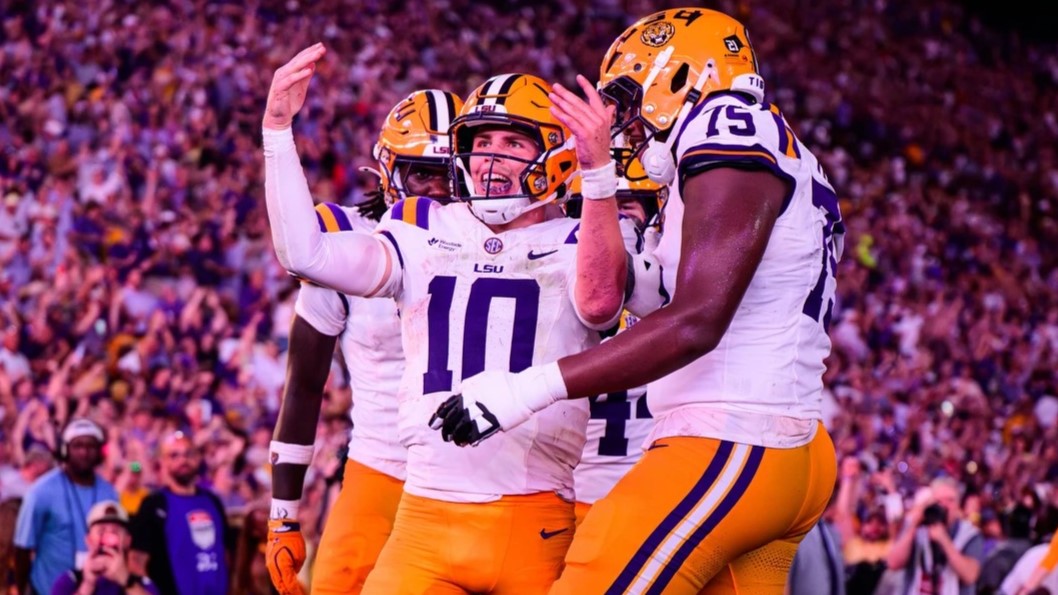
So, it’s vital the SEC’s policy for its availability reporting is followed. That brings us to Wednesday night’s news that LSU quarterback Sam Leavitt is doubtful to play in Saturday’s much-anticipated game against No. 8 Ole Miss.
Without any insider knowledge beyond what anyone can read on the internet, this writer finds it hard to believe Leavitt won’t play. However, I’ve already covered that and the theories about why Leavitt landed on the report.
Now, let’s talk about what every Ole Miss fan wants to see happen to LSU: punishments.
If Leavitt does play after being listed as doubtful (or even if he’s upgrade one level with each report and is a gametime decision Saturday), there will be real questions about why he was listed on the report to begin with.
To start, let’s identify the specific rules LSU could possibly be violating.
First, Leavitt is listed as doubtful and not out. That eliminates the SEC’s automatic violation possibility. According to Section 4.C, “It would constitute an automatic violation of this policy if a student-athlete participates in a game after being listed as Out on the Game Day Update.”
It’s important to note that no automatic violations would be found. But there are other possible rules in violation. Section 5, Duty to Act in Good Faith, of the reports stands to be the most obvious.
“Institutional personnel have a duty to act in good faith to comply with this policy. Acts of gamesmanship intended to hide a student-athlete’s true participation status for competitive or strategic reasons are prohibited. Any other conduct that reasonably could be construed as misleading or creating unnecessary confusion regarding a student-athlete’s participation status is likewise prohibited. An institution must take extra precautions to act in good faith to accurately disclose the status of a high-profile student-athlete,” the policy reads.
The policy goes on to list three examples of cases where a school could be found to not be acting in good faith. One of them fits the current situation exactly.
“An institution listed a high-profile student-athlete as Doubtful on the Initial Report (and, in football, listed list him as Doubtful on the Thursday Update and Friday Update and as a Game Time Decision on the Game Day Update) leading up to several consecutive games notwithstanding that the student-athlete continued to play his/her normal role in each game and there was no credible explanation for why the student-athlete was repeatedly listed as Doubtful and a Game Time Decision.”
The current reporting from Baton Rouge, courtesy of On3’s Pete Nakos, is that Leavitt did not throw in Wednesday’s practice because of a sore shoulder. This might not pass the smell test for Ole Miss fans, but it would likely cover the “credible explanation” requirement mentioned above.
What’ll be more telling is the updated reports. Don’t be surprised to see Leavitt be upgraded to questionable and probable before being listed as a game-time decision. That’s this writer’s prediction.
If that’s the case and the reporting is consistent about a sore shoulder, LSU likely won’t face any punishment. Even if Leavitt is completely healthy, fine and fully plans on playing Saturday. It’ll be hard to prove otherwise.
So, yes, Ole Miss fans will call out Leavitt’s status as baloney and they may be right. But it’ll be hard to find supporting evidence. Even then, the first fine for a violation is only $25,000.
Considering LSU reportedly spent about $50 million to build its current roster, a fine of .05% isn’t much of a punishment.