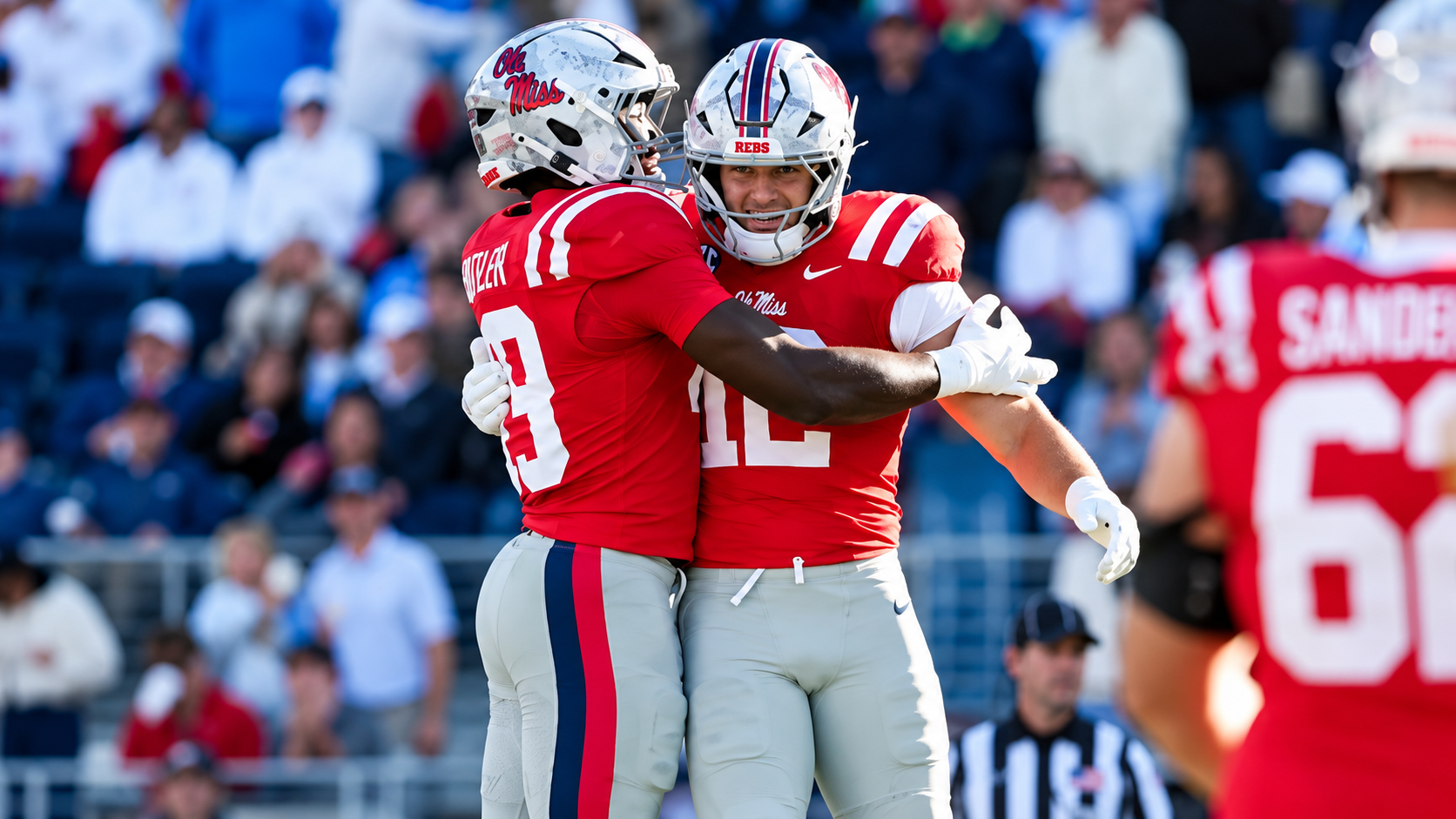
First impressions are hard to change but Ole Miss may be well on its way to completely changing those impressions.
For much of this season, Ole Miss has fielded the worst rushing defense in the SEC and one of the worst in the nation.
There was plenty of evidence supporting that reputation, particularly after Florida gashed the Rebels for more than 300 rushing yards before their bye week.
But after what happened Saturday afternoon at Vaught-Hemingway Stadium, it might be time to start looking at this defense differently.
Ole Miss held Missouri to just 39 rushing yards on 26 carries in a 31-3 victory, delivering its second consecutive dominant performance against an SEC rushing attack.
And this wasn’t against some struggling offense that couldn’t run the football.
Land𝘀𝗵𝗮𝗿𝗸 attack 🦈@LukeFerrelli x #HottyToddy pic.twitter.com/K6axOo2AiL
— Ole Miss Football (@OleMissFB) October 17, 2026
Missouri entered Saturday with one of the hottest running backs in the country. Jamal Roberts had rushed for more than 200 yards in each of his previous two games and appeared poised to have another big afternoon against a defense allowing an SEC-worst 176.4 rushing yards per game.
Instead, Roberts finished with just 39 yards on 20 carries, averaging a paltry 2.0 yards per attempt.
His longest run of the afternoon went for only six yards.
That last number might be the most impressive of them all.
Ole Miss didn’t simply limit Roberts’ production by occasionally making a big play in the backfield. The Rebels consistently prevented him from generating meaningful yardage.
Of Roberts’ 20 rushing attempts, 15 gained three yards or fewer. Six went for no gain or negative yardage.
And the Rebels only got better as the afternoon progressed.
Roberts gained 24 yards on eight carries in the first half. His 12 second-half attempts produced just 15 yards.
Missouri’s other running backs didn’t fare much better. Xai’Shaun Edwards managed eight yards on three attempts, leaving the Tigers’ running backs with a combined 47 yards on 23 carries.
BP said NOT TODAY ❌@BlakePurchase x #HottyToddy pic.twitter.com/lQf2lxvl2b
— Ole Miss Football (@OleMissFB) October 17, 2026
Perhaps the best example of Ole Miss’ defensive improvement came during the second quarter.
Trailing 14-3, Missouri reached first-and-goal at the Ole Miss 3-yard line after Edwards broke a 10-yard run.
On the next play, Jalyn Crawford and Suntarine Perkins stopped Edwards for a one-yard loss 9with some help from a bobbled snap). Luke Ferrelli and Tah’j Butler followed with another tackle for loss on second down.
An incomplete pass caused by Will Echoles and a missed field goal later, Missouri had nothing to show for reaching the 3-yard line.
It was the kind of physical defensive stand that seemed almost unimaginable when Florida was running through the Rebels three weeks earlier.
And that’s where Saturday’s performance becomes particularly interesting.
Against Florida, Ole Miss surrendered 302 rushing yards. Against Vanderbilt last weekend, the Rebels allowed just 103 yards on 37 attempts.
Now they’ve held Missouri to 39.
That’s 142 rushing yards allowed across two SEC games, fewer than half of what Florida managed by itself.
And it’s not as though Vanderbilt and Missouri abandoned their rushing attacks entirely. The two teams combined for 63 attempts, averaging just 2.3 yards per carry.
There’s no denying the circumstances surrounding Saturday’s game helped Ole Miss. Missouri fell behind 21-3 by halftime and increasingly relied on Austin Simmons to move the football through the air.
But the Tigers weren’t running effectively before the score got out of hand, either. Missouri managed just 29 rushing yards on 13 attempts in the first half.
Nor should two performances completely erase the defensive problems Ole Miss experienced earlier this season.
There’s still plenty to prove.
Will Echoles 𝘿𝙄𝙎𝙍𝙐𝙋𝙏𝙄𝙉𝙂 your feed 🫨@echoles_william x #HottyToddy pic.twitter.com/HSyN3c1Pld
— Ole Miss Football (@OleMissFB) October 17, 2026
But Pete Golding emphasized physicality during the bye week, putting his team through live work in pads to address the problems that surfaced against Florida.
The results since then suggest that work accomplished something significant.
Ole Miss entered Saturday allowing 176.4 rushing yards per game. After holding Missouri to 39, that average has dropped to approximately 153.5 yards through six games.
More importantly, the Rebels have allowed just 71 rushing yards per game since the bye.
The season-long statistics still reflect the defense that struggled earlier this season. But the last two games offer compelling evidence that it is no longer the same unit.
Before the bye week, Ole Miss needed to prove it could stop someone from running the football. Vanderbilt provided the first indication that things were changing.
Missouri offered something considerably more convincing.
It doesn’t mean Ole Miss has suddenly become an elite rushing defense. But it does mean opponents might have to reconsider the assumption that running against the Rebels is an easy way to move the football.
Because for two consecutive weeks, that assumption has been proven spectacularly wrong.
And perhaps it’s time to start judging the Ole Miss defense by what it’s becoming rather than what it used to be.