

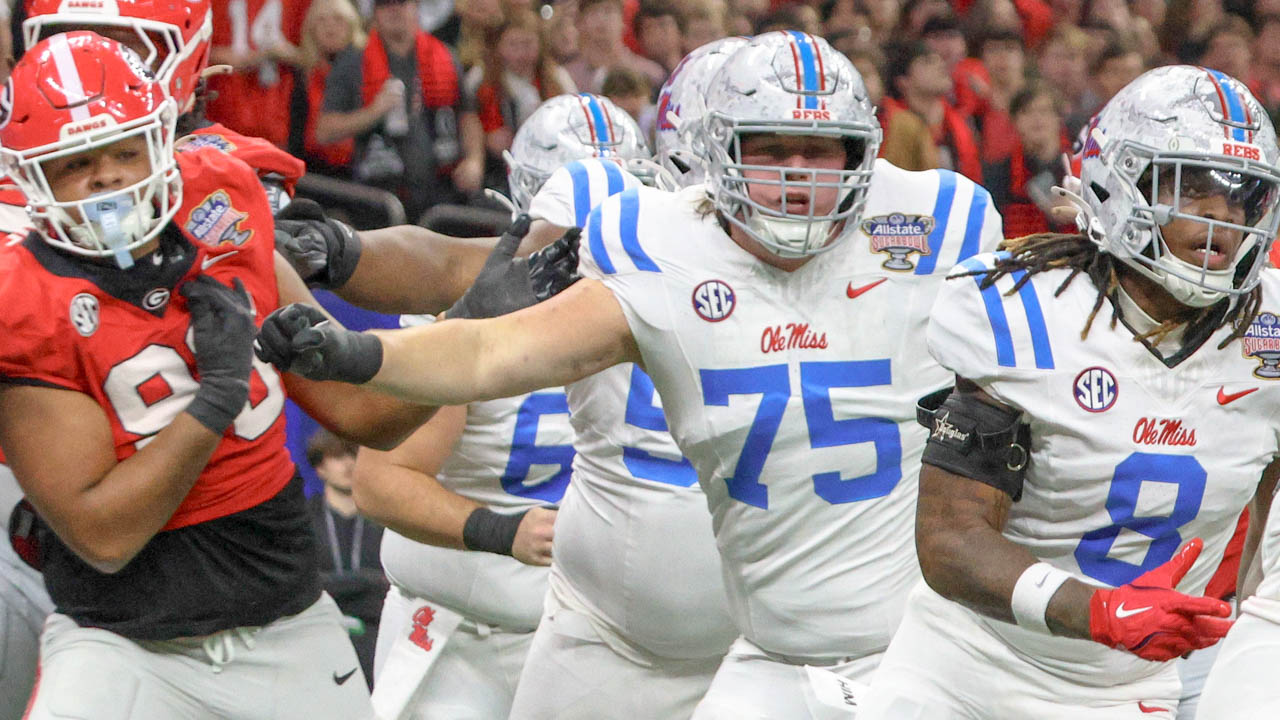
If you want to understand what Ole Miss is trying to become under new head coach Pete Golding, start with the simplest line he delivered in a recent interview.
“Big men run this league.”
In the SEC, he who wins at the line of scrimmage, wins on the scoreboard. Or something like that. Point is the best teams in the SEC are the ones with the best offensive and defensive lines. What Golding said was coach speak, but sometimes coach speak is 100% accurate.
It also explains why 14 of Ole Miss’ 21 high school commitments in its 2027 signing class are offensive or defensive linemen. Golding isn’t just building depth. He’s building identity.
The approach didn’t come out of nowhere. Winning in the trenches isn’t a state secret. But the point got made anyways for Golding and the Rebels in the College Football Playoff semifinal loss to Miami.
Golding didn’t sugarcoat it. He pointed straight at the trenches and said the quiet part out loud.
“I really felt like we lost that game in the trenches at the end of the game on the defensive side of the ball because of a lack of rotation and not having enough guys who could play winning football at that time,” he said in an appearance on the Talk of Champions podcast.
That’s as honest as it gets. And it’s the kind of honesty that usually leads to a shift in how a program recruits.
Ole Miss learned from it CFP loss. Golding walked away convinced that the Rebels needed more bodies, more competition and more players who could survive a 15‑ or 16‑game season without wearing down. That’s how you get a class where two-thirds of the commitments are linemen.
It’s also where NIL comes in.
“You’ve got to be really smart from a mathematical standpoint with how you’re allocating money and making sure you’re investing it the right way,” Golding said.
That’s the modern version of trench recruiting. It’s not just about identifying big bodies. It’s about deciding which big bodies are worth real investment. Linemen are expensive because linemen are essential.
And in a league where every team is trying to build a two‑deep rotation that can survive November, NIL becomes part of the calculus.
Golding’s staff didn’t just hit the trenches hard. They hit them locally. This was a rare year where the five‑hour radius around Oxford was loaded with linemen on both sides of the ball. Golding made it clear Ole Miss wasn’t going to miss that window.
“This was a really big year to make sure we hit on most of those guys,” he said.
Don’t think this a one-year anomaly or anything. This is the Rebels’ new identity.
Golding’s philosophy isn’t tied to one recruiting cycle. It’s tied to how he sees the SEC. It’s tied to how he sees roster building. It’s tied to how he sees the difference between winning 10 games and winning 13.
“You never have enough depth with guys who can play winning football,” he said.
Ole Miss will still recruit quarterbacks, receivers and defensive backs. They’ll still use the portal to plug holes.
But the backbone of the program is shifting. Golding wants a roster that can rotate, withstand injuries, survive long seasons and win games at the line of scrimmage.
The Miami loss didn’t define Ole Miss. It clarified Ole Miss.
And if Golding is right, the Rebels won’t get pushed around in December again.