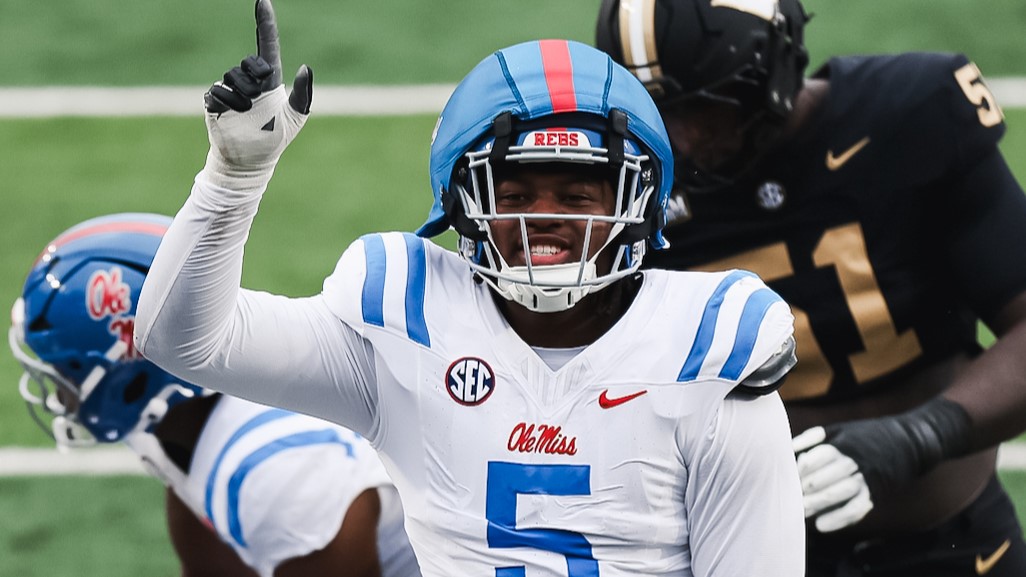
It wasn’t perfect and head coach Pete Golding won’t have to search far for mistakes to highlight, but No. 9 Ole Miss got the win.
Winning on the road in the SEC is never easy, especially when it was as rainy and windy as it was in Nashville, beating Vanderbilt 52-17 is something the Rebels can live with.
We’ll have all week to dissect the finer details of the Rebels’ win and what areas need to be fixed. But a win is a win and here are five stats that show why Ole Miss got the win.
4
That’s how many takeaways Ole Miss had, which is one more than it had tallied in the first four games.
The Rebels picked off two Jared Curtis passes, forced him to fumble at his own goal line and forced a fumble on the ensuing kickoff. That led to the Rebels scoring 17 points off of turnovers, which accounts for nearly half of their margin of victory.
The turnovers are also responsible for the Rebels scoring 21 points in the final 62 seconds of the first half. That was the point in the game the outcome felt decided and all that was left was to determine how big of a win it would be.
2.8
That’s how many yards per rush attempt Ole Miss’ defense allowed.
Remember what happened the last time we saw this defense on the field. Florida and Jadan Baugh ran at will against the Rebels, ripping off runs of above five yards on a consistent basis.
Vanderbilt didn’t come into Saturday’s game with an out-of-this-world rushing attack, the Ole Miss defense left them little room to run. Vanderbilt attempted two more rushes than Ole Miss but gained 93 fewer yards. The Commodores averaged exactly half as many yards per attempt.
That was great to see, as were the eight tackles for a loss that cost the Commodores 41 yards.
That was missing against Florida. The question now is will it show up the rest of the season too?
7:38
That’s how much longer Vanderbilt had possession than Ole Miss, but still ended up losing by 35 points.
The Commodores were able to extend drives, especially in the second half. The opening drive of the second half was almost as long as the different in times of possession.
But many of those drives ended in either a field goal, punt or turnover. Ole Miss, meanwhile, moved down field fast and didn’t settle for field goals. They had some punts and an interception, but the offense didn’t leave the field often without scoring six points.
Add in the end of the first half and its easy to see why the Rebels didn’t as much time on the field as Vanderbilt.
73
That’s how many rushing yards Makhi Frazier had to lead Ole Miss.
Kewan Lacy played and played well. He had seven carries for 39 yards and a touchdown, but didn’t play in the second half. And with Lacy’s injury history, Ole Miss has always known it would need a second ball carrier. It’s part of the reason it brought in Frazier and the former Michigan State running back delivered.
He had 13 total carries and averaged 5.6 yards per carry. If your ground game is picking up five yards each time, the entire game gets a lot easier.
3
That’s how many sacks Ole Miss had against the Commodores. It’s not a record-setting stat, but it’s an important one.
It showed the Rebels did have the ability to pressure an opposing quarterback and not all pressures resulted in sacks. Some resulted in hurried throws that fell incomplete.
But in the first game back after not recording any sacks against Florida, it was good to see the Rebels playing frequently in Vanderbilt’s backfield.