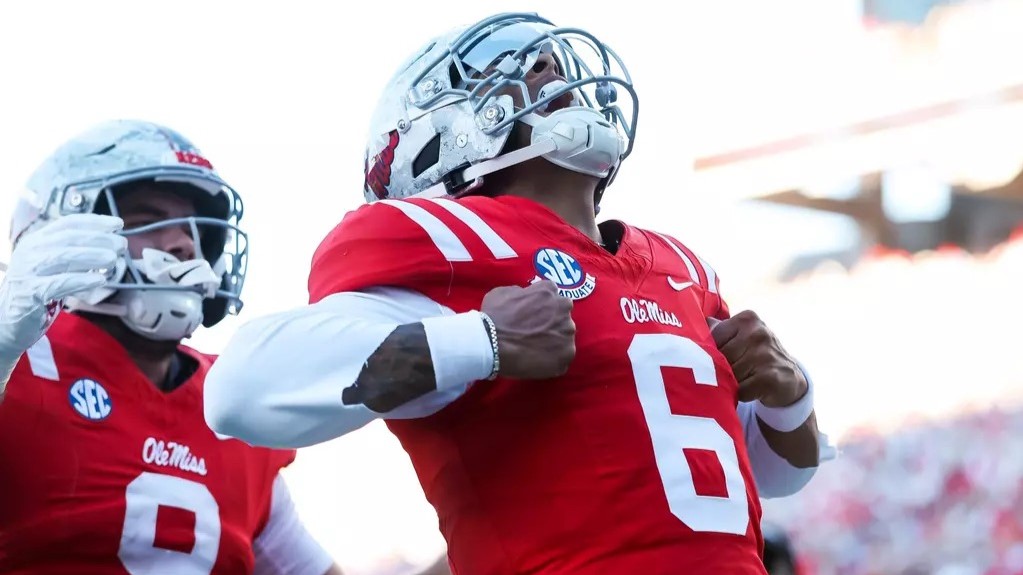
Ole Miss didn’t play a perfect game against Missouri on Saturday afternoon, but the Rebels did more than enough right to make sure the outcome was never seriously in doubt.
The Rebels dominated the Tigers 31-3 at Vaught-Hemingway Stadium, improving on both sides of the football while delivering perhaps their most complete performance of the season.
From a defense that completely neutralized one of the SEC’s most productive running backs to an offense that continued finding success on the ground, there was plenty for Ole Miss to be encouraged about.
Here are three things that went particularly well for the Rebels.
Ole Miss’ rushing defense continues its remarkable turnaround
Ole Miss’ improved rushing defense against Vanderbilt wasn’t a one-week exception.
After allowing just 103 rushing yards against the Commodores, the Rebels held Missouri to a paltry 39 yards on 26 carries, an average of 1.5 yards per attempt.
Even more impressive was how Ole Miss handled Missouri running back Jamal Roberts, who entered the game coming off consecutive 200-yard rushing performances.
Roberts finished with just 39 yards on 20 carries, and his longest run went for only six yards.
Considering Florida gashed Ole Miss for 302 rushing yards before its bye week, the Rebels’ recent performances suggest something significant has changed.
Ole Miss has now allowed just 142 rushing yards in its last two games combined, averaging 2.3 yards per attempt.
[Read more about Ole Miss’ remarkable defensive turnaround here.]
Kewan Lacy and Makhi Frazier dominated Missouri’s defense
While Missouri struggled to establish anything on the ground, Ole Miss had almost no trouble running the football.
The Rebels finished with 257 rushing yards on 38 attempts, averaging an impressive 6.8 yards per carry against a Missouri defense that entered the game with one of the SEC’s strongest rushing units.
And much of that production came from two players.
Kewan Lacy, continuing to battle through injuries that have bothered him throughout the season, rushed for 122 yards on 16 carries. He averaged 7.6 yards per attempt and produced a 23-yard run.
Makhi Frazier was nearly as productive, finishing with 101 yards on 15 carries and averaging 6.7 yards per attempt. His longest run went for 22 yards.
Combined, the two running backs accumulated 223 rushing yards on just 31 attempts.
Their success was particularly important considering how heavily Ole Miss has relied on quarterback Trinidad Chambliss and its passing attack at various points this season.
Chambliss still contributed three passing touchdowns and another on the ground, but the Rebels didn’t need him to shoulder the entire offensive burden.
Instead, Ole Miss established a balanced attack that accumulated 498 total yards and consistently kept Missouri’s defense guessing.
After entering the season with questions about whether it could consistently establish a rushing attack, Ole Miss now has consecutive games providing evidence that its ground game is becoming a legitimate strength.
Ole Miss dominated the situations that mattered most
Missouri wasn’t completely incapable of moving the football Saturday.
The Tigers finished with 378 total yards, including 339 through the air, and occasionally generated enough momentum to threaten the Rebels’ defense.
But whenever Missouri approached a scoring opportunity, Ole Miss seemed to find a way to shut it down.
The best example came during the second quarter.
Trailing 14-3, Missouri reached first-and-goal at the Ole Miss 3-yard line after a 10-yard run by Xai’Shaun Edwards.
On the next play, Jalyn Crawford and Suntarine Perkins tackled Edwards for a one-yard loss.
Then Luke Ferrelli and Tah’j Butler combined to stop Edwards for another loss of one yard.
An incomplete pass and a missed 23-yard field goal later, Missouri walked away with nothing.
It wasn’t the only time Ole Miss delivered in a critical situation.
The Tigers went just 6-for-17 on third downs and failed on both fourth-down attempts. They also converted only one of their three red-zone opportunities into points, failing to score a touchdown on any of them.
Meanwhile, the Rebels converted nine of their 14 third-down opportunities and scored on all four of their trips inside Missouri’s 20-yard line.
Three of those red-zone possessions resulted in touchdowns.
That disparity in execution was one of the biggest reasons Saturday’s game became so one-sided.
Missouri occasionally moved the football, but Ole Miss consistently made the plays necessary to prevent those drives from becoming points.
And when the Rebels had opportunities to score, they generally took advantage.
Combined with the improvement against the run and the continued development of the rushing offense, that kind of situational execution provides plenty of reasons for optimism moving forward.