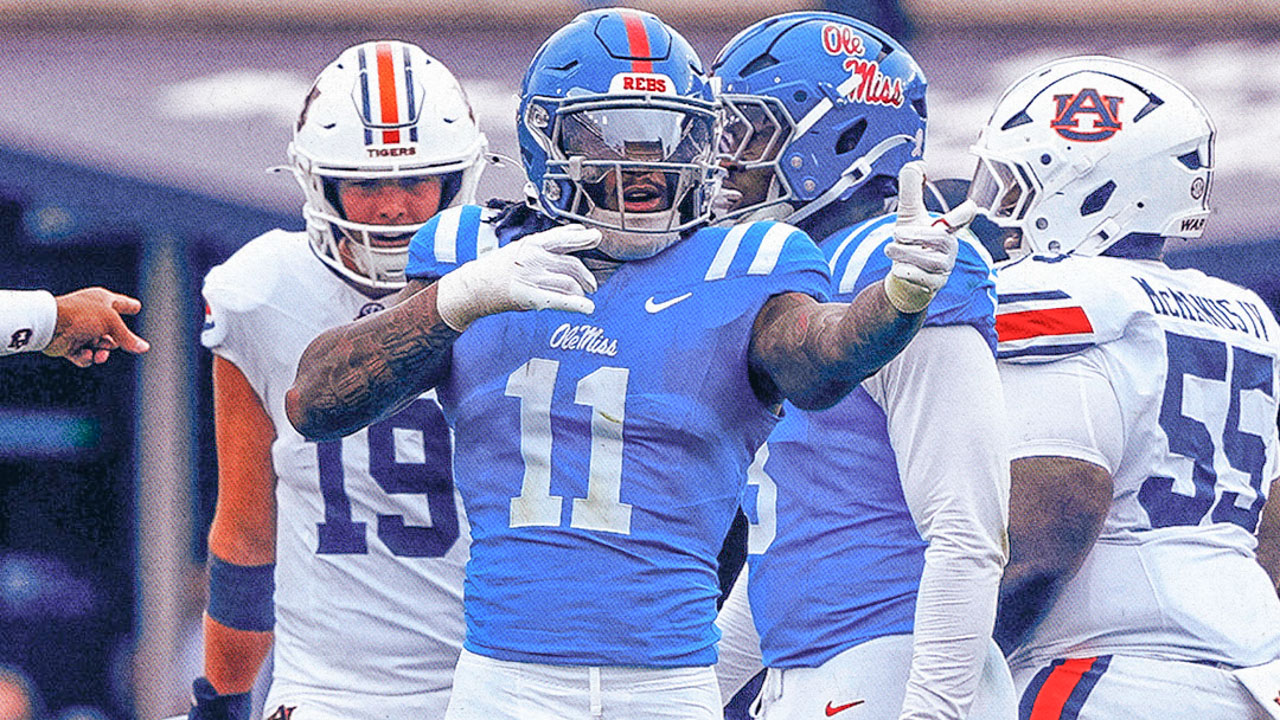
Auburn showed up in Oxford on Halloween weekend hoping to play the role of spoiler.
For about two and a half quarters, the Tigers made things uncomfortable. Then Ole Miss turned the game into a horror show for Auburn.
The Rebels transformed a two-point game late in the third quarter into a 45-15 rout at Vaught-Hemingway Stadium, sending the Tigers home with more tricks than treats.

Here are five numbers that explain how Ole Miss turned a close game into a blowout.
224
That’s how many rushing yards Ole Miss racked up with All-American Kewan Lacy on the sidelines.
Sophomore Shekai Mills-Knight ran for a team-high 75 yards, quarterback Trinidad Chambliss had 65 and Makhi Frazier had 60. Those three alone averaged five yards per carry.
Golding talked this week about having Chambliss use his legs more and that it was about time Mills-Knight to breakout on the main stage. Both of those things clearly happened.
But it’s not just those three that made impacts. Backup quarterback Deuce Knight was in for only a short time at the end and tallied three carries for 19 yards and a touchdown. Even defensive tackle Will Echoles got in on the action with a one-yard touchdown run in the first half.
Fans hear coaches say it all the time. You have to run the ball to win the game. It’s cliché, but true. The Rebels’ run game opened up the passing game and what was a close, two-point game turned into a 30-point win.
2.3
That’s how many yards per run Auburn averaged against the SEC’s worst run defense.
The Rebels have had more good games stopping opposing teams’ runs than bad, but the lone bad performance of the last month was a loss. So, the worries and concerns still remain valid and the Tigers did have some success early on.
But the Ole Miss defensive line was too much for Auburn’s offensive line to handle. The Rebels had 10 tackles for a loss that cost Auburn 39 yards. Quarterback Byrum Brown finished with just five rushing yards, accounting for sacks. Before that, he had just 31 rushing yards and most of that came on scrambles.
The Tigers might’ve had a better chance at taking advantage of Ole Miss’ shaky secondary if they had a more dangerous rushing threat.
81.3%
That was the Rebels’ third conversion rate. They converted 13 of the 16 third downs faced. That’s an exceptional number and helps explain why Ole Miss was able to have four drives last 11 or more plays and six that lasted eight or more plays.
Auburn had its own success on third downs, especially in the first half. It converted 7-of-14 third downs, but six of those conversions came when facing a third-and-7 or longer. Four of those came before halftime, too.
28
That’s how many unanswered points Ole Miss scored after Auburn made it a two-point game midway through the third quarter.
The trend really started when the Tigers failed to convert a two-point conversion that would’ve tied the game because from then on, Ole Miss dominated.
The Rebels responded to that Auburn touchdown with an 8-play, 75-yard touchdown drive featuring Chambliss’ 26-yard scoring run.
Then Auburn had a questionable fair catch decision called against it and started the ensuing possession at its own one-yard line. Ole Miss forced a three-and-out and a few minutes later Caleb Cunningham hauled in a six-yard touchdown catch to extend the lead to 31-15.
At that point, it was all over for the Tigers. No momentum. Nothing to fall back on to have some success. The Rebels didn’t need to keep scoring, but they did and that’s how you turn a close game into a blowout.
4
That’s how many sacks Ole Miss had against Auburn.
Tah’j Butler and Suntarine Perkins each had two sacks, but the entire defensive front seven was putting constant pressure on Brown. The box score doesn’t do that effort justice. Only five quarterback hurries were credited to Ole Miss defenders, but the pressure was clear and constant.