

Third-and-13 is supposed to be a pretty favorable situation for a defense.
For Ole Miss on Saturday, it was apparently just another opportunity for Auburn to move the chains.
Early in the second quarter, Tigers quarterback Byrum Brown connected with Chas Nimrod for 24 yards on third-and-13, keeping alive a touchdown drive that would eventually take nearly seven minutes off the clock.
Unfortunately for the Rebels, that wasn’t an isolated incident.
Auburn converted five of its eight third-down opportunities in the first half, including four of five requiring at least eight yards.
Brown repeatedly escaped pressure, extended plays and found open receivers for first downs.
It was one of the biggest reasons Auburn remained within striking distance for much of the afternoon.
But something changed after halftime.
Ole Miss finally started getting off the field, limiting Auburn to two conversions on six third-down attempts in the second half of what eventually became a 45-15 victory.
So what changed?
According to Pete Golding, the explanation was pretty simple.
“They did their job,” the Ole Miss coach said afterward.
Golding wasn’t suggesting the Rebels unveiled some revolutionary defensive strategy during halftime. Instead, he pointed to mistakes in execution that had repeatedly allowed Auburn to extend possessions.
“One of them, we were in man, went to push alert and screwed it up,” Golding said. “One was a missed tackle. One was a scramble. We’re in zone and we don’t plaster the route.”
In other words, the defense was in position to make a stop, only to make mistakes that gave Auburn another opportunity.
Linebacker Keaton Thomas described the improvement as a product of communication and halftime adjustments.
“Talking on the sideline, making adjustments and making sure that we’re being elite communicators,” Thomas said after the game. “Especially me, having the green dot, getting guys set faster and letting them know the checks faster. It all plays a part. Those third downs, it happens. It’s football. We shook back, made the adjustments and took care of it for the rest of the game.”
Once those adjustments were made, the defense began producing better results.
That was particularly noticeable in the fourth quarter.
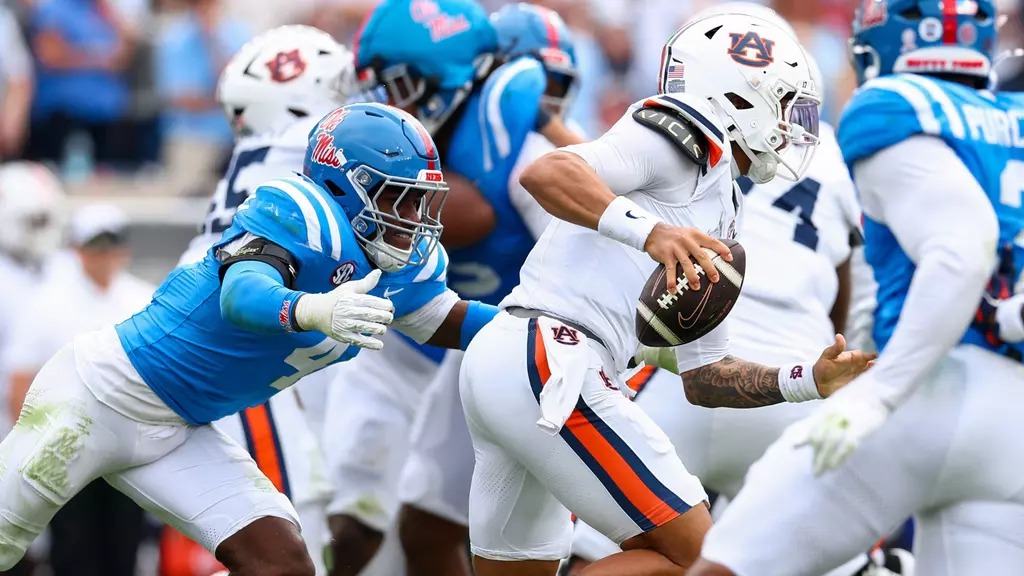
With Ole Miss leading 31-15, Tah’j Butler sacked Brown for a 10-yard loss on third-and-8, forcing Auburn to punt.
The Rebels took advantage of the field position and scored three plays later.
Later, Suntarine Perkins recorded a 9-yard sack on another third-and-8, forcing Auburn into an unsuccessful fourth-down attempt.
Those were the kinds of plays Ole Miss had struggled to finish earlier.
The final numbers still illustrate why the problem deserves attention.
Auburn converted seven of 14 third downs overall, including six of 11 requiring at least seven yards. Three conversions came when the Tigers needed 10 or more yards.
Those aren’t particularly encouraging numbers heading into next week’s matchup against No. 3 Georgia.
But there was also something encouraging about how Ole Miss responded.
After allowing Auburn to cut its lead to 17-15 midway through the third quarter, the Rebels didn’t allow another point.
The defense forced two punts and a turnover on downs across Auburn’s next three possessions, helping Ole Miss score 28 unanswered points.
Now the challenge is playing that way from the beginning, rather than spending an entire half figuring it out.
Because against Georgia, the Rebels might not have the luxury of giving an opponent so many extra opportunities.