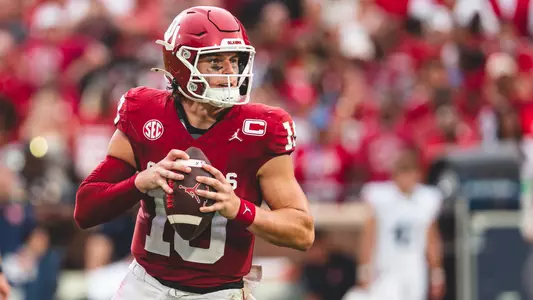
NORMAN, Okla. — Oklahoma quarterback John Mateer is showing signs of progress after spending the past two weeks working to regain his rhythm and command after returning from hand surgery.
There has been progress but still searching for the consistency that defined his early-season success.
Mateer fractured a bone in his right throwing hand during the first quarter of a Sept. 20 win over Auburn and missed three weeks before returning against Texas.
His comeback began unevenly in a 23-6 loss to the Longhorns, when he went 20 of 38 for 202 yards and three interceptions. A week later, he showed greater control, completing 19 of 27 passes for 155 yards and a touchdown in a 26-7 win over South Carolina.
Before the injury, Mateer averaged more than eight yards per attempt, a number that has dipped to 5.3 and 5.7 yards per attempt in his two games back.
His focus now, he said, is on steady execution rather than trying to force big plays.
“Just staying efficient,” Mateer said. “The explosive plays come, but you can’t force them.”
For the season, the Washington State transfer has completed 65 percent of his passes (135 of 207) for 1,566 yards with seven touchdowns and six interceptions.
According to Pro Football Focus College, Mateer has 10 turnover-worthy throws this season, while Sooner receivers have contributed eight drops — roughly 5.6 percent of targets.
Those numbers highlight both Oklahoma’s reliance on a controlled passing game and its struggles with generating explosive plays.
The Sooners rank 49th nationally in plays of 20 yards or more, 114th in plays of 30 or more yards and last in the nation in plays of 40 yards or more.
When Mateer goes deep, results have been mixed. He is 10 of 24 for 304 yards, two touchdowns and two interceptions on passes traveling 20 or more yards in the air.
His most productive range has been intermediate throws — 10 to 19 yards — where he’s 61 percent for 509 yards and three touchdowns. That area represents just over 22 percent of his dropbacks.
All six of Mateer’s interceptions this season have come on throws between the hashmarks, underscoring the challenge of reading interior coverage and timing routes in tight windows.
Oklahoma’s offensive design emphasizes quick decisions and pre-snap reads. Opponents blitz on 40 percent of Mateer’s dropbacks and generate pressure on 30 percent of total passing plays.
Despite that, Mateer has been sacked only 10 times, largely due to his quick release — averaging 2.56 seconds in the pocket and just 2.08 seconds on deep throws.
His ability to read defensive movement before the snap has been key to keeping Oklahoma’s offense steady. Many of his deep attempts are dictated by coverage rather than reaction, limiting unnecessary risks.
The Sooners’ offense also relies on balance through the ground game. A week after rushing for just 80 yards against Texas, Oklahoma rebounded with 177 yards and two rushing touchdowns against South Carolina.
Mateer contributed as both a passer and a runner, showing improved confidence in using his legs since returning.
This season, he has 59 rushing attempts for 272 yards, with only 11 of those coming on scrambles. He has run for 17 first downs and recorded six runs of more than 10 yards, averaging 2.15 yards after contact.
His mobility remains an important dimension for the Sooners’ offense, especially when facing blitz-heavy defenses.
The upcoming game against Ole Miss will test both Mateer’s recovery and Oklahoma’s offensive structure. Georgia scored on every possession against the Rebels last week, using play-action and screens to manipulate coverage.
Oklahoma uses those concepts selectively — screens on 14 percent of snaps and play-action on 20 percent — but may increase both to keep the Ole Miss defense guessing.
Mateer’s ability to process pressure quickly will be critical against an Ole Miss defense that thrives on confusion and pre-snap disguises. The Rebels’ defensive front has been among the SEC’s most aggressive, forcing opposing quarterbacks into hurried throws.
The Sooners enter the matchup at 6-1 overall with five top-20 opponents remaining on their schedule, including the Rebels. Each contest will test the durability of both Mateer’s hand and Oklahoma’s offensive rhythm as the postseason approaches.
Mateer’s best passing performance against a Power Four opponent came in Week 2 against Michigan, when he threw for 270 yards on 34 attempts. Replicating that efficiency will be key as he continues regaining form.
Eight quarters into his comeback, Mateer has shown both steadiness and the lingering effects of his layoff. The Sooners’ success in the coming weeks may depend on whether their quarterback can recapture the touch and confidence that defined his early-season play.