Down South, quarterback changes tend to linger.
They hang around the program like a summer heat wave, even when nobody wants to talk about them.
Ole Miss, somehow, never let that one settle in.
When Austin Simmons went down with an injury at Kentucky in the season’s second week, the assumption around the Rebels was simple. He would heal, return, and at least get a chance to reclaim the starting job.
College football, of course, does not care much for assumptions.
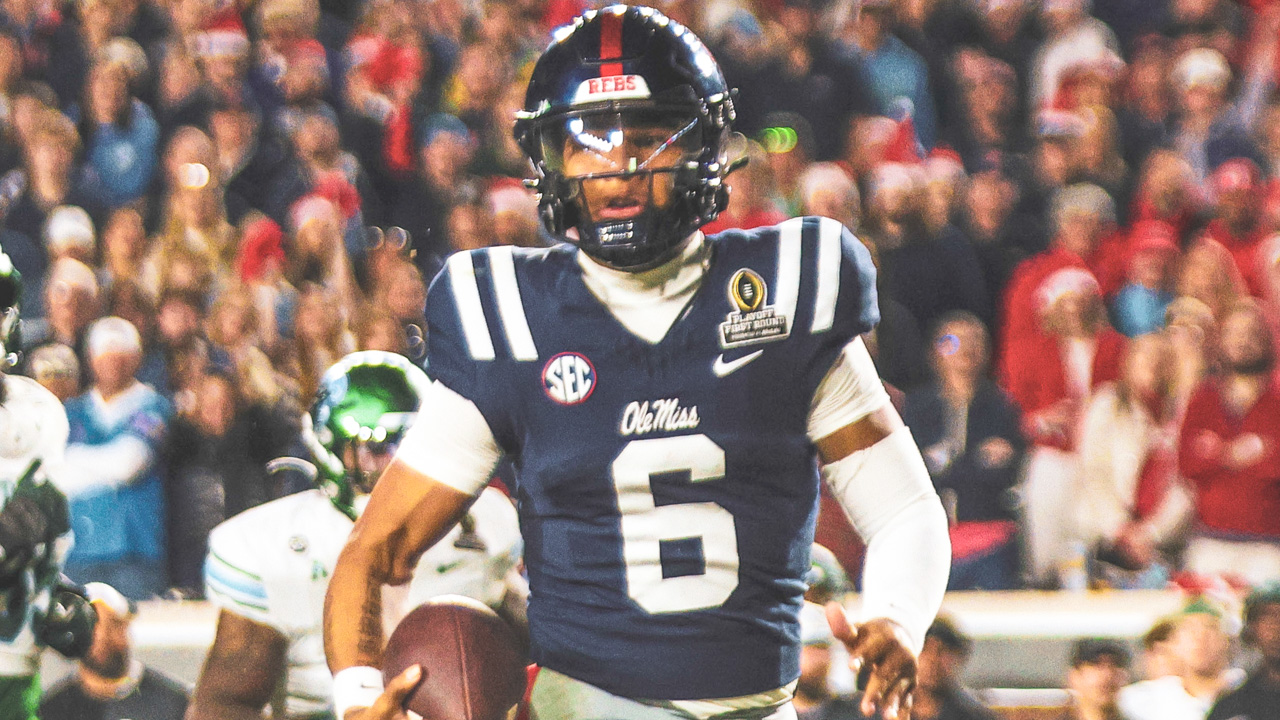
By Week 3, Trinidad Chambliss had taken over the offense. By the end of the regular season, he had taken Ole Miss somewhere it had never been before: into the College Football Playoff.
The unusual part was not that the job changed hands. That happens every fall, somewhere. The unusual part was what did not follow.
There was no quarterback debate. No visible divide. No drip of frustration leaking out of the Manning Center.
Instead, Simmons stayed engaged, vocal, and present. While Chambliss turned into one of the season’s most positive stories, Simmons became a constant on the sideline, often greeting his teammate after drives and offering support that never felt forced.
That mattered more than most box scores.
As the Rebels kept winning and the pressure climbed, the quarterback room stayed calm.
That steadiness helped Ole Miss navigate a historic regular season and land on the short list of teams still playing for something meaningful in January.
Chambliss noticed it the entire way.
“Credit to Austin, throughout the whole season,” Chambliss said Saturday after the win over Tulane. “He’s been locked in. He’s been attentive to any meetings, anything going on during the game. I give all my respect to Austin because I know this year hasn’t been the easiest for him.
“He had a lot of preseason hype and for what happened, that’s really hard for someone to go through. All my respect to Austin and he always is just locked in.”
That praise cuts deeper than a typical postgame quote. Simmons entered the year with expectations.
The injury changed his role, his rhythm, and his visibility. Many players struggle in that spot.
Simmons didn’t disappear.
Chambliss also spoke about trust across the quarterback room, noting confidence that if something went wrong, the next player would be ready. That belief does not come from silence. It comes from work.
Ole Miss benefited from it week after week.
Stability now, uncertainty later
That harmony will not last forever.
College football rarely allows two capable quarterbacks to share space for long, and the Rebels are no exception. The future of the position hinges on a decision that has not yet arrived.
Chambliss, a transfer from Ferris State, is waiting on an eligibility waiver from the NCAA. If that waiver is approved — either immediately or through an appeal — the expectation is he will return to Ole Miss next season.
If that happens, the likely next step for Simmons is the transfer portal. Miami is viewed as a strong option, with LSU also mentioned as a possible destination.
That would be the natural outcome of a modern quarterback room, not a failure of chemistry.
There is another path, though.
If the waiver is denied, Simmons has a strong chance to remain with the Rebels. That decision would depend on how well he connects with new offensive coordinator John David Baker and the offense Baker plans to bring with him.
Those conversations belong to the offseason.
Right now, the quarterback room remains united as Ole Miss prepares for a College Football Playoff quarterfinal against Georgia in the Sugar Bowl next week in New Orleans.
Chambliss says the daily routine has not changed.
“Yeah, we talk everyday in our quarterback meetings,” he said. “We joke around. It’s a lot of laughter in that meeting room but also a lot of seriousness. But yeah, we talk everyday. We have a great relationship.”
That relationship helped define this season.
Ole Miss did not avoid adversity. It simply handled it better than most. One quarterback seized an opportunity. Another stayed ready. Together, they helped push the Rebels into the most important games the program has played in decades.
In a sport built on noise, that quiet cooperation told the louder story.
Key takeaways
- Trinidad Chambliss took over the starting role and guided Ole Miss into the CFP
- Austin Simmons stayed engaged and supportive despite losing the job
- Quarterback stability played a key role in the Rebels’ historic season