

Until a real decision is made about expanding the College Football Playoff, days like Monday will become more and more common for everyone.
The playoff expansion debate reopened this week with the SEC Spring Meetings being held this week.
The latest question on the table is whether the College Football Playoff should jump from 12 teams to 24. It sounds simple enough, but the arguments around it show how differently everyone sees the future of the sport.
Coaches, unsurprisingly, are all for it. More playoff spots mean more job security, more chances to sell progress, and more ways to survive a bad Saturday in October.
Broadcasters aren’t nearly as enthusiastic. ESPN has invested heavily in the bowl system, and doubling the playoff field would push bowls even further into irrelevance they already have a foot in.
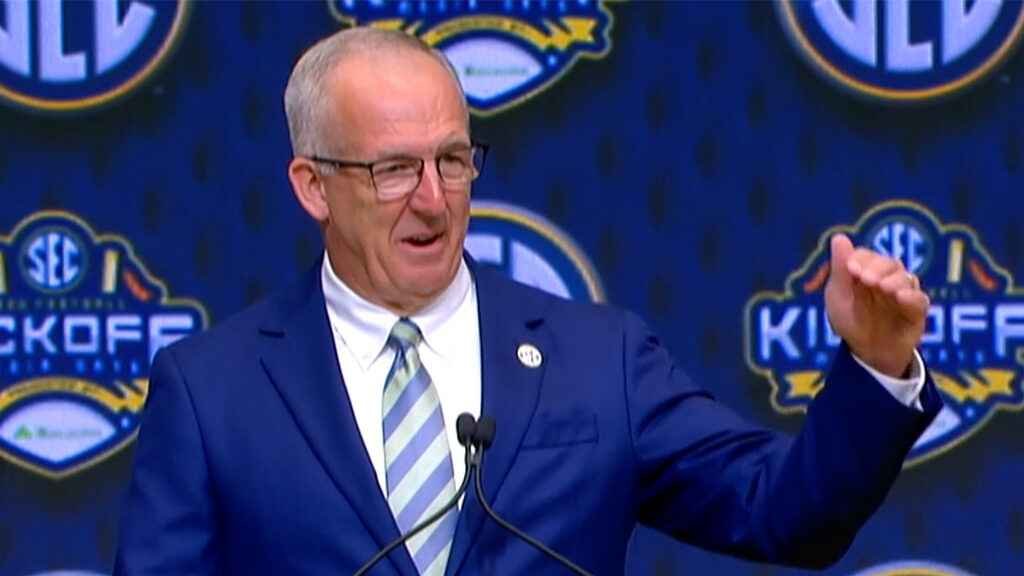
Then there’s the SEC, which is treating the whole conversation with a lot more caution than people expected. Commissioner Greg Sankey didn’t sound bothered by the noise around expansion when he spoke Monday.
Greg Sankey, on fans not favoring a 24-team CFP, and how it shapes discussion
“My opinion, it merits paying attention..Not like it’s scientific research, kind of mass opinions. I don’t disregard it, but it also shouldn’t be the primary force. It’s a piece of information” pic.twitter.com/3ZGrPe4bpc
— Trey Wallace (@TreyWallace) May 26, 2026
“Doesn’t bother me,” Sankey said. “People tell me that, but I don’t know if you pay attention in college sports. Positions seem to change a lot.”
That’s true, and it’s also a reminder that the SEC hasn’t planted a flag on any specific number. Sankey made that clear too.
“I’m not an opponent of 24 or 28,” he said. “We have to inform the decision-making. I think we did a good job informing our position last year on 16. We’ll consider other ideas, certainly, this week and moving forward.”
The hesitation isn’t about fear of competition. It’s about what happens to the regular season when you suddenly double the number of teams that get in.
Sankey pointed out that every major professional league expanded slowly, one step at a time. College football jumped from four to 12 in one move, and that was already a seismic shift.
“You want to be careful about how far you go,” he said. “A game that may not have that same type of leverage, if you will, or that same type of value because both teams could be in [the playoff].”
That’s the heart of it. If the playoff becomes too big, the urgency that makes college football special starts to fade. You can’t sell every Saturday as life-or-death if half the sport knows it’s getting in anyway.
And even if you expand, the same old problem remains.
The last team out will always complain. The first team in will always insist it could win the whole thing.
We’ve already seen what happens when teams that aren’t built for that stage get thrown into it. Tulane and James Madison were great stories last year, but their first-round games showed the gap between “playoff qualifier” and “playoff contender.”
More teams won’t magically fix that. It’ll just create more mismatches and first-round blowouts.
The sport needs to decide what it wants the playoff to be.
A reward for elite teams? A wide-open tournament? A television product?
Right now, the answer depends on who you ask.
But if the goal is to protect the regular season while still giving more teams a path, then doubling the field overnight probably isn’t the solution.
The SEC seems to understand that. The rest of the sport should think about it too.