

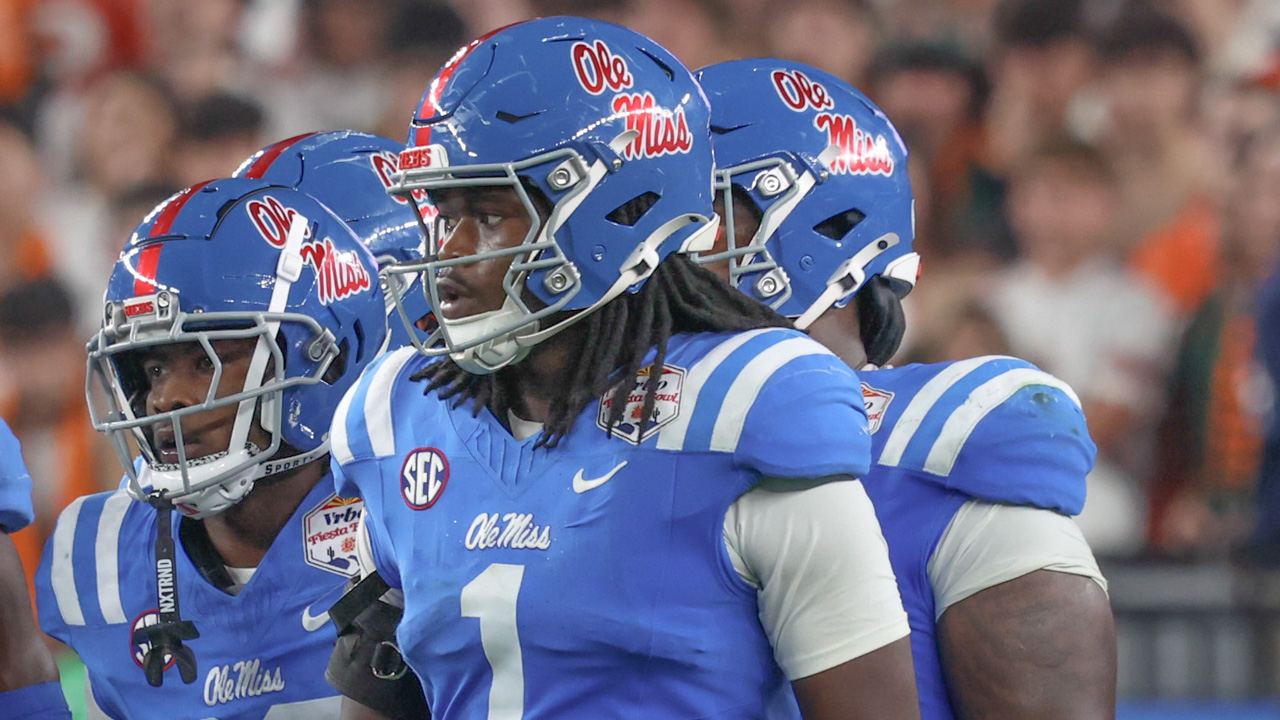
College sports might as well start exploring some type of courtroom sport with how often winners and losers are decided in them.
Most of the fights have been players or schools versus the NCAA, but Ole Miss and LSU might be headed toward a different kind of legal arena.
Ole Miss athletic director Keith Carter told the Clarion Ledger’s Sam Hutchens that the school has been waiting roughly six months for buyout payments tied to former Rebels Princewill Umanmielen and Devin Harper.
Both players signed revenue sharing contracts to stay at Ole Miss, then reversed course and transferred to LSU to join Lane Kiffin. Those contracts included buyout clauses, and Ole Miss says the money still hasn’t arrived.
In Carter’s words, going to court is now on the table.
“That would be an option, going and asking a court to get that money for you,” Carter said. “Contracts are with the players. LSU could pay that on behalf of the players. So, we’re kind of exploring all of that right now.”
Umanmielen was one of Ole Miss’ best defensive players in 2025. Harper was a promising young offensive lineman. Both signed revenue sharing deals shortly before leaving, which is why Carter says Ole Miss feels strongly about enforcing the buyouts.
Revenue sharing contracts are different from NIL agreements. NIL deals run through collectives and focus on outside income opportunities. Revenue sharing contracts are direct agreements between a school and a player, outlining payments and buyouts in clear terms. When those deals are broken, the buyout language kicks in.
Previous reports have the combined total just shy of $1 million, though Carter declined to confirm the exact number.
“I don’t really want to comment on that,” Carter said. “It was significant. They were good players.”
Carter acknowledged that athletic departments across the country have been hesitant to enforce buyouts against teenagers. But he said the timing and circumstances of these two cases make them different.
“Those are the kind that, having signed a brand‑new rev share contract basically a week or two before wanting to leave, those are the kind that put you in a bind, especially there in the portal cycle,” Carter said. “Those two we’re going to continue to figure out how to collect. We feel like based on the contract we deserve to collect.”
It’s also customary for the school receiving the transfer to cover the buyout fee. Carter said Ole Miss has paid buyouts on behalf of incoming players before, which adds another layer to the expectation that LSU will eventually settle the tab.
Whether this ends in a courtroom or gets resolved quietly behind the scenes, it’s another sign of how fast the sport is changing.
Contracts, buyouts, and legal leverage are becoming as much a part of roster building as recruiting visits and portal scouting.
College sports may not have a courtroom league yet, but Ole Miss and LSU might be about to play the next round.