
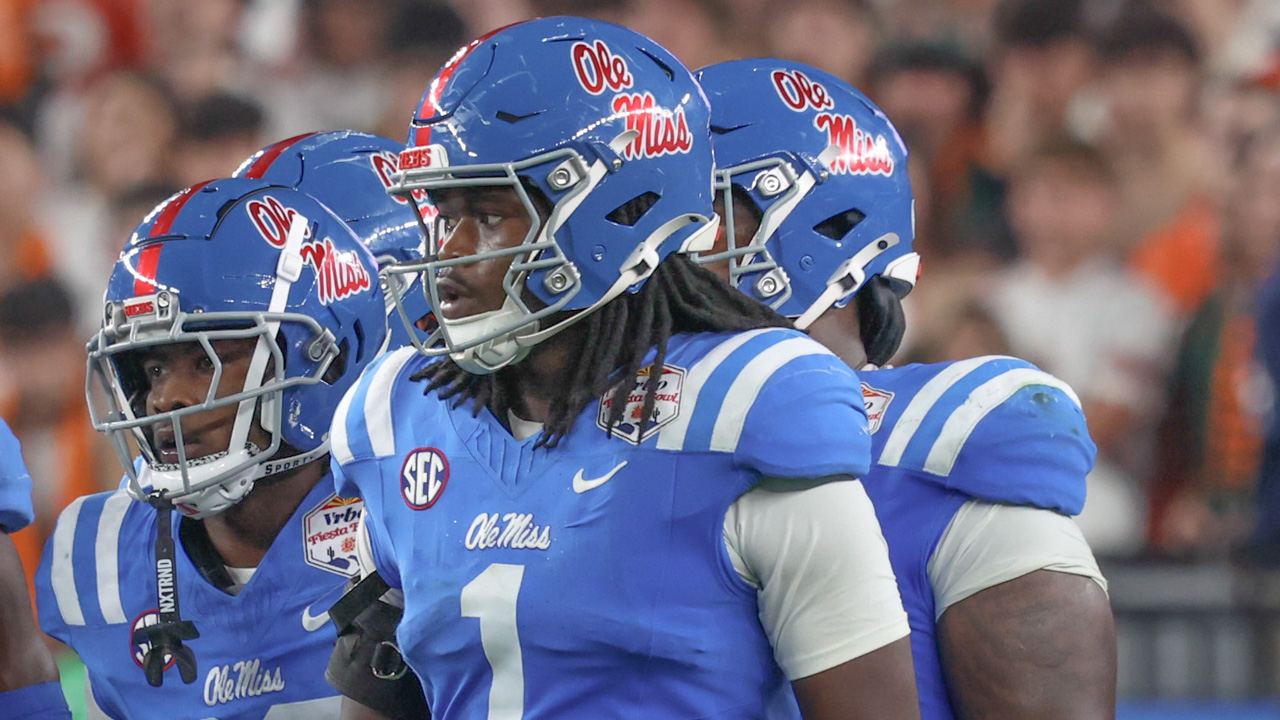
LSU has officially paid Ole Miss the $1.5 million buyout owed for Lane Kiffin’s departure last November.
That part is normal. Coaching buyouts have been around forever. Schools have been cutting checks for coaches to leave, arrive, or change jobs for decades. Nobody blinks at that anymore.
What’s new is everything that comes next.
LSU still owes Ole Miss $997,000 in player buyouts for EDGE Princewill Umanmielen and offensive lineman Devin Harper.
Both players re‑signed with Ole Miss in January, then followed Kiffin to Baton Rouge. That triggered the buyout clauses attached to their new agreements. According to OM Spirit’s Ben Garrett, via Chuck Rounsaville, Ole Miss has not yet received those payments.
Umanmielen’s buyout is $590,000. Harper’s is $407,000. And unlike coaching buyouts, this is still unfamiliar territory for a lot of fans. But it’s becoming standard practice.
Players now have the same freedom coaches have always enjoyed. Coaches have never had to sit out a season after switching schools. They just moved, and the buyout money was paid.
Now players can move just as freely, and buyouts are simply a byproduct of that freedom.
Umanmielen led Ole Miss in sacks last season before signing a reported $1 million NIL agreement with LSU. Harper was expected to compete for a starting role. Their departures hurt, but the buyouts exist to soften that blow. It’s the same logic schools have used for coaches for decades.
And if you want to talk about money in college sports, look at what’s happening with five‑star running back David Gabriel Georges.
According to On3’s Pete Nakos, Georges is expected to become the highest‑paid running back prospect ever coming out of high school. The deal is projected to push past $1 million. Tennessee and Ohio State are the two programs most commonly mentioned, but Ole Miss is right there in the mix. Georges visited all three schools last month and canceled a scheduled Georgia visit.
NEW: 5-star RB David Gabriel Georges is expected to be the highest-paid RB recruit in history, @PeteNakos reports💵
He is in line to become the first RB prospect with a $1M deal.https://t.co/VYimDXkSTG https://t.co/YOsiVd9la1 pic.twitter.com/WZzTe6GKEq
— On3 (@On3) July 1, 2026
He’s worth the attention. Georges ran for 1,726 yards and scored 27 touchdowns last season at Baylor School. He’s violent through contact, fast in the open field, and has the kind of vision that makes him a day‑one difference maker.
So here’s the fun hypothetical.
Ole Miss just received $1.5 million from LSU for Kiffin. LSU still owes nearly another million for Umanmielen and Harper. What if, in some alternate universe where the rules allowed it, Ole Miss took that player buyout money and tacked it onto its offer to Georges? Would that vault the Rebels into the favorite spot?
Possibly.
Realistically, it doesn’t work that way. NIL money has to come from collectives, donors, and approved channels. Schools can’t just redirect buyout payments into a running back’s pocket. But the thought does highlight how dramatically the sport has changed. A million dollars used to be a coach’s buyout. Now it’s a high school running back’s market value.
And that’s why LSU paying Ole Miss for Kiffin barely registers as surprising. It’s the old world. The player buyouts are the new world. Both exist now, side by side, because players finally have the same mobility coaches have always had.
Ole Miss got its check for Kiffin. LSU still owes the checks for Umanmielen and Harper.
And college sports keeps evolving, one buyout and NIL deal at a time.