

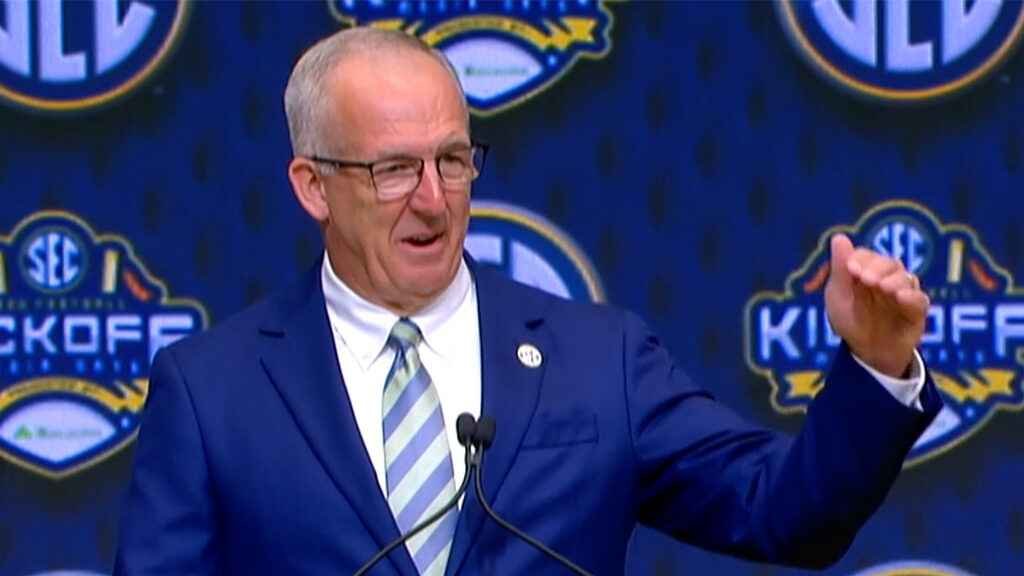
SEC Commissioner Greg Sankey didn’t try to dress it up or bury the answer.
When he was asked Monday morning how real the conversations were about the SEC breaking away from the rest of college athletics, he didn’t hedge or redirect. He didn’t offer a long preamble. He just said it.
“So, they’re real.”
That’s the kind of line that hangs in the room for a second. Not because Sankey was threatening anything, but because he was acknowledging something everyone around college football has felt or been wondering about for a while.
The frustration is real. The conversations are real. And the idea of the SEC exploring a different model isn’t bluster anymore. It’s a reflection of how messy the national picture has become.
Ole Miss fans don’t need a reminder of how often the sport’s biggest decisions get stuck in place.
The NCAA spent years dragging its feet on NIL rules, benefitting from antitrust violations under the guise of amateurism.
“What I think is important is those comments represent a high level of frustration with the circumstance in which we find ourselves,” Sankey said. He talked about years of trying to modernize rules, only to see national votes stall out. He mentioned the CFP expansion process that sat idle because “colleagues couldn’t move.” He even brought up the volunteer coach rule that Division I couldn’t agree on, saying the inability to fix it “creates risk.”
None of that was bluster. It was a commissioner explaining why the league’s patience has worn thin.
And he made sure to clarify that the breakaway talk isn’t some negotiating tactic aimed at Congress.
“I do not believe that is a leverage point,” he said. “I think that’s just honest communication.”
That honesty matters right now because the Protect College Sports Act is being rewritten on the fly.
Sankey said the SEC is “engaged specifically now in ongoing dialogue around improving the Protect College Sports Act,” and he laid out the four principles the league wants addressed.
- Enforceable national standards.
- A truly national framework.
- Real transparency.
- Equal treatment for similar organizations.
Those aren’t small tweaks. They’re the foundation of what the SEC believes a national model should look like. And until Congress delivers something that fits that framework, the frustration isn’t going anywhere.
Sankey wasn’t shy about the stakes.
“If Congress is going to act, and again I believe it should, we have one opportunity to get this legislation right,” he said. He also warned that if the bill passes with gaps, “we won’t be returning to DC in a year or two asking and receiving help to correct” them.
That’s why the breakaway conversations keep surfacing. Not because the SEC wants to blow up college sports, but because the league is tired of operating inside a system that can’t make decisions quickly or consistently.
Sankey even joked that he wishes these conversations stayed private.
“I would prefer that stay in a meeting room or on a videoconference, not be part of the D1 ticker the next morning,” he said.
But once they’re out there, they’re out there. And they’re out there for a reason.
None of this means the SEC is ready to pack up and start its own world. Sankey talked plenty about the pride the league takes in competing nationally, and Ole Miss has felt that pride across multiple sports.
Sankey said there is “meaning and value and I do think a national expectation that we participate in a national organization.”
But he also made it clear that the national organization has to function. It has to deliver consistency. It has to deliver stability. And right now, it isn’t.
That’s the story this week in Tampa.
Not just the Protect College Sports Act itself, but the growing sense that the SEC is done pretending everything is fine.
Sankey didn’t bring frustration to Media Days to make noise. He brought it because the league wants a system that works.
And when the commissioner says the conversations are real, we should believe him.