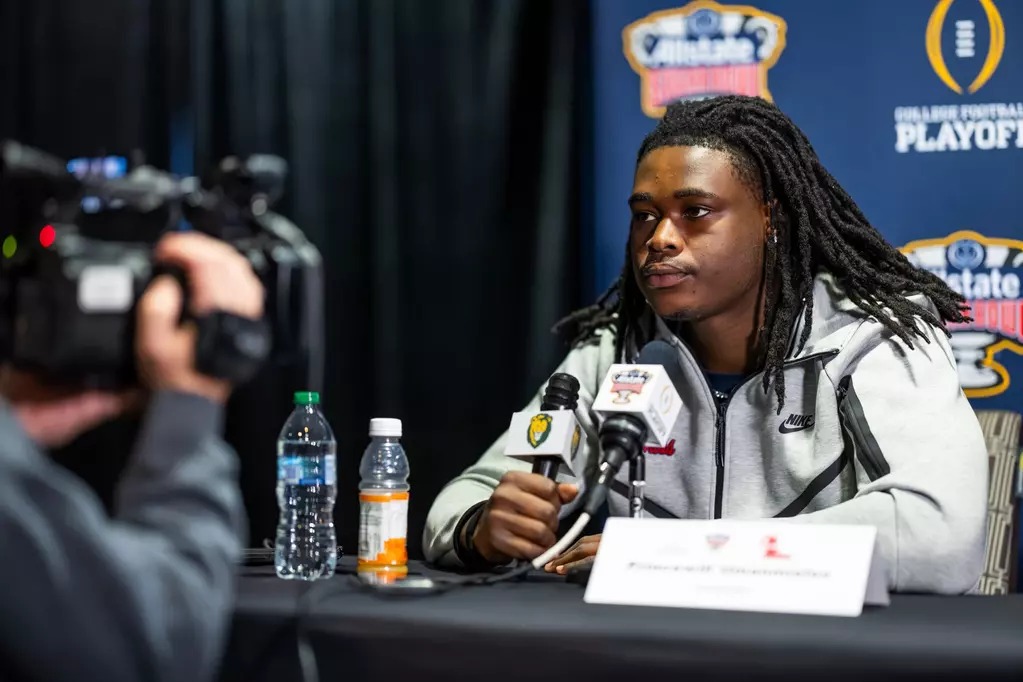
The public reaction to Tuesday night’s news that Ole Miss had filed lawsuits against two of its former players has been predictable.
The Ole Miss side says Princewil Umanmielen and Devin Harper should honor the contracts they signed and pay their respective buyouts.
The LSU side says that Ole Miss is wrong, petty and acting like a scorned, vindictive ex-lover. After all, a million dollars isn’t going to make or break any SEC school.
The non-biased crowd sees it as not being a great look for Ole Miss, but also understands the school didn’t have many options. And not enforcing the buyouts sets a precedent not even LSU fans want set (because if the roles were reversed, the reactions would be too).
It’s all talk, though. The Rubicon has been crossed.
No amount of LSU fans calling Ole Miss broke or anything else will change that. Really all it does is paint themselves into a corner for if/when a player leaves LSU without paying a buyout. Of course, that’s assuming college football fans react with some amount of logic and self-awareness.
But my question is this: why isn’t LSU covering the costs of the buyouts?
Yes, the buyout is part of a contract between Ole Miss and each player. LSU is not a party to the contract and, therefore, has no legal obligations to do anything.
The same is true for coaching contracts, too, and LSU paid Lane Kiffin’s buyout at Ole Miss. Why isn’t the school footing the bill for the players’ buyouts?
It’s foolish to think the buyouts didn’t come up for both Harper and Umanmielen when making the decision to transfer to LSU. Both players had to know about the six-figure buyout (if they didn’t, they need new representation) and, logically, they had to receive some assurances they either wouldn’t have to pay it themselves or would have additional compensation to cover that cost.
What kind of recruiting pitch would tell a player that the buyout is his problem, not the new school’s? If that was the pitch, then why bother recruiting the player in the first place? Maybe if the NIL offer covers the cost, but then that would’ve been discussed too.
Logically, it doesn’t make sense for this situation to reach this point.
LSU doesn’t have to pay the buyouts, but it is difficult to believe the buyouts were never discussed during either recruitment. LSU now refusing to pay, either directly or indirectly, is the only reason this reached the lawsuit stage.
An illogical explanation is that LSU convinced Harper and Umanmielen that Ole Miss wouldn’t enforce the buyouts. But there was never a zero percent chance of that happening. And in a college sports world built on contingency plans, even the smallest possibility gets accounted for.
What happens next might be predictable. Ole Miss filing the lawsuits shows it’s serious about enforcing the buyouts, and that could lead to a negotiated settlement between the school and both Harper and Umanmielen.
LSU would either pay that themselves or reimburse the players somehow. That’s what schools do for coaches. LSU did it for Lane Kiffin and for Brian Kelly in 2021.
LSU’s argument that it is not a party to the contracts explains why Ole Miss sued the players instead of LSU. But it does not answer the broader question of why LSU has not handled these buyouts the way it handles similar obligations for coaches.
It’s already set the precedent that it’s willing to pay a buyout to another school.
Of course, if this sport treated players the way it treats coaches, none of this would’ve reached a courtroom.