

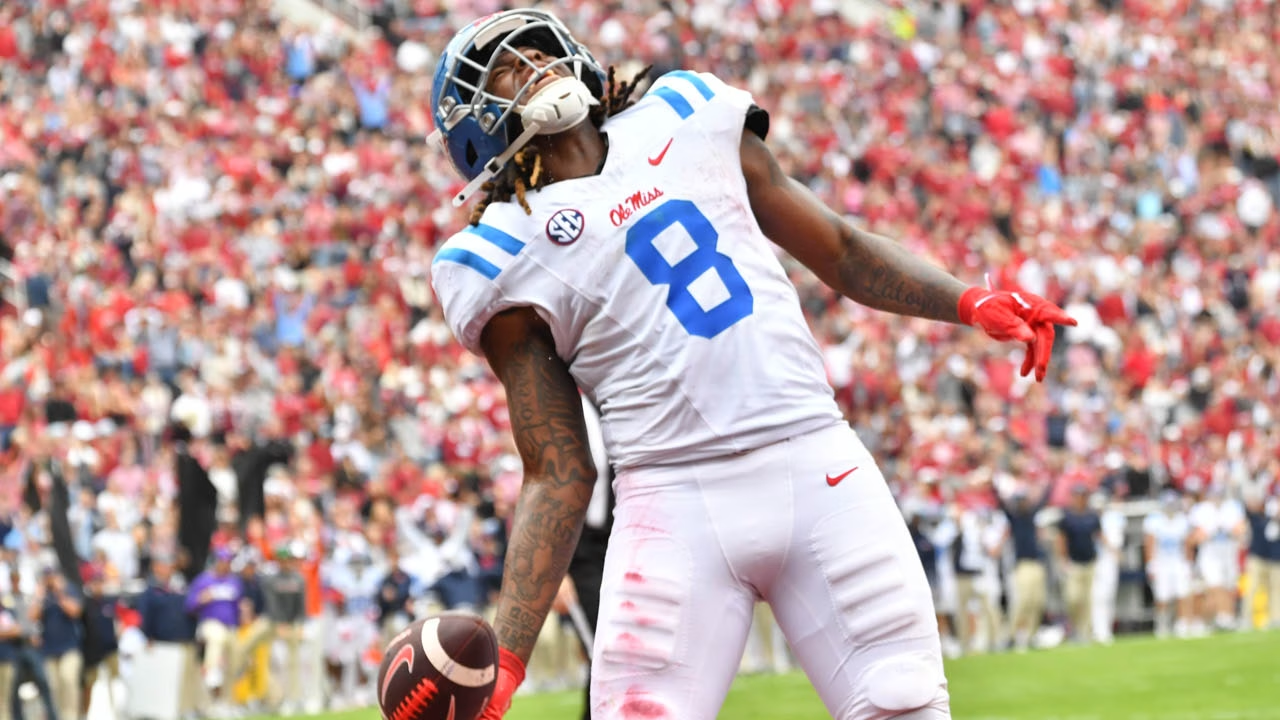
Professional sports have dealt with tanking for decades. When leagues reward the worst teams with the best draft picks, some franchises naturally decide losing is the quickest path to winning later. If you have no postseason hopes, you might as well lean into the losses.
College sports have never had that problem. There’s no draft. There’s no incentive to lose. If anything, job security depends on winning as much as possible.
But is tanking finally happening in college sports? Not by teams. By the NCAA.
The NCAA is losing eligibility cases at a rate that feels like it’s taking Ozempic. Since the NCAA adopted its new age-based model, virtually every major challenge to its treatment of athletes who exhausted eligibility in 2025-26 has ended badly for the NCAA.
The core issue is simple: the NCAA did not grant a waiver to athletes who started competing in 2022-23, just finished their fourth season, and suddenly had no eligibility left under the new rule.
Athletes from that class immediately sued. And they’ve been winning.
A judge in Colorado issued the most sweeping ruling, granting a preliminary injunction that allows all athletes who began competition in 2022-23 to play this season.
Before that, a judge in Tennessee granted a preliminary injunction to 19 basketball players, including former Rebel AJ Storr.
Most recently, a Louisiana judge issued a temporary restraining order for 33 athletes, including 16 football players who were either in or just left NFL training camps.
The trend isn’t slowing down. There are lawsuits filed for Div. II and III athletes to gain a fifth year of eligibility, track athletes challenging the fifth-season exclusion and one case with class-certification motions pending.
All of these cases have their own intricacies and contradictions. The Colorado ruling kept the professional-participation rules intact and didn’t open a transfer portal window. The Louisiana ruling does both of those things.
Does anyone looking at the NCAA’s record over the last month feel particularly confident it’s suddenly going to start winning these cases?
Maybe the NCAA couldn’t know it would lose. But it absolutely knew it was inviting litigation.
The NCAA spelled it out in its own guidance: “Student-athletes who used their final season of competition (under previous rules) during 2025-26” would have “no additional eligibility.” That’s a bright red line.
The NCAA does have an explanation. It said granting the class of 2022 another season would disrupt rosters, scholarships and opportunities for younger athletes. There’s just one problem: when the NCAA made that argument in Colorado, the judge specifically noted that it provided no evidentiary support for the supposed widespread harm.
Did the NCAA really think athletes wouldn’t challenge it? Did it believe it could defend the rule in court? If so, that’s a whole different problem.
But what if the NCAA did anticipate the lawsuits, knew it would lose, and left the rule unchanged anyway? What good would that do?
Every time a judge grants an injunction or restraining order, chaos erupts. Social media melts down. Administrators panic. Commentators declare the death of college sports. The NCAA gets portrayed as powerless and overwhelmed.
And that’s exactly the environment where the NCAA can argue it needs help. More specifically, congressional help.
The Protect College Sports Act is being pitched as the NCAA’s lifeline. Supporters say it’s the only way to restore order and stability. But getting any bill through Congress requires momentum, urgency and a sense that the system is collapsing.
Chaos creates that. Chaos creates momentum. Chaos creates urgency. Chaos creates the kind of environment where the NCAA can walk into Congress and say the sport is spiraling and only lawmakers can save it.
NCAA President Charlie Baker said exactly that when he cited the chaos created after the Colorado and Tennessee court rulings.
“Today’s rulings and the chaos they bring to college sports are exactly why it’s time to pass this bill.”
Statement from NCAA President Charlie Baker:
"Without targeted intervention from Congress, college sports cannot set nationwide rules everyone can play by and without Congress, failed professionals will continue to use college sports as a fallback option — robbing the next…
— NCAA News (@NCAA_PR) August 1, 2026
I’m not suggesting NCAA lawyers are walking into court trying to lose. I’m suggesting the people who make NCAA policy have remarkably little incentive to stop giving those lawyers losing cases when every defeat strengthens their argument for congressional protection.
The NCAA adopted a transition policy it knew would provoke litigation.
Courts repeatedly told it the policy probably wouldn’t survive. Instead of eliminating the source of the litigation, the NCAA continued defending it while simultaneously using the resulting chaos as Exhibit A for why Congress should give it antitrust protection.
A court ruling just opened the door for players on NFL rosters to return to college football.
This is exactly why Congress must act.
The Protect College Sports Act creates clear, national eligibility rules instead of leaving college sports trapped in endless legal chaos. https://t.co/phUwAIy39j
— Senator Ted Cruz (@SenTedCruz) August 20, 2026
If that’s the play, then the NCAA isn’t just losing these cases. It’s tanking them.
And like any team that tanks, it’s not trying to win today. It’s trying to win something much bigger down the road.