OXFORD, Miss. — College football has always lived with some calendar tension, but this year has shown how far the strain has spread, especially for Ole Miss.
All of this was brought into focus in a recent story by Dan Wetzel at ESPN, detailing the chaotic picture things have become.
Of course it’s all made worse from the scheduling issue for coaches when a drama queen of a coach trying to manipulate everything for chiefly has benefit.
It has become a real burden for high school athletes who have only a small window to make the biggest choice of their lives.
The college football calendar problem is no longer just about million-dollar coaches changing jobs; it is about teenagers pushed into rushed decisions during a chaotic stretch.
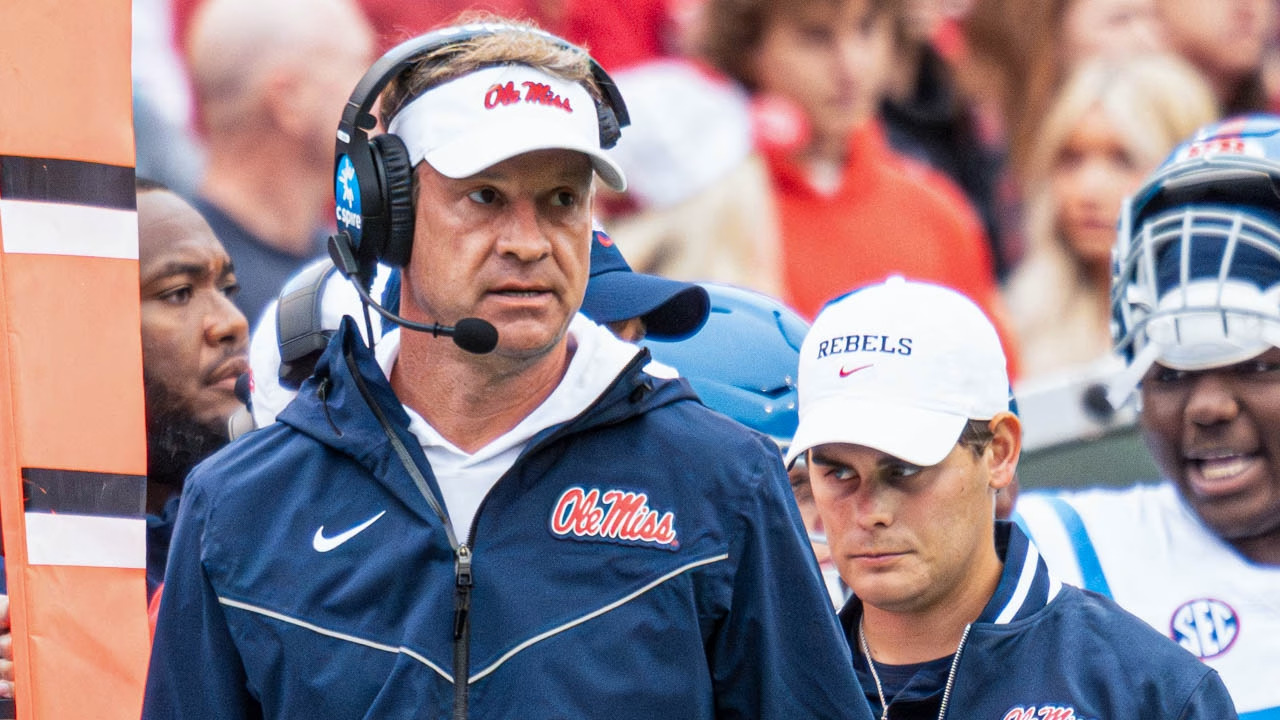
The recent coaching move by Lane Kiffin, who left Ole Miss for LSU with the Rebels still in the playoff hunt, captured how off-balance the schedule has become.
The moment he arrived in Baton Rouge, Kiffin began meeting with families and top recruits like five-star prospect Lamar Brown.
Brown remains verbally committed, but according to the story, he will not sign until he knows what staff LSU will put around him. Even for a player of his level, the picture is unclear with only days before signing begins.
Short window crunches recruits’ time to choose
This is the hard part for recruits. The early signing period opens Wednesday. Decisions that should take months now happen in a matter of days.
And as coaches move, staffs shuffle, and rosters shift, high school athletes often have the least information of anyone involved.
As one high school coach told ESPN, this has hurt the high school athlete the most. He added that the process is not really a process at all and called it chaotic.
Detroit Catholic Central coach Justin Cessante said his program has five players expected to sign with FBS schools this cycle, and all have felt the squeeze.
Three of his seniors committed early, only to watch their situations change by late fall. Benjamin Eziuka committed to Penn State, but when the coach who recruited him was fired, he made a new plan and is now headed for Virginia Tech.
Jack Janda committed to Wisconsin before things shifted there, and now he is expected to sign with Iowa.
Samson Gash committed to Michigan State, but after their head coach was fired and a new one arrived only 48 hours before signing day, he reopened his recruitment because there was no time to build a relationship or understand what the new staff wanted.
Cessante said all three chose before the season, and all three had to make late decisions because of coaching changes and rumors.
He added that this is supposed to be a decision about the next four or five years of a young player’s life, but the time to make that choice keeps shrinking.
Many recruits sign without ever meeting the new staff in person. Coaches, meanwhile, sometimes have only one or two days to decide if they want to keep earlier commitments.
This issue began years ago but has grown worse recently.
Why the calendar shifted
Before 2017, recruits typically signed in February. That allowed coaching searches to finish, new staffs to settle in, and recruits to make calm decisions after talking with the people who would actually coach them.
But coaches pushed for a December signing window, arguing it helped with roster management. Then last year, again at the urging of coaches, the signing period moved even earlier to the first Wednesday of December.
This change dropped it right in the middle of the playoff rush, bowl prep, and the most active coaching carousel in college football history.
The transfer portal adds another layer.
The main portal window opens in early January, weeks after high school recruits sign.
Programs often turn to the portal to fill roster needs, but when they do, it can leave incoming freshmen buried on depth charts at places they barely had time to learn about. Those same freshmen then enter the portal a year later, adding to the cycle of roster turnover.
Ideas for fixing the problem
Some coaches believe pushing signing back to February would help stabilize the process. It would give high school players more time, allow new staffs to form, and give everyone a clearer idea of who fits where.
One coach said there should be a standard expectation for how this works, but right now, there is no standard.
Everything is accelerated, and that squeeze lands hardest on young players who have the least control.
The current calendar may offer coaches a little certainty, but it creates uncertainty everywhere else.
The people with the longest futures at stake — the athletes — have the smallest window.
And until the sport slows the process down again, the pressure will stay on the high school kids caught in the middle of a system designed around coaching stability rather than player clarity.
Key takeaways
-
The early signing period now lands in the middle of coaching changes, putting high school athletes under major time pressure.
-
Coaching turnover forces recruits to reconsider commitments with little information and almost no time to build relationships.
-
Many believe moving signing back to February would give both recruits and staffs the stability the current calendar lacks.