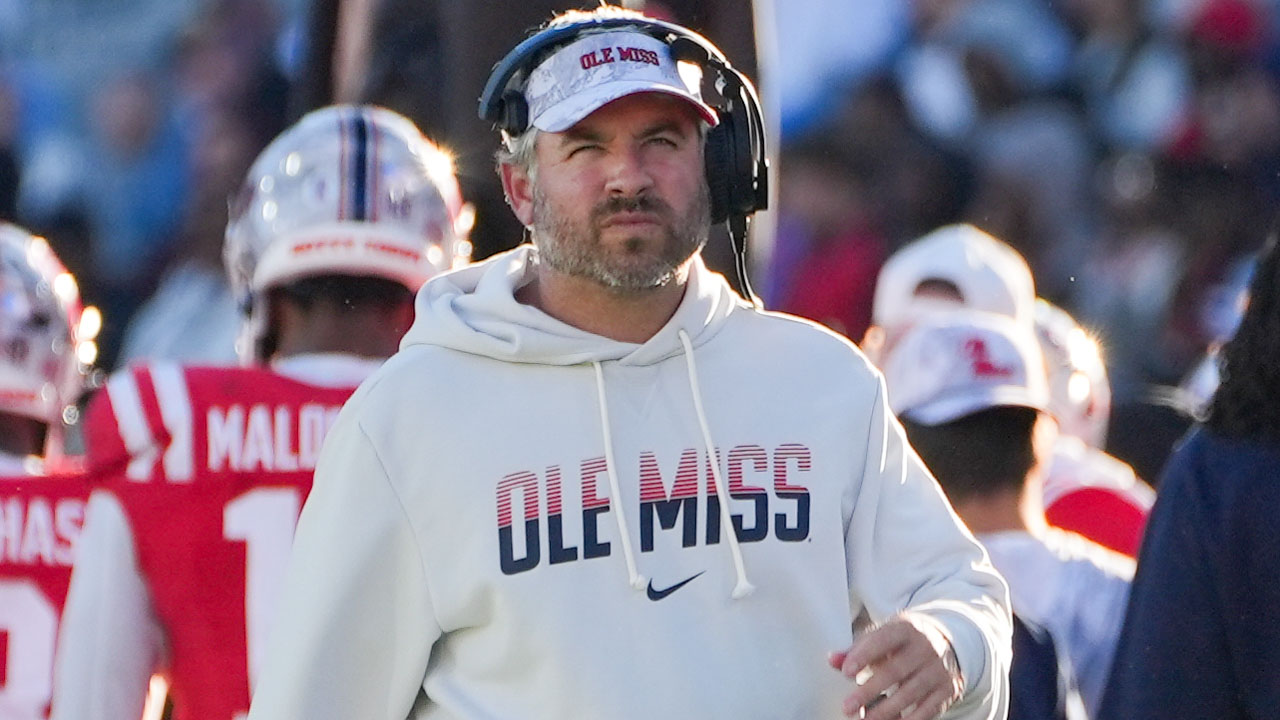
The odds don’t entirely favor Ole Miss this Saturday against Texas, but they are much more in the Rebels’ favor than in the past weeks.
No. 7 Ole Miss heads to Austin to face the Longhorns who have fallen from No. 1 to No. 19 in the last two weeks thanks to a pair of surprising losses.
Suddenly, Texas doesn’t look as dangerous as it did after beating then-No. 1 Ohio State earlier this season.
But the Longhorns are still good and won’t be a doormat for the Rebels visiting the Lone Star state. Ole Miss will need to have one of its best games of the season in a very difficult environment.
There’s plenty of storylines and angles that’ll go into determining the outcome. Here are five questions that’ll play major roles in that determination.
Does Colin Simmons play?
Texas head coach Steve Sarkisian isn’t going to reveal this answer until he absolutely has to. But there are reports that Simmons will miss multiple weeks due to a high-ankle sprain.
If those reports are true, the Longhorns will be without one of the nation’s best defenders.
Simmons has been one of the most disruptive players this season. He has 10.5 sacks, 16 tackles for a loss and has forced two fumbles. He’s accounted for more than half of the Longhorns’ 19 total sacks.
Even before leaving the Florida game with an injury, Simmons had accumulated eight tackles, four tackles for loss and the Longhorns’ only sack.
Simmons’ absence would go beyond just sack totals. He commands attention in blocking schemes, creates pressure without Texas needing to blitz and can disrupt running plays behind the line of scrimmage.
Playing without Simmons on the other side of the line of scrimmage would be a significant advantage for Trinidad Chambliss and the Rebels’ offense.
Can Ole Miss force Texas into third-and-long?
Of the many eye-popping stats Texas has produced in its two losses, its ineffectiveness on third downs have been the most startling.
In a 27-24 loss to Oklahoma, the Longhorns were just 3-of-14 on third downs and punted eight times. The next week in loss to Florida with the exact same score, the third down offense was even worse. Texas was 2-of-10 on third downs.
That’s five total third down conversions in two weeks for a team that was considered to have an elite offense.
It’s also where Ole Miss’ improved run defense could make a difference. If the Rebels can limit Texas on first and second downs, they’ll force Manning into obvious passing situations and make an already struggling third-down offense even more vulnerable.
Can Ole Miss establish the run against one of its toughest defensive tests?
Texas is one of the best teams at stopping the run. It ranks No. 27 in the nation allowing just 106.3 yards per game on the ground. Ole Miss hasn’t fielded a dominant rushing attack but is averaging 153.8 ypg.
The Rebels are also coming off a game where two backs gained more than 100 rushing yards.
Establishing the run would accomplish more than simply producing yards. It would keep Texas’ defensive front honest, create opportunities for play-action passes and prevent the Longhorns from focusing exclusively on pressuring Chambliss.
Chambliss is good enough to carry the offense, but that doesn’t guarantee a win (ex: Florida). There needs to be respectable rushing attack or else the Longhorns’ defense will just pin its ears back and go after Chambliss every play.
Can the Rebels’ defensive backs cover every passing option?
The improvements Ole Miss has made in its run defense have partially overshadowed a season-long problem.
The Rebels held Missouri to only 39 rushing yards last week, but still gave up more than 300 passing yards to Austin Simmons.
That matters because the Tigers don’t have the playmakers at receiver like Texas does. Cam Coleman, Ryan Wingo and Emmett Mosley V can turn routine completions into explosive gains and the Longhorns’ season highlights are full of big passing plays.
Mosley had a 62-yard reception against Florida, Wingo leads in receptions and receiving yards and Coleman is averaging 16.8 yards per catch.
Ole Miss’ secondary will have to be at its best to limit that big play potential.
Can Ole Miss finish drives with touchdowns?
Ole Miss does a lot of things really well on offense. But one things its truly great at is finishing drives.
The Rebels have scored touchdowns on 21 of 24 red-zone trips (87.5%), while Texas has allowed red-zone touchdowns on just seven of 16 opportunities (43.8%).
Field goals are nice and all, but opportunities to reach the end zone could be limited against a Texas defense allowing just 17.8 points per game. When the Rebels get inside the 20-yard line, settling for three points instead of seven could prove costly.
Ole Miss has been among the nation’s best at turning red-zone opportunities into touchdowns. But against a Texas defense that’s been equally impressive at preventing them, something will have to give Saturday night.