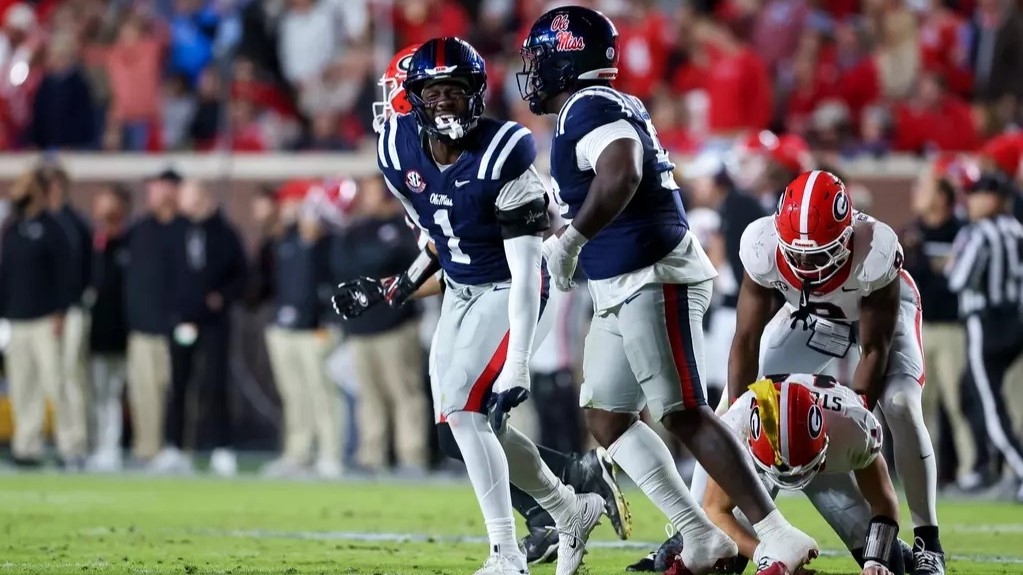
Some losses require a deep dive to understand what happened.
Saturday night’s 42-7 defeat to Georgia isn’t one of them.
From the opening play, the Bulldogs controlled the line of scrimmage, won the explosive-play battle and never allowed Ole Miss to find any sort of rhythm.

The final score tells part of the story, but a handful of numbers explain just how lopsided the game really was.
Here are five stats that show why Georgia’s win over the Rebels was every bit as dominant as it looked.
295
That’s how many rushing yards Georgia tallied in Saturday night’s win.
The Bulldogs ran for more than four times as many yards as Ole Miss, who had 66 rushing yards. A lot of their runs went for positive gains with only 13 yards lost on runs.
Georgia also didn’t have to rely on a single ball carrier. Four players had six or more carries. Nate Frazier led the way with 16 carries for 110 yards and Dwight Phillips Jr. had 11 carries for 66 yards.
Fans shouldn’t be too surprised because this is the defense we saw against Florida and Texas earlier this season.
There must’ve been a feeling of “here we go again” probably crept in when Frazier had a 46-yard run on the first play from scrimmage for Georgia. The Bulldogs were so successful running the ball, throwing it wasn’t really required much.
9
That’s how many completions Georgia quarterback Gunner Stockton had on 15 pass attempts.
The Bulldogs simply didn’t need to pass much with a run game as effective as what they had. But when Stockton did throw, nearly half of his completions were touchdowns.
Talyn Taylor caught three of those touchdown passes, including scores of 58 and 65 yards.
Here’s what makes that even more remarkable: Georgia and Ole Miss finished with exactly the same number of passing yards (186). The difference? Ole Miss needed 38 attempts to get there and didn’t throw a single touchdown.
Georgia didn’t have to throw often, but when it did, the Rebels had almost no answers.
7.6
That’s how many yards per play Georgia averaged in the win. Comparatively, Ole Miss averaged only 3.7.
The Rebels actually ran more offensive plays than Georgia (69-63), but got outgained by 229 yards (481-252).
Think about that for a second. Georgia averaged more than twice as many yards per play despite running fewer plays.
And it wasn’t just one or two explosive plays inflating that average. Georgia consistently moved the football, particularly on the ground, where the Bulldogs averaged 6.1 yards per carry.
The Bulldogs also scored touchdowns on their first three possessions, gaining 229 yards on those drives alone. That’s just 23 yards shy of Ole Miss’ total offensive production for the entire game.
When an offense is averaging nearly a first down every time it snaps the football, it’s going to be a very long night for the defense. And Saturday was an especially long night for Ole Miss.
5
That’s how many sacks Ole Miss gave up to the Bulldogs.
That’s a lot of sacks for any offensive line to give up, but it stands out more when considering the Rebels had given up just six sacks all season.
Chambliss had little opportunity to sit in a clean pocket and deliver passes. Georgia blitzed Ole Miss all night, specifically running overload blitzes to one side of the formation.
And the fault isn’t exclusively with the offensive line. The Rebels’ running backs struggled with pass-blocking. Multiple times during the TV broadcast, the announcers heavily criticized the running backs’ inability to stop a Georgia blitzer.
Making it worse was that Chambliss either had no time escape the pass rush or, when he did, was closely pursued and forced to throw an incomplete pass.
Not many defenses have found a formula to contain Chambliss. The Bulldogs did.
0
That’s how many three-and-out possessions Georgia had on offense.
The Bulldogs scored touchdowns on their first three drives, gaining 229 yards on those drives alone. They consistently moved the ball throughout the game, even when drives ended in punts. But that happened only three times.
Forget about the Rebels’ struggles getting off the field on third downs this season. They rarely put Georgia in a difficult third-and-long situations.