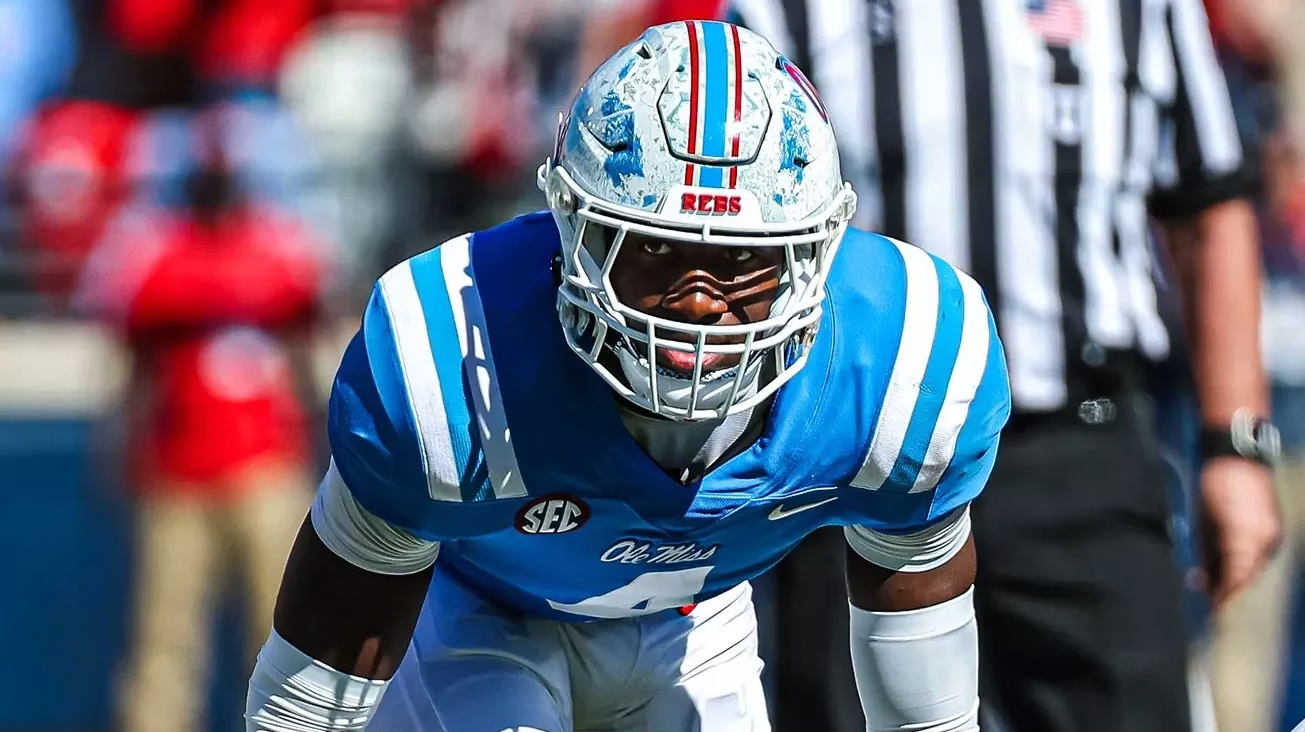
Pete Golding’s plan for Suntarine Perkins did not come with fireworks or loud announcements.
It came with something far more useful for the Rebs linebacker: patience, purpose, and a willingness to resist the urge to chase sacks at every turn.
In a season where Ole Miss pushed itself into the College Football Playoff as the No. 6 seed, the third-year defender out of Raleigh, Miss., quietly became something he had not been before — a complete linebacker.
Golding, who spent two seasons as the Rebels’ defensive coordinator before becoming head coach last week, used Perkins’ first two years to show off his speed and raw athletic ability.
Perkins could fly off the edge, overwhelm blockers, and hit quarterbacks with a burst that few players in the SEC could match.
But Golding also knew that living as a 220-pound edge rusher was not a long-term plan, especially for a player thinking about the next level.
This year, the coach leaned into a different path. He asked Perkins to broaden his game, learn more spots, cover more space, and show what he could do beyond sprinting at quarterbacks 40 times a game.
It was a long bet, but the Rebels needed it — and Perkins needed it even more.
The one knock on Perkins had always been his size. At 220 pounds, he looked more like a Will linebacker than a traditional edge player. Golding never hid that point during recruitment or development.
“I love Perkins’ energy, his attitude, his body language,” Golding said in August. “He’s a Will linebacker by stature.”
But Golding also had a plan.
“Hey, we’re going to get you on the field where we can get you on the field the fastest,” he told Perkins. “That might not be exactly what you’re playing at the next level.”
The shift would not happen overnight. But Ole Miss began rolling out packages to move Perkins around once he settled into his primary position, and this season became the first real chance to show what that meant.
Perkins’ snap count stayed same, but game changed
Perkins played 595 snaps last season, and he played 595 snaps this season. That is where the similarities end.
In 2024, when Ole Miss finished 10-3 and led the nation in sacks and tackles for loss, Perkins spent 543 of those snaps on the edge.
He rushed the passer 260 times and dropped into coverage only 113 times. His job description, in simple terms, was: go get the ball.
And he did, producing 10.5 sacks and confirming what the Rebels already knew — he could be their most disruptive weapon.
This year, the Rebs sat at 11-1 heading into the College Football Playoff, but Perkins’ role changed dramatically. His athleticism didn’t vanish, but the staff asked him to show something different.
He rushed on 158 passing downs but spent 200 snaps in coverage. That total coverage workload nearly doubled, and the results were much better than the drop in sacks suggested.
Yes, his sack total cratered to just two. But Perkins finished fourth on the team in total pressures and second in quarterback hits — not the numbers of a player disappearing, but one adjusting.
More importantly, he became one of the Rebels’ top pass defenders.
Only three Ole Miss players held quarterbacks under 50 percent completions for the season — Perkins, Wydett Williams, and Ricky Fletcher.
That is not the résumé of an edge-only player. That is the résumé of someone becoming more valuable.
Perkins gave up eight catches for just 45 yards on 17 targets. He also ranked second on the team in pass breakups behind Williams.
Golding saw exactly what he hoped to see.
“His versatility on tape to get him drafted to his highest point is still going to be there regardless of where we put him at,” Golding said. “He’s an elite player. He’s much more heavier-handed than people think he is based on his size.”
For a coach stepping into a new role, it was a good sign that one of the Rebels’ most dynamic defenders was also one of their most adaptable.
Versatile Perkins gives Ole Miss options in playoff
Ole Miss will face Tulane on December 20 at 2:30 p.m. The winner moves on to the Sugar Bowl on January 1 to play Georgia.
Whatever the Rebs become in the postseason, Perkins’ versatility shapes the defense in ways that no simple stat line will show.
Golding now has a player who can rush, cover, shift, disguise, and survive the physical demands of modern football — all at 220 pounds. And he has film to prove it.
Perkins does not need a ten-sack season to become a top NFL prospect anymore. He just needs what he showed this fall: range, instincts, and a willingness to stretch his game.
Ole Miss needed that same thing. And for once in this sport, the player’s long-term goals and the team’s short-term goals lined up perfectly.
It may not have been the flashiest plan Golding ever designed, but it worked.
Key takeaways
-
Suntarine Perkins grew into a full linebacker instead of a pure edge rusher.
-
The Rebels gained more defensive flexibility as his coverage role increased.
-
Ole Miss enters the CFP with a more versatile defensive leader.