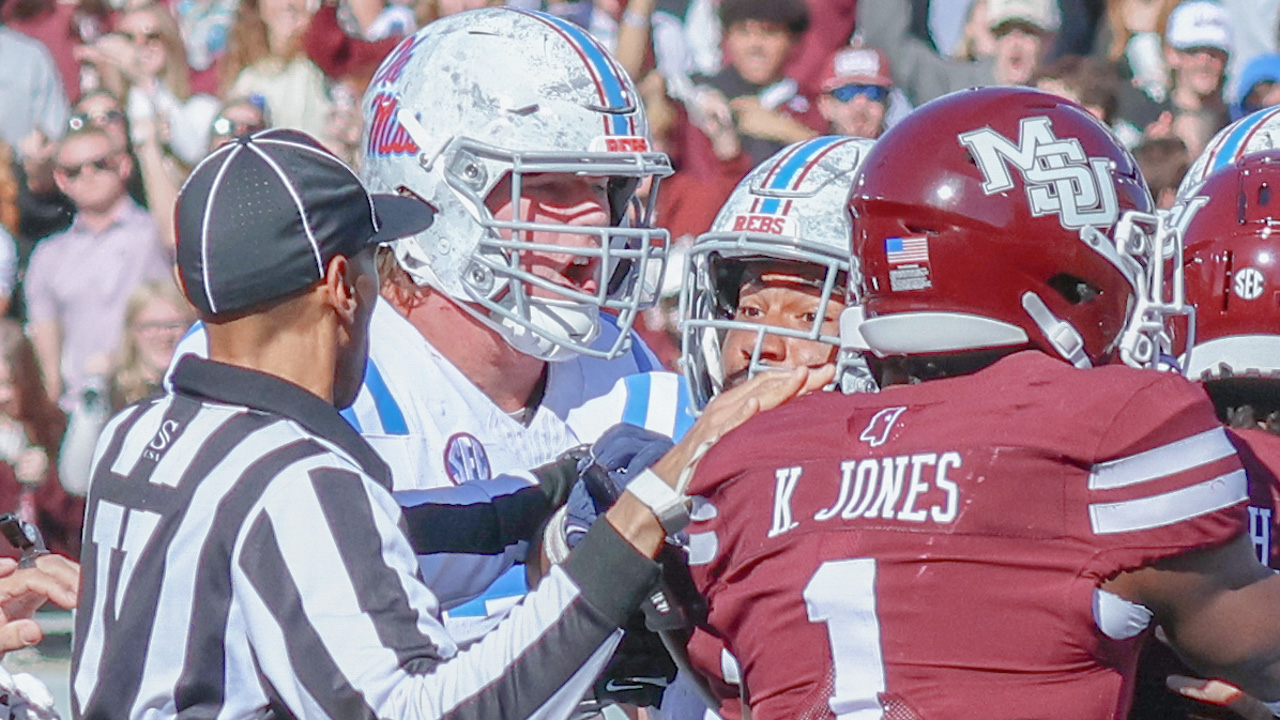
The Ole Miss offensive line didn’t change overnight.
It didn’t dominate headlines or suddenly become a talking point. Instead, it settled — slowly, quietly, and deliberately — into something functional and reliable.
That kind of progress is easy to overlook, but for the Rebels, it mattered.
Early in the season, Ole Miss was still assembling its front. Transfers were learning tendencies. Communication was ongoing.
The group hadn’t yet had the benefit of extended game reps together.
At the center of that process was Patrick Kutas, whose own road into the lineup required patience. Limited contact during fall camp slowed his start and forced the line to develop without full continuity.
As weeks passed, both Kutas and the unit around him began to stabilize.
“That’s really what it’s been for me,” Kutas said after practice Sunday. “Just getting more reps and getting comfortable again.”
Comfort, for an offensive lineman, often translates into trust — trust in technique, trust in teammates, and trust that assignments will hold.
Repetition turned into reliability
Ole Miss’ first extended look at its offensive line as a complete unit came in live action, not practice. From there, the improvement followed a steady pattern rather than a dramatic leap.
Each week brought clearer communication and fewer breakdowns. The Rebels weren’t chasing perfection. They were chasing consistency.
“I think it’s been week by week,” Kutas said. “We’re getting more comfortable with each other. We’re starting to trust each other a lot more.”
That trust showed up in measurable ways. Through the early portion of SEC play, Ole Miss ranked among the league’s best in limiting sacks. For a group still finding its rhythm, that mattered.
The improvement wasn’t about overpowering opponents. It was about keeping the offense on schedule and reducing negative plays.
Kutas’ increasing role helped anchor the interior, giving the rest of the line the freedom to play faster and with more confidence.
“Trusting myself, trusting the guys next to me — that’s been big,” he said. “Knowing the game plan is going to work.”
What the Rebels’ line looks like now
As the season progressed, the Rebels’ offensive line developed an identity rooted in steadiness rather than flash. The front five became more predictable — in a good way.
Assignments were cleaner. Protection was more reliable. The offense benefited from fewer disruptions.
Kutas’ progress didn’t go unnoticed. He earned SEC Co-Offensive Lineman of the Week honors, recognition that reflected both individual growth and collective improvement.
Still, his focus stayed narrow.
“I recognize it, but then I move forward,” Kutas said. “It’s cool, but it doesn’t really change how I look at myself.”
That mindset mirrored the line’s approach. Ole Miss didn’t linger on progress. It treated improvement as something to build upon, not something to celebrate.
For the Rebs, the offensive line’s development provided clarity. Roles became defined. Communication became instinctive.
And while no offensive line is ever finished, Ole Miss now looks far more settled than it did early in the year — a unit shaped by patience, repetition, and one lineman finding his footing.
Key takeaways
Patrick Kutas’ increased comfort helped Ole Miss stabilize the offensive line through improved trust and communication.
The Rebels limited sacks early in SEC play, reflecting steadier protection across the front five.
Ole Miss’ offensive line identity formed gradually, built on reps and cohesion rather than sudden breakthroughs.