

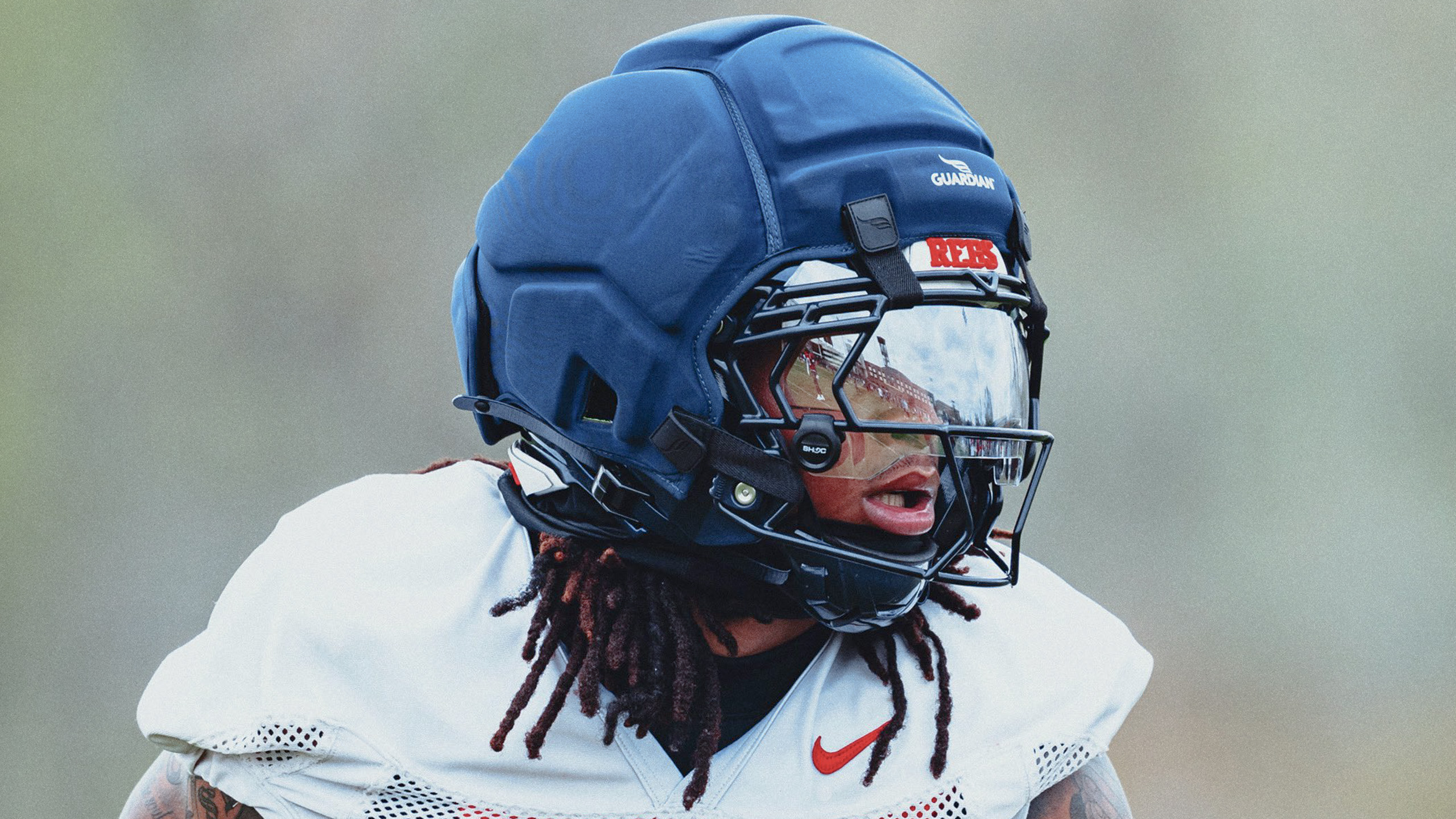
If there was one theme Pete Golding kept circling back to in his interview, it was depth. Not talent. Not scheme. Depth. Real rotational depth. The kind that holds up in November and doesn’t crack in a 15‑ or 16‑game season. And Golding sounds like a coach who believes he has it.
“I’m really excited about the depth,” Golding said. “We have a lot of guys who can play winning football.”
That’s not a throwaway line. That’s a head coach telling you the roster looks different.
Linebacker: The strongest group on the roster
Golding didn’t hesitate when asked about the linebackers.
“I feel like this is probably the best linebacker group as a core,” he said. “You’ve got three guys who have played here who are SEC starters and can be rotational pieces.”
The Rebels return Suntarine Perkins, who was second on last year’s team in tackles, but also brought in transfers Keaton Thomas (Baylor), Luke Ferrelli (Cal/Clemson), Tony Mitchell (Mississippi State) and Tah’j Butler (Georgia Tech). Combined those five players recorded 336 tackles last season.
That’s the kind of luxury Ole Miss hasn’t had in years. Instead of scrambling to find reliable starters, Golding has four players with significant playing experience who can rotate without a drop-off. In a league built on physicality, that matters.
Perkins, Thomas and Ferrelli are, on paper, the most likely starters at the three main linebacker positions. Thomas actually earned some recognition recently when he was named one of the top 10 most impactful transfers by On3’s Chris Low this week.
“He’s probably the best all-around linebacker that I’ve coached in the SEC over nine years, and that’s including all the Bama guys. As far as being the total package, I think he’s going to have an elite year,” Golding told On3.
Low added, “At 6-1 and 240 pounds, Thomas plays fast and physical and will be a main cog in a defense Golding thinks will be the most talented he’s had at Ole Miss.”
Why depth matters now more than ever
Golding kept coming back to the same idea: the season is too long to survive without depth.
“Once you start playing 15‑ or 16‑game schedules, you’ve got to have a good foundation from a strength standpoint and a stability standpoint to maintain throughout the season,” he said.
That’s the reality of modern college football. You can’t lean on 22 starters anymore. You need 40 players who can contribute. You need rotation. You need accountability. You need a roster that doesn’t fall apart when the calendar flips to November.
For the Rebels’ linebackers, even if Perkins, Thomas and Ferrelli are the starters, Mitchell, Butler, junior college transfer Raymond Collins, Mark Trigg Jr. or one of the five freshmen will be called on to play meaningful snaps.
Golding and Ole Miss feel good about those plays, too.
Can depth close the gap?
That’s the real question. Ole Miss has made the playoff. Ole Miss has won big games. But the gap between making the playoff and winning it usually comes down to depth. Georgia has it. Alabama has it. Ohio State has it. Last year, Ole Miss didn’t.
This year, Golding thinks they do.
“We have a lot of guys who can play winning football,” he said.
Ole Miss doesn’t need to be perfect. It needs to be deep.
The linebacker unit is just an example. The defensive line and secondary also had reinforcements brought in to extend their depth too.
Golding wanted this team to deep. It’s starting look like that’s the Rebels have built.