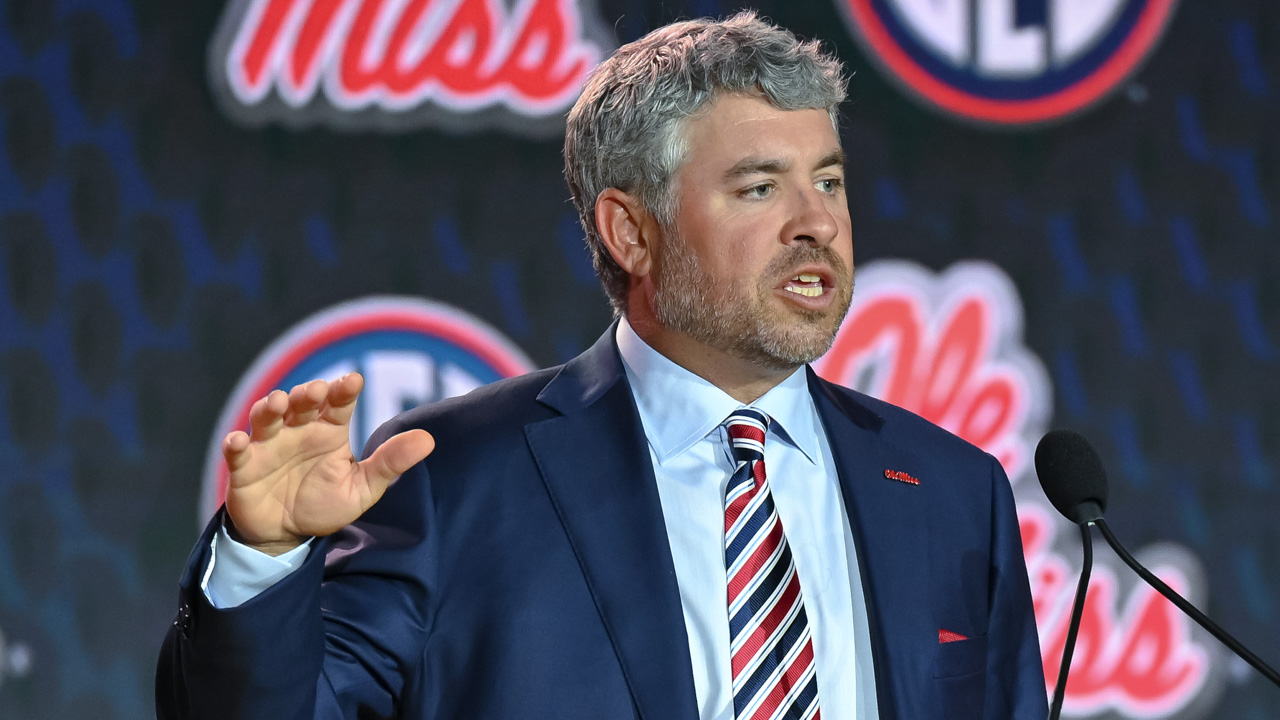
SEC Media Days always bring some memorable moments. Ole Miss coach Pete Golding just delivered the most memorable one of this year’s microphone marathon.
Certain topics were expected to be asked about because they’re the same ones Golding has been answering since November.
Lane Kiffin. Transitioning from defensive coordinator to head coach. Kiffin. How good quarterback Trinidad Chambliss and Kewan Lacy are. Kiffin. Tampering. And, of course, Kiffin.
On Wednesday when Golding took to the main stage for the first time, it wasn’t the former Ole Miss coach who drew the most memorable moment. It was the questions about tampering in college football, specifically Clemson’s accusations and the ongoing NCAA investigation.
The first time Golding was asked about tampering, he gave the “politically correct” answer he probably worked on with the athletics’ communications department.
“I don’t get into feelings, to be honest with you. We have a compliance department. They get paid to do their job, and they do a really good job. It’s our responsibility to recruit really good players, coach them extremely hard and get them ready to win football games,” Golding said. “We’re going to continue recruiting really good players, both in the high school market and the portal market, and we’ll continue doing it the way we’ve done it.”
That’s a coach speak-like answer. He doesn’t say much and certainly nothing headline worthy. He gave a much different answer when he was asked about tampering again. Specifically, he was asked how he’d fix tampering.
Golding’s answer said the part everyone knows about, but doesn’t want to talk about it.
“We operate within the rules of the program,” Golding said. “But when you’re on the interstate and people are flying by you, what do you start doing? You’re going to speed up, or you’re going to get hit.
“In this profession, you’re going to get fired.”
That’s it. That’s the end game.
Coaches keep their jobs if they’re winning. To win, you have to recruit the best players at both the high school and college level. To recruit the best players, especially in the transfer portal, you have to start when everyone else does.
If everyone starts recruiting college players when they enter the transfer portal, all it takes is one coach to start before then to get an advantage. Then everyone starts early until one coach starts even earlier and it snowballs from there.
The coaches not keeping pace aren’t going to be employed very long.
Golding’s entire answer to being asked how to fix tampering was insightful and did have some emotions to it. It’s probably what he’s been wanting to say for months and it finally spilled out.
But anyone remotely aware of the current state of college sports knows tampering is a thing. How else would anyone be able to explain why a player would enter the transfer portal with a “do not contact” tag?
“You’re a reporter. Would you quit your job before interviewing for another job or being offered another job? No. Nobody would,” he said. “But we have a portal that you can enter with a ‘do not contact’ designation. You’re essentially saying, ‘I’m going to quit my job where I’m getting paid, enter the portal because I need a new job and tell everybody that nobody can call me for an interview.’
“What have we created?”
A messy situation is what’s been created. When a player enters the portal with a “do not contact” tag, it’s been assumed, rightfully and wrongly, the player already knows where they’re headed.
But how would a player already know where he’s going before entering the portal. That’s where agents and player representatives comes into play.
“On top of that, we’ve created representation for these players. It’s the representatives’ responsibility to make sure the players get paid well and have opportunities,” Golding said. “By design, it has put a lot of people in bad positions.”
Let’s act like this is anything new. Tampering has been a problem in every professional sports league. Free agents signing multi-year, record-setting deals one minute into the start of free agency is a giant red flag that player and team were talking before it was allowed.
Now it’s part of college sports and is something fans are still coming to terms with. But, like Golding said, recruiting in college football isn’t some beacon of moral goodness.
“Let’s also not act like recruiting in college football over the last 100 years has been the most moral thing that has ever existed,” Golding said before adding later, “But the model is obviously broken.”
Frankly, as has been pointed out in the space before, athletic directors have been essentially tampering with other schools’ coaches for decades. Golding said that part out loud, too.
“I think this exists in any job. Coaches are under contract. Do you think other athletic directors aren’t calling us during the year? Some of the same ones who are complaining about all this stuff are the ones calling coaches to come to other schools. It’s everywhere. It’s in every profession.”
Golding didn’t solve tampering on Wednesday. He didn’t pretend he could. What he did was acknowledge the world everyone in college football already operates in.
The portal, the agents, the “do not contact” tags, the back‑channel conversations, the job‑security pressure. It’s all part of the deal now. And instead of giving the polished answer, Golding said what everyone else tiptoes around.
The model is broken, and everyone knows it.