Four games into a season isn’t a large enough sample size to know exactly what a team is and isn’t. But it’s close enough that trends can emerge that alter our perception of what a team was going to be.
It’s why we have been writing so much about the Ole Miss defense and how it hasn’t lived up to the expectations most of us had before the season.
But what about the offense? Is it where we expected it to be?
Yes and no.
The offense is good, despite some slow starts and midgame disappearances. But it’s not what we expected at the start of the season.
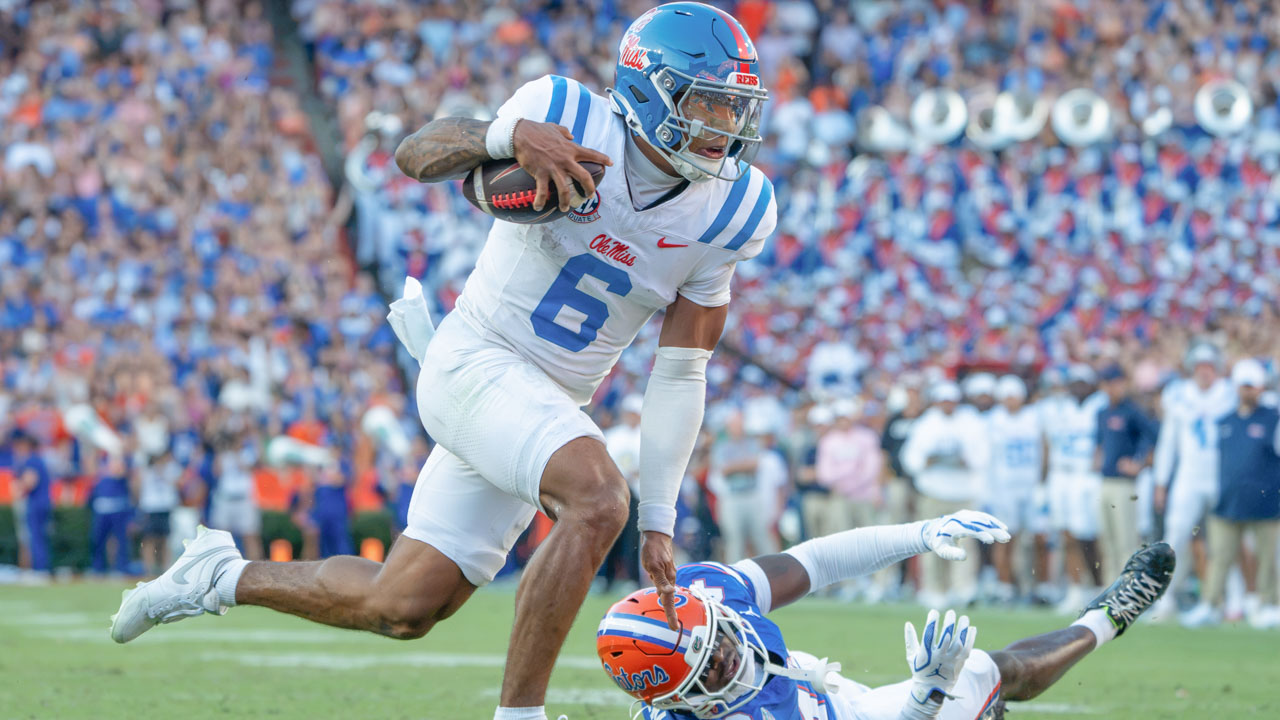
Ole Miss was expected to lean more on the rushing attack than passing. Three returning starters on the offensive line, an All-American running back, a quarterback with legs and a pair of running back transfers all pointed towards the Rebels having a potent rushing attack.
That hasn’t been the case. Instead it’s the passing attack driving the offense.
Ole Miss is No. 1 in the SEC and No. 10 nationally in passing at 322.5 yards per game, but only 14th in the SEC and 119th nationally in rushing at 117.5. Last year’s team averaged 313.3 passing and 176.3 rushing.
That’s a dramatic shift in offensive identity. So, why has it happened?
Let’s take a closer look.
A new offensive coordinator
Let’s start with the obvious possibility. Charlie Weis Jr. followed Lane Kiffin to LSU and Ole Miss coach Pete Golding brought in John David Baker to run the offense.
Much of the talk in the preseason was how the offense would look similar to last year’s and in some ways it has. Chambliss and Baker talked about what worked best and kept that part of the offense.
Baker’s system also has more formations with two tight ends, but still has one of the fastest paces in the country. If anything, you would expect the offense to lean even more on the run. But there are a lot of variables that go into play-calling, so the new offensive identity can’t be solely attributed to having a new offensive coordinator.
Kewan Lacy hasn’t been Kewan Lacy
The second most easily identifiable possibility is that Lacy hasn’t played as well as he did a year ago. After all, he did have one of the best single-season performances in Ole Miss history.
However, Lacy has been Lacy when he’s been on the field. Last season he averaged 5.1 yards per carry. This season, on 39 carries, he’s averaging 4.9. No, what’s keeping Lacy from being Lacy is injuries.
He missed most of the second half of the season-opening game against Louisville with an upper leg injury. He came back to face Charlotte and LSU, but suffered another injury late in the game. That forced him to miss last Saturday’s fiasco in Gainesville.
If Lacy had been healthy all season, especially late against LSU and against Florida, the Rebels are probably handing the ball off instead of letting Chambliss toss it.
Defenses are stacking the box
Watching the Rebels against LSU and Florida, one thing was clear: they didn’t want to get beat by the Rebels’ run game.
Defenses weren’t exactly stacking the box every time. That’s too risky with a receiver like Deuce Alexander that’s capable of beating every 1-on-1 matchup.
But you see plenty of bodies along the line of scrimmage and linebackers shooting inside gaps and aggressively flowing with the play.
If Ole Miss is running the ball well, it puts the defense in a very bad spot.
Send more defenders to stop the run and watch Alexander score another 62-yard touchdown.
Keep four defensive backs in coverage and you’re relying on the front seven alone to get the job done.
Sometimes that’s been enough (i.e., Florida). Other times it hasn’t and you end up with game like the opener against Louisville with Chambliss throwing long touchdown passes.
So, is this the new Ole Miss identity?
Probably not. Running the ball is such an important part of winning football games, Ole Miss can’t become too reliant on its passing attack. So, expect to see it continue to find ways to get the ground game going.
Getting Lacy back after three weeks of rest and recovery should help.
The offensive line has been healthier than it was a year ago. The staff has a bye week to recalibrate.
And the schedule ahead is full of teams that will challenge Ole Miss in ways that make balance more of a necessity than an option.
The passing game has carried the load so far, and that’s fine.
It’s kept Ole Miss in games and won a couple outright.
But if the Rebels want to look like the team they thought they would be, the run game has to come with them. It doesn’t need to be dominant. It just needs to be present.