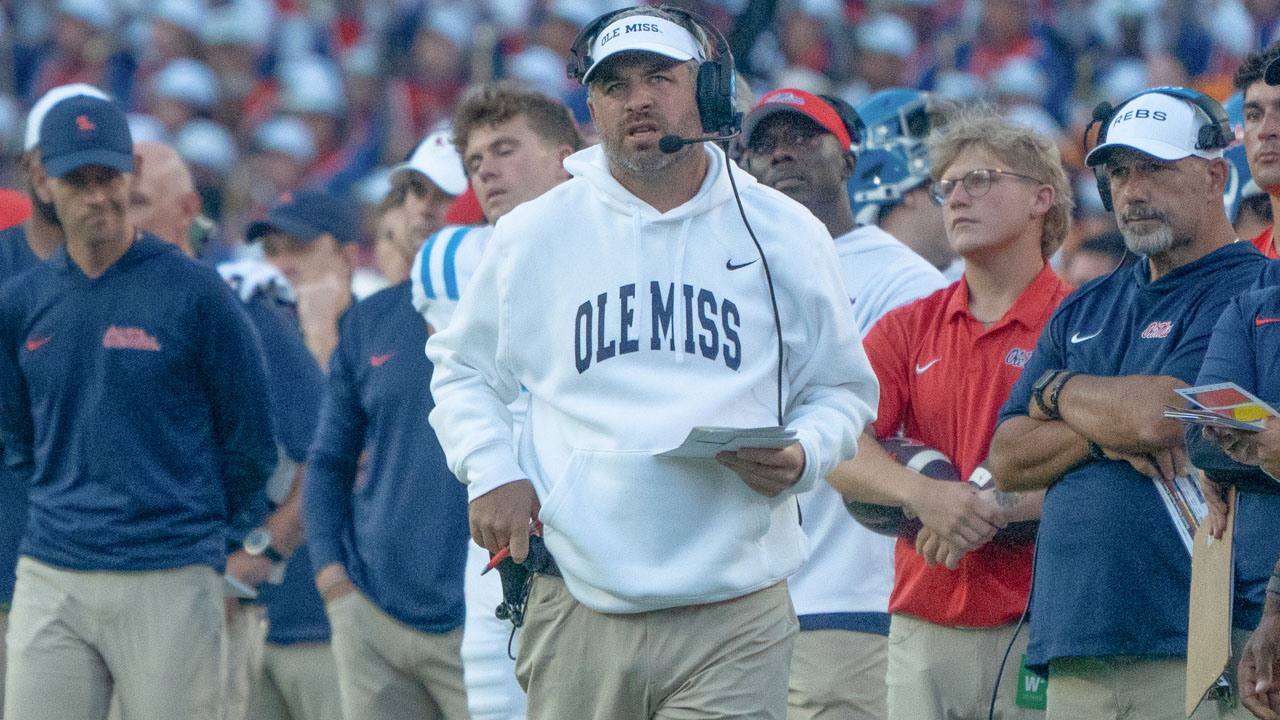
Pete Golding has plenty of people he can meet with during Ole Miss’ bye week to figure out what went wrong at Florida.
One of the most important conversations, however, might have to be with himself.
That comes with the territory when the head coach is also the defensive play caller of a game that’s best described as a defensive fiasco.
Ole Miss’ defensive collapse in Gainesville wasn’t merely a bad afternoon for one side of the ball. It was the first real stress test of the coaching structure Golding deliberately created when he took over the program.
Golding knew becoming a head coach would bring responsibilities that had little to do with calling defenses. There would be recruiting, roster management, game management and countless other decisions demanding his attention.
He still wanted to call the defense.
So Ole Miss built a staff designed to allow Golding to remain heavily involved in the part of football that made him a head coach in the first place. That was one of the reasons he hired Delta State head coach Todd Cooley as the assistant to the head coach, among others.
“That was part of the staff build. The Tom Lukes, Todd Cooleys and Austin Thomases of the world are there for that,” Golding said during SEC Media Days in July. “They handle all that crap and keep it off my desk so we can focus on recruiting really good players and coaching good football.”
Cooley was specifically brought in on the coaching side (Thomas is the General Manager, Luke is the Associated A.D. for Player Development) to allow Golding to continue to focus on the defense.
“From a practice-structure and management standpoint, I can still call the defense and have a guy who can run an effective practice in terms of periods and everything else,” Golding said during one of his preseason press conferences about Cooley. “He has done an awesome job. It has taken a lot off me and allowed me to focus back on the defense.”
There hadn’t been much reason to question that arrangement before Florida.
Ole Miss opened the season 3-0 and Golding had already handled the emotional weight of beating LSU, his former boss Lane Kiffin and one of the most anticipated games in recent program history.
Then came Gainesville.
Florida rushed for 302 yards and scored 52 points. Ole Miss didn’t record a sack or force a turnover and managed only one tackle for loss. The Rebels also missed 14 tackles.
Golding acknowledged afterward that some of his attempts to manufacture stops actually contributed to the problem.
When the Rebels couldn’t create negative plays naturally, they became more aggressive. Those all-or-nothing calls sometimes became explosive plays for Florida.
“In some of those games, when you lose leverage or miss tackles, you probably start getting into some calls that you shouldn’t,” Golding said in his postgame press conference. “It becomes feast or famine on some of those things. A couple of times, I probably put our guys in an all-or-nothing position that became explosives because I was trying to get back into this thing and get a stop.”
That’s a problem for the defensive play caller.
But while Golding was trying to solve that problem, Pete Golding the head coach still had an entire football team to manage.
That’s what makes this bye week more interesting than simply figuring out better run fits or deciding whether different players need more snaps.
Golding has to evaluate the person making those defensive decisions, too.
Most head coaches can walk into a coordinator’s office after a performance like Florida and ask why certain calls were made, whether the scheme became too aggressive or whether personnel should have been handled differently.
Golding can ask those questions.
He just has to answer them, too.
That doesn’t mean one ugly defensive performance should lead to Golding surrendering play-calling duties.
Golding should own what happened at Florida. Ole Miss should fix it. But four games into a system he intentionally designed, one defensive disaster is not a reason to tear the system apart.
Florida didn’t prove Golding can’t do both jobs.
It simply provided the first real evidence of how difficult doing both can become.
There will be more moments this season when the defense can’t get off the field. There will be injuries, fourth-down decisions, offensive problems and clock-management situations happening while Golding is also trying to figure out how to stop the opposing offense.
Those moments will ultimately determine whether the structure works.
Golding built Ole Miss believing there was room for Pete Golding the head coach and Pete Golding the defensive play caller.
Florida didn’t prove otherwise.
But during this bye week, Golding has to begin figuring out exactly where one job ends and the other begins.