

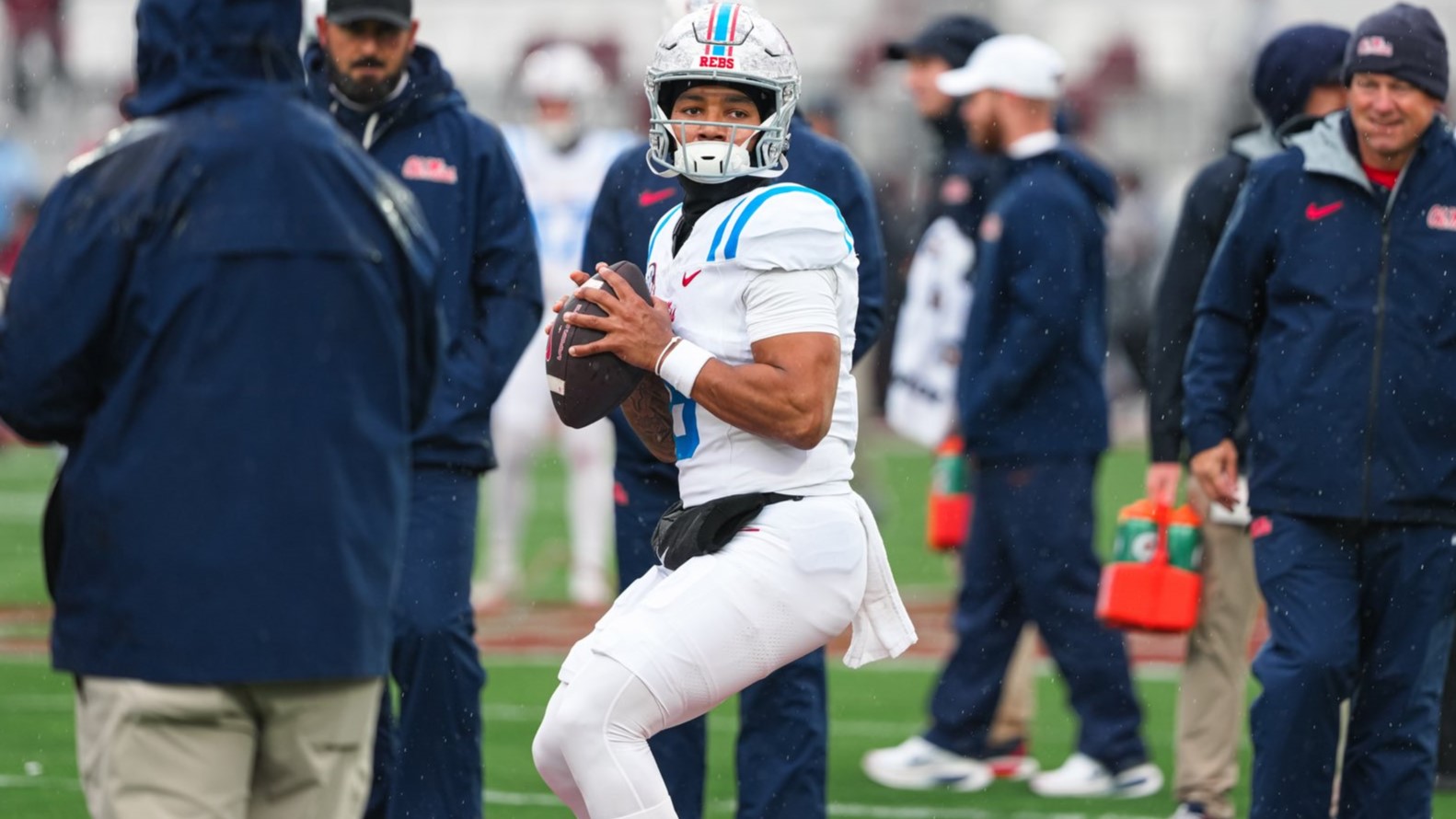
Every issue that has plagued Ole Miss this season was on display Sunday in Norman, Okla.
The defense couldn’t stop the run or get off the field on its own. The Rebels trailed 14-0 in less than 15 minutes. The offense’s running game, outside of a few promising moments, was largely dependent on Trinidad Chambliss scrambling. Ill-timed penalties. Another running back going down with an injury. Opposing receivers running open downfield.
The Rebels showed all of that and more on a cold, rainy day against Oklahoma that saw their hopes of a College Football Playoff berth vanish in a 24-17 loss.
From the beginning, even when Ole Miss cut its deficit to only one possession or recovered a second onside kick this season, it felt like the Sooners would get the win.
The Rebels continued their opening drive struggles this season with another three-and-out. Oklahoma turned around and marched 75 yards downfield in 13 plays and almost eight minutes.
On its next possession, Ole Miss stayed on the field for four plays before punting away to Isaiah Sategna III who returned it 75 yards for a touchdown.
Just like that, the Rebels trailed 14-0.
Sure, they had some good moments. The Rebels eventually found some success running the ball with Shekai Mills-Knight and made it 14-7 early in the second quarter.
But even that success was marred by an injury to Mills-Knight, who left the game just before Joshua Dye’s 19-yard touchdown run and never returned.
Mills-Knight was headed toward a coronation of sorts. He was the most productive Rebel in the first half, averaging five yards per carry, and looked like someone ready to make a serious claim to the starting running back job next season.
Maybe he still will. But his absence, combined with Kewan Lacy and Makhi Frazier already being sidelined, left the Rebels painfully short-handed in the backfield.
Of course, even if Mills-Knight stayed in the game, he wouldn’t have helped the defense much.
With every passing week, Ole Miss’ dominant defensive performance against Missouri looks more like the exception than the rule. Oklahoma ran the ball 49 times for 188 yards and averaged 3.8 yards per play. Quarterback John Mateer led the way with 70 yards and a touchdown.
That’s not the dominant rushing performance we’ve seen opponents have against the Rebels. But it was good enough for the Sooners to sustain drives and keep Ole Miss’ defense on the field.
At some point, these problems stop being isolated mistakes and start becoming the identity of a football team.
Ole Miss has had plenty of opportunities to prove its losses to Florida, Texas and Georgia were simply bad days. Instead, Sunday was another example of a team that hasn’t been able to put everything together when it matters most.
And now, with its College Football Playoff hopes gone, Ole Miss has little left to play for beyond pride and whatever momentum it can carry into next season.