

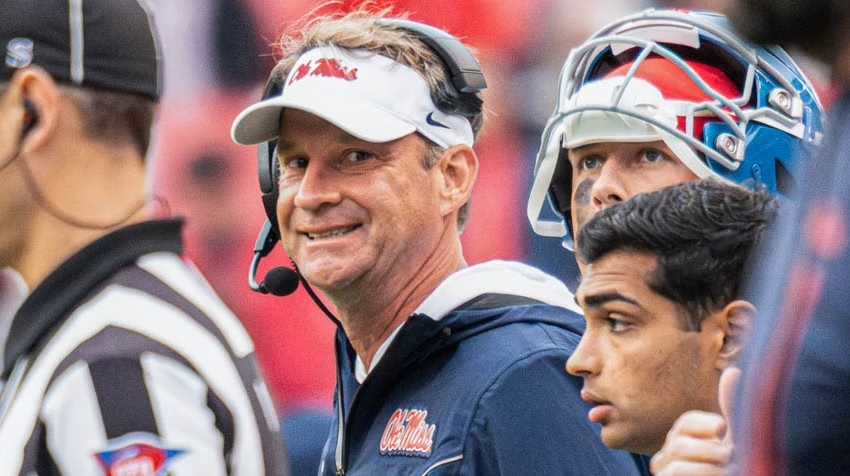
OXFORD, Miss. — Lane Kiffin wasn’t dealing with rumors or off-field speculation Wednesday when he closed out the SEC’s weekly teleconference.
The Ole Miss head coach instead focused on finishing games, Oklahoma’s elite defense, and how the College Football Playoff selection process should evolve.
The No. 8 Rebels (6-1, 3-1 SEC) face No. 13 Oklahoma (6-1, 2-1) Saturday at 11 a.m. CT on ABC in a matchup that will shape the November playoff race.
Kiffin’s tone was direct, straight-forward, and layered with respect for an opponent that leads the nation in total defense.
Emphasis on finishing games
Kiffin opened his remarks by praising the Rebels’ work during the week while pointing to what’s next.
“Good week of practice so far. Extremely challenging game,” he said. “Obviously one of the harder places to play in the country and then adding to that what I think, really, in our six years, is the hardest defense we’ve played.”
That comment quickly pivoted into accountability. In dissecting the loss at Georgia, Kiffin said the issue wasn’t talent or schemes — it was closing time.
“You’ve got to finish games off,” he said. “We’re up by two scores late in the third, actually have them stopped on fourth-and-1, and the guy keeps moving his feet and we don’t finish the tackle.
“We’re going to have the ball up nine points in their territory going into the fourth quarter. You’ve got to finish things.”
Kiffin noted the same flaw surfaced earlier in the season.
“We’ve said earlier in the year we couldn’t finish games like we liked,” he said. “Up two scores in a number of games, ended up being one-score games because we didn’t finish them. Said when we played better teams, it’s going to get us, and it got us.”
Comparing defensive masterminds
When asked to compare Georgia’s Kirby Smart and Oklahoma’s Brent Venables, Kiffin didn’t hesitate.
“They couldn’t be any more different,” he said. “They’re both awesome at what they do and get players that fit their schemes, but they’re completely different.”
He described Venables as a coach who “runs every defense ever invented,” while Smart prefers to “be really good at what they do.”
Both, Kiffin added, prepare their players with precision.
“They do a great job of overall, everything,” he said. “Playing plays. The signal thing, that’s a compliment. That’s part of your job — to ready your players all week for the plays that come and then try to figure out on game day what they are.”
Oklahoma’s aggressive style has yielded the nation’s No. 1 defense, giving up only 213 yards per game.
Venables’ group ranks near the top nationally in sacks, tackles for loss and third-down defense. Kiffin called it “the most disruptive” defense Ole Miss has faced since he arrived in 2020.
The playoff analytics argument
The conversation turned analytical when Kiffin was asked about the potential for five SEC teams to make the expanded 12-team College Football Playoff. He said selection should hinge on data, not conference quotas.
“They really need to be much more based off of analytics because there’s not enough non-conference games in the system we have to show,” he said.
He pointed to how baseball and basketball handle their postseason metrics.
“Records are just part of the system,” he said. “You can’t at all start thinking it’s this many from this conference, this many from that conference.
“If you want to get the best 12, you’ve got to take the résumé, everything — look at how they played, where they played — and pick the best 12.”
Kiffin has voiced similar frustrations before. Last December, he argued the playoff committee overlooked deserving teams, saying the field didn’t reflect the 12 best.
He said again Wednesday that college football remains “the only one still doing that” and said last year’s playoff lacked several top programs.
When asked if he expects those analytics to factor more heavily this season, Kiffin said, “I don’t know. They’ve said they’re going to, but we’ll see.”
Vegas as the benchmark
Kiffin expanded on his philosophy of using Vegas odds as a true measurement of team strength.
“What would Vegas do? They’re the best at what they do,” he said. “Way better than any committee, way better than anybody could.”
He said committee members should imagine betting their own money.
“If you had to bet your kids’ college funds, who would you bet on?,” ha asked. “On a money line without the points? That should tell you who the better team is.”
That’s Kiffin’s practical approach that often gets overlooked. He can blend football knowledge with data and probability.
He has long argued that Vegas models are more predictive than committee rankings, a stance he’s repeated since his early years at Ole Miss.
Quarterbacks and Oklahoma’s challenge
The coach also discussed his quarterback, Trinidad Chambliss, who threw efficiently in last week’s win.
“He needs to continue to protect the ball like he did last week,” Kiffin said. “Continue to work on accuracy with the throws and play like he did the first three quarters last week on the road.”
He praised Oklahoma’s John Mateer, who recently returned from injury.
“Their quarterback is really elite, getting healthy. Amazing that he even came back as fast as he did. Does a great job throwing and running.”
Kiffin’s respect for Oklahoma’s structure underscored what’s at stake — a road test against a disciplined defense in front of a hostile crowd.
The outcome could significantly influence playoff discussions, even if Kiffin isn’t focused on it.
“I’m not even thinking about that,” he said. “You ask me a question, I’m going to answer it. It’s not because I’m thinking about it.”
The SEC’s evolving landscape
Beyond Saturday’s game, Kiffin addressed how the league’s depth and the arrival of Oklahoma and Texas have changed the equation.
“It’s harder now to build your résumé,” he said earlier this season. “When everyone’s good, there aren’t breaks in the schedule.”
That reality, combined with expanded playoff stakes, has made finishing games — the theme he returned to several times — more crucial than ever.