

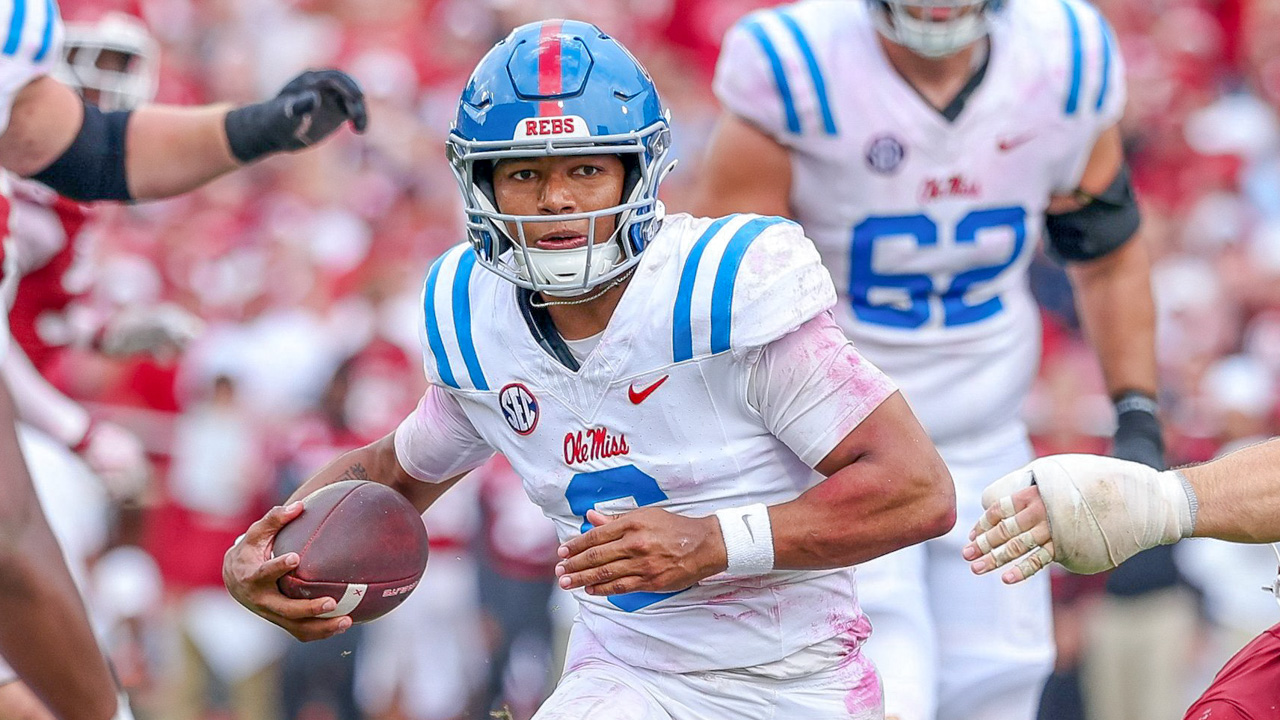
That may be the Rebels’ biggest advantage as Ben Garrett pointed out in a story at On3’s OMSpirit.com.
A Calhoun County judge, Robert Whitwell, is scheduled to hear Chambliss’ request for a preliminary injunction Feb. 12 in Pittsboro, Miss. That’s about 35 miles from the Ole Miss campus.
If granted, the injunction would prevent the NCAA from enforcing its eligibility ruling and allow Chambliss to play during the 2026 season while the case works its way through the courts.
That single ruling could decide Ole Miss’ quarterback situation long before any final verdict.
The NCAA already denied Chambliss a sixth year of eligibility the day after Ole Miss’ Fiesta Bowl loss to Miami and formally rejected his appeal Wednesday, closing every remaining NCAA path.
“Now that the NCAA has denied the appeal of the waiver, there are no more NCAA avenues for them to take,” On3 national college football analyst Andy Staples said.
So Ole Miss took a different road — and chose the destination carefully.
Attorneys for Chambliss filed suit Jan. 16 in Lafayette County Chancery Court, then secured a preliminary injunction hearing in neighboring Calhoun County. Staples said the venue choice was intentional, designed to maximize the chances of a favorable ruling.
That’s no surprise at all. Just about any legal matter both sides want to have the home field advantage.
Voters in Calhoun and Lafayette County overwhelmingly favor Ole Miss.
And the judge’s background only reinforces that point.
Whitwell is a former partner at Farese, Farese & Farese. He holds degrees from Delta State and Ole Miss Law. Even his résumé reads like it was pulled from a Grove tailgate.
Why Whitwell’s Decision Matters More Than Lawsuit
The lawsuit itself isn’t expected to move quickly. That delay is the strategy.
Staples said the case could stretch long enough for Chambliss to play the entire 2026 season if an injunction is granted, regardless of how the case eventually ends.
“They’ve got a hearing next week and what they want is an injunction,” Staples said. “What the injunction would do is it would keep the NCAA from enforcing its own rules and allow Trinidad Chambliss to play while this is all pending.”
Pending is the key word.
“For Trinidad Chambliss’ purposes, it doesn’t matter if he ultimately wins the case,” Staples said. “If he gets the injunction, he gets to play this season. That’s the whole point of this.”
The NCAA is represented by attorney Doug Minor of Holland & Knight in Atlanta. The suit alleges the NCAA committed a bad-faith breach of contract with Ole Miss, with Chambliss listed as a third-party beneficiary.
But none of that matters if Whitwell says no.
If the injunction is denied, Chambliss would likely begin preparing for the NFL. Ole Miss would then turn its attention fully to Auburn transfer Deuce Knight.
That option exists, but it comes with uncertainty.
“As great as Deuce Knight looked in that one start against Mercer, you’ve got a lot more film on Trinidad Chambliss right now,” On3 analyst JD PicKell said.
Chambliss gives the Rebels certainty. He threw for 3,937 yards and 22 touchdowns last season, finished eighth in Heisman Trophy voting, and led Ole Miss to a program-record 13 wins.
He also ranks third in school history in single-season total offense with 4,464 yards. Ole Miss has already re-signed Chambliss for next season, with sources indicating his deal exceeds $5 million.
Ole Miss won a record 13 games last season, including two in the College Football Playoff under new head coach Pete Golding.
None of that guarantees Whitwell’s ruling.
But when a case lands just south of Oxford, before a judge whose résumé mirrors the fan base, Ole Miss has already gained something the NCAA can’t regulate.