

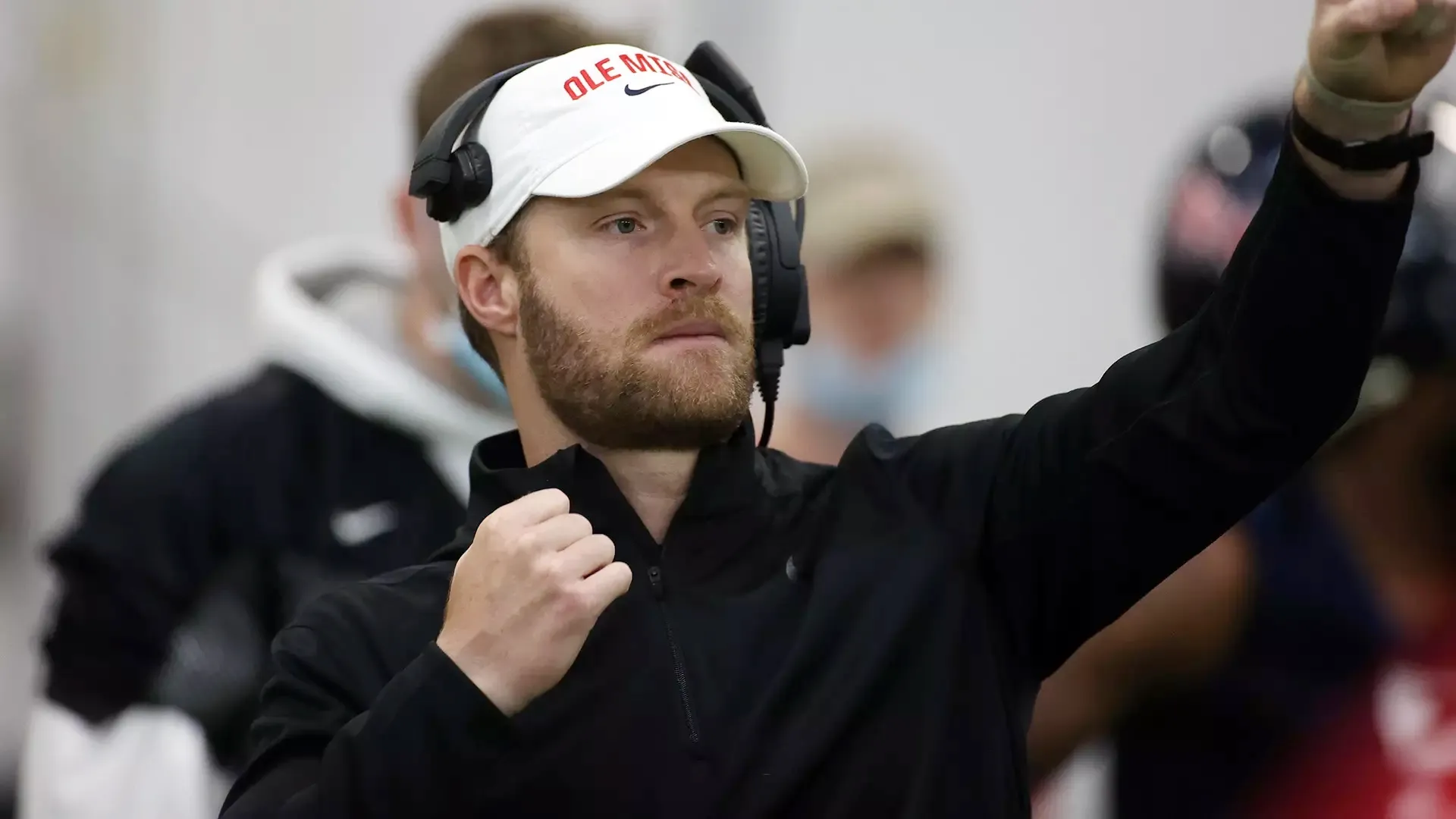
The questions were always going to come.
When Ole Miss made the move to bring back John David Baker as offensive coordinator, fans and analysts alike started wondering what the Rebels’ attack would look like in 2026.
Would it be faster? More balanced? Would there be a heavy dose of pass-first sets or would the ground game take center stage?
The short answer is probably yes to at least most of those things. The longer answer is more interesting.
Baker himself has been pretty straightforward about it.
The offense isn’t getting flipped upside down. It’s being refined, sharpened and built on what’s already been working in Oxford.
“I would say 80% of it is exactly the same that it’s been,” Baker said in the spring.
What does that mean for Ole Miss heading into the season?
They don’t want defenses to be able just throw out last year’s film and feel confident they’ve got the Rebs figured out. That other 20% is where things get interesting.
Tempo Is Still the Foundation
One of the first things Baker talked about when he arrived was tempo. That’s no surprise because it’s been a trademark of this offense for years.
The way Baker talks about it now sounds different than the way coaches used to talk about going fast just to keep opponents off balance.
“Tempo will always be the basis of what we do,” Baker said. But he’s also quick to point out that going fast isn’t always the move. “The other thing I learned the most is picking your poison — knowing when it’s time to go fast, when it’s time not to, when to slow it down and what you’re trying to accomplish with the tempo.”
That’s a mature offensive philosophy.
It’s not just hitting the gas and hoping for the best. Baker treats tempo like a weapon you choose to pull out at the right time, not one you wave around every play.
What’s also shifted is the reason behind the pace.
In the early days of this system at Ole Miss, tempo was used to level the playing field when the talent gap between the Rebels and opponents was narrower. That’s not the case anymore.
“Now we feel like it’s gotten to the point where the talent level that we have in the room, now it’s an advantage for us,” Baker said. “We’ve got to use it the right way. We’ve got to pick our spots with it. But that will always be the core of this offense.”
That’s a telling quote.
It suggests the Rebs aren’t just playing fast because they can but because the roster can actually handle the demands it puts on players.
A Proven Résumé Backs Up the Hype
Baker didn’t walk into Oxford on reputation alone. His offense at East Carolina ran a lot of plays, too.
The Pirates ran 940 plays in the 2026 regular season — that’s 78.3 per game — and ranked 14th nationally in total offense. Ole Miss, by comparison, ran 898 plays at 74.8 per game last season.
At ECU, Baker’s passing attack ranked 16th in the country. Quarterback Katin Houser threw for 3,300 yards and 19 touchdowns.
The running game wasn’t bad either, checking in at 35th nationally. That kind of balance is exactly what Ole Miss needs to maintain as defenses become more familiar with the system.
For context on where Baker’s been his first run at Ole Miss in 2021 as passing game coordinator saw the Rebels lead the SEC in total offense at 492.5 yards per game.
Quarterback Matt Corral was building Heisman Trophy buzz before an ankle injury ended his shot at the award.
In 2022, the offense set a program record with 3,336 rushing yards behind Quinshon Judkins (1,567 yards, 16 touchdowns) and Zach Evans (936 yards, nine TDs).
This isn’t a guy guessing his way through an offense. Baker has helped run some of the most productive attacks in Ole Miss history.
Learning by Fire Made Him Better
Baker’s two seasons at East Carolina did more than pad his résumé. They genuinely changed how he operates as a play-caller.
Working under a defensive head coach meant Baker had to figure a lot of things out on his own. There wasn’t a veteran offensive coordinator down the hall to bail him out when something wasn’t working.
“ECU was my first time in my career working for a defensive head coach, which was awesome,” Baker said. “As I’m game-planning, as we’re going through it, finding the answers or finding things that are wrong in what we’re doing, that was kind of all on me.”
He didn’t sugarcoat the learning curve either.
“I didn’t have an older guy in the room who had called plays in this offense before to help me,” Baker said. “I had a great staff around me that helped me game-plan and do all those things, but I didn’t have an older guy in the room to help me with some of that. So it allowed me to learn by fire that first year.”
Making tough calls with no safety net forces growth. Baker came back to Oxford a sharper, more confident offensive mind because of it.
Locker Room Already Likes What It Sees
It helps when your players actually like the guy drawing up the plays. Wide receiver Deuce Alexander didn’t hold back when talking about Baker.
“He’s just a great guy to be around,” Alexander said. “He’s not like some OCs where you’d be kind of scared to say something to him. If I see him, I always say what’s up, dap him up. We always talk ball — plays, concepts, defenses, whatever.”
That kind of open communication between a coordinator and his skill players matters more than people realize.
When receivers and quarterbacks feel comfortable bringing ideas to the offensive staff, the whole operation runs smoother.
Offensive lineman Delano Townsend offered a similar take.
“The first time I met him was during the playoffs,” Townsend said. “He sat down with me one-on-one and broke everything down, because I wasn’t here when he was here previously. He gave me a little backstory and I’ve loved him ever since he’s been here.”
That’s not a guy just collecting a paycheck. That’s a coach building individual relationships with his players before the spring even gets rolling.
A Blend of Influences Shapes the Playbook
Baker’s offensive philosophy didn’t come from one place.
It’s a mix drawn from his time under Lane Kiffin, Jeff Lebby and Charlie Weis Jr., plus true Air Raid disciples Seth Littrell and Graham Harrell.
He’s pieced together an approach that feels organic rather than borrowed.
“From Ole Miss and North Texas, I basically pieced together what we do offensively and a large part of it is what we did here for three years in my time here and then continued to do that at East Carolina,” Baker said. “All those people had a huge influence and there are pieces from all of them within the offense. It derives from a lot of different places, but all really good coaches.”
Ole Miss coach Pete Golding liked what he saw in Baker for a reason. The familiarity with the system meant there’d be no awkward adjustment period for the Rebels.
Baker already knew the language. He just had to bring a few new words along with him.
What That 20% Actually Does
Here’s the thing about that 20% Baker mentioned. It doesn’t have to be huge to matter.
One or two new concepts or alignments that defenses haven’t seen from this group forces opposing coordinators to spend extra prep time on something they’re not sure will even show up.
That uncertainty is a real competitive edge.
If a defense prepares almost entirely for what Ole Miss did last year and Baker rolls out something different, the Rebs gain a few extra steps on them.
If the defense spends too much time on the unknown, they might not be as sharp on the things Ole Miss does 80% of the time.
Either way, the Rebels win. That’s smart offensive design.
The Ole Miss offense that helped win 13 games and reach the College Football Playoff semifinals last season is still very much intact.
Baker isn’t tearing it down.
He’s building on top of it with the experience of a coordinator who’s been tested away from Oxford and came back better for it.