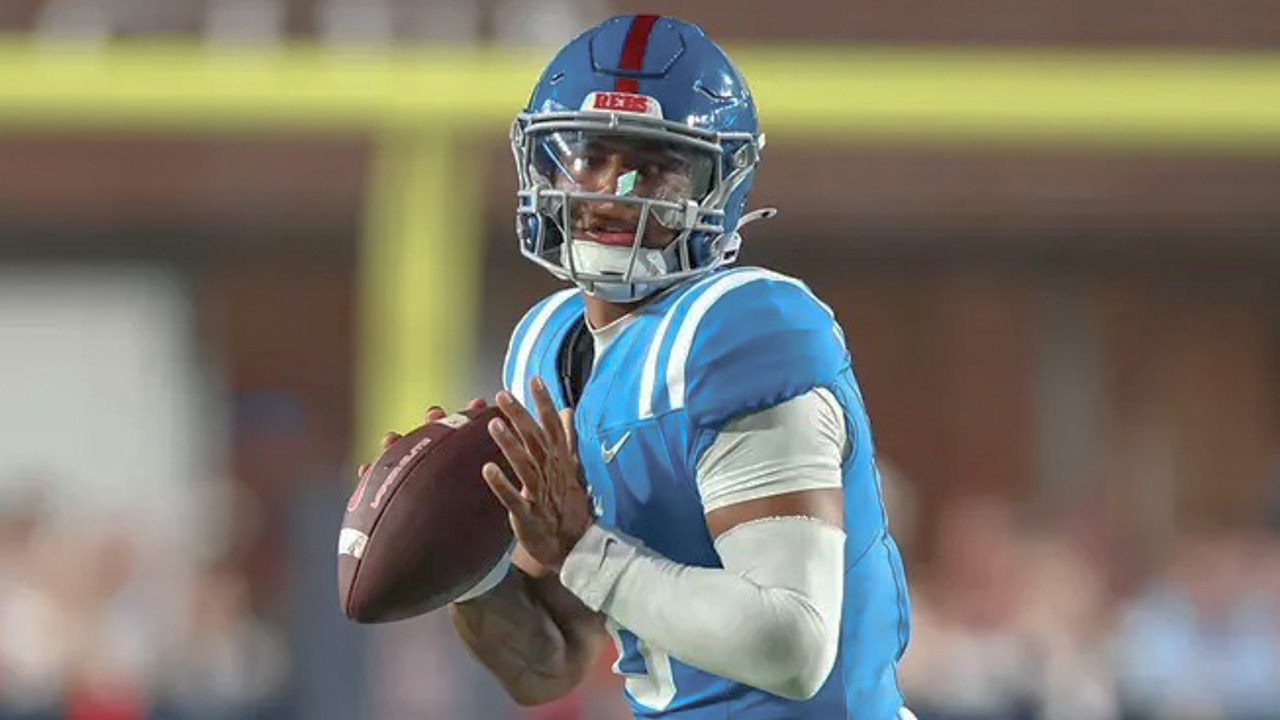
One of the most important days of the college football offseason is less than 48 hours away for Ole Miss fans.
On Thursday morning in Pittsboro, Mississippi, quarterback Trinidad Chambliss will have his hearing for a preliminary injunction motion heard by Calhoun County judge Robert Whitwell.
If the injunction is granted, Chambliss will be the Rebels’ starting quarterback in 2026 as his lawsuit against the NCAA slowly progresses through the court system.
If the injunction isn’t granted, Chambliss will be headed to the NFL.
The stakes are simple, but how Chambliss and his attorneys can win and get the injunction isn’t very simple.
ICYMI: New Twist in Trinidad Chambliss Case as Ole Miss Seeks NCAA Reconsideration
There are three things that Chambliss and his attorneys must prove to the judge on Thursday that will determine if an injunction is granted. Let’s break down each of those things.
Likelihood that he will prevail in the lawsuit
Essentially, Chambliss or his attorneys must convince the judge that the merits and evidence of the lawsuit makes it more likely than not that Chambliss win the lawsuit.
This isn’t the slam dunk that some might think. The crux of Chambliss’ inability to gain another year of eligibility through the NCAA is whether or not he was medically redshirted in 2022.
The record-keeping at Division II schools isn’t like what it is at Division I schools. Letters from Ferris State coach Tony Annese and senior associate athletic director Sara Higley were attached to a pair of affidavits filed last week.
In the letters, it’s explained that there are stats from the NCAA that shows Chambliss played in two games during the 2022 season. But those records don’t match what Ferris State has and instead supports the claim Chambliss did not take part in any game during that year in any capacity due to his ongoing battle with an illness.
“According to NCAA stats, Trinidad Chambliss played in 2 games in 2022. We have reviewed travel logs, excused absence forms, and watched game film. We can attest that Trinidad did not dress for or compete in any games in 2022,” the letter reads.
Annese, Ferris State’s head football coach, stated in his letter that Chambliss did not play or dress out in any games during the 2022 season.
This requirement is maybe the most complicated, but it does feel like Chambliss has a strong argument to make. This would be one that would require some in-depth reading of all the filings and affidavits to accurately predict.
Will suffer irreparable harm if not injunction is granted
The NIL deal that surfaced in December, the one reportedly worth $5 million and contingent on Trinidad Chambliss being eligible at Ole Miss in 2026, is central to the irreparable‑harm analysis.
If the court denies an injunction and Chambliss is forced to leave college football, he’ll enter the NFL, get drafted, and begin his professional career.
If he later wins the lawsuit, he can’t rewind his life and return to college to trigger that NIL agreement. Once he’s in the NFL, the opportunity to earn that specific deal is gone forever.
Is the loss of that opportunity something a court can fix after the fact?
Irreparable harm usually means harm that can’t be undone with money. Chambliss would argue that the NIL deal isn’t just a dollar figure. Instead he’d argue that it’s a unique, time‑bound opportunity tied to his eligibility and tied to Ole Miss’s roster plans.
The NCAA, on the other hand, could argue that because the deal has a clear monetary value, a court could simply award damages later, which would cut against a finding of irreparable harm.
So, the issue becomes whether the court views the NIL contract as a replaceable financial loss or as a one‑of‑a‑kind opportunity that disappears permanently if he’s not allowed to play.
Chambliss’s strongest position is that no amount of money later can restore the chance to return to college football, play at Ole Miss, and earn that specific NIL package — and that makes the harm irreparable.
Consistent with public interest or public good
One argument the NCAA is making in eligibility cases is that players seeking extra years of eligibility take away roster spots from high school athletes.
That makes sense. If the best programs are giving roster spots to players with five, six years of experience, that’s one less spot for a freshman. The freshman then has to go to a smaller school where, if he’s successful, he can leave via the transfer portal for a bigger school. That’s part of the cycle critics of the transfer portal frequently cite.
However, according to the affidavits filed last week, Chambliss playing in 2026 won’t take away a roster spot.
“The transfer portal window for the 2026-2027 academic year is now closed, and there are no quarterbacks currently in the transfer portal or in high school Ole Miss intends to recruit or who Ole Miss expects to add to its roster,” Ole Miss general manager Austin Thomas said in his letter. “Trinidad Chambliss, if he is eligible to participate in intercollegiate athletics at Ole Miss in the 2026-2027 academic year, will not displace any other quarterback on the Ole Miss football roster.
“Ole Miss intends to retain the other quarterbacks currently on its football roster, unless any other quarters leave due to academic, behavioral, or disciplinary issues.”
That would seem to indicate no harm will be done to the public at-large. (Mississippi State fans might strongly disagree, though.)
Final Thoughts
Nothing about Thursday’s hearing is automatic.
Chambliss has compelling points to make on all three fronts, but each comes with its own gray areas, from conflicting Division II records, to how a court defines irreparable harm in the NIL era, to whether one extra quarterback truly affects the broader public interest.
What looks straightforward from the outside becomes far more complicated once the legal standards come into play.
That’s why this hearing matters: not because the answer is obvious, but because it isn’t.