

When conference commissioners and media pundits talk about the College Football Playoff, it’s usually about how many more teams will be in future playoffs?
The CFP will stay at 12 teams for 2026, but it’d be surprising if that number isn’t increased for the 2027 season. It’s no secret why this is talked about so much. More teams in the CFP means more fans can realistically hope to in the field.
But there are other changes being discussed and, apparently, a major change has already been made.
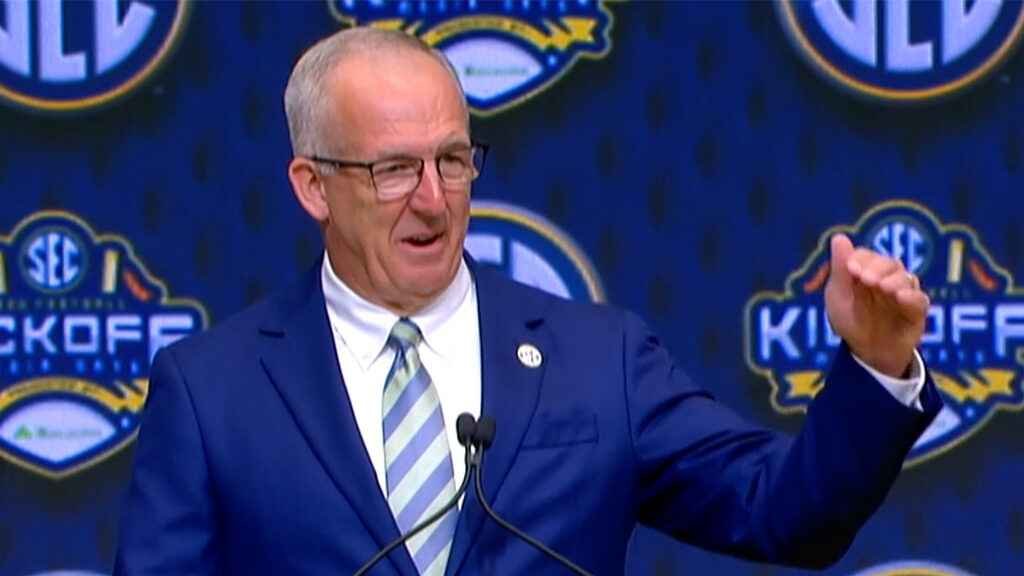
SEC commissioner Greg Sankey recently revealed (or put a spotlight on something that hasn’t been covered) a significant change to CFP.
“It’s interesting next year the opportunity for the one seed to pick its path,” Greg Sankey told Paul Finebaum at the Regions Tradition Pro-Am. “The location of its quarterfinal bowl and the location of its semifinal bowl, and then the two seeds to have a quarterfinal bowl option, and obviously, placed in the semifinal bowl. So we talked about those logistical issues, really good TV success, really good attendance success last year, and how we continue to build. Those are the real key topics.”
It was said in such a nonchalant way most people might’ve missed it, but it could have a huge impact on the playoff field.
Basically, the No. 1 seed gets control as they decide both their quarterfinal and semifinal locations. The No. 2 seed will get to pick its quarterfinal destination.
The advantages are obvious and significant. They get travel control. Shorter trips mean fresher players and louder crowds with fan dominance. Familiarity also plays a factor here, as some programs understand certain bowls better than others. That edge is now getting sharper.
Last season, that would’ve meant No. 1 Indiana and No. 2 Ohio State making some important decisions. The Hoosiers went to the Rose Bowl while the Buckeyes were in the Cotton Bowl. Under the new format, they could’ve gone someplace else.
This coming postseason schedule has already been set. In the CFP Quarterfinals, the Fiesta Bowl will be played on Dec. 30, while the Cotton Bowl, Peach Bowl, and Rose Bowl will all be played on January 1. The CFP Semifinals feature the Orange Bowl on January 14 and the Sugar Bowl on January 15.
So, let’s pretend Ole Miss goes unbeaten and ends up the No. 1 seed. The Rebels could to go to Arizona, Texas, Georgia or California for the quarterfinal game. And they’d almost certainly choose the Sugar Bowl for the semifinal.
Ole Miss had a respectable contingent of fans at last year’s Fiesta Bowl in Arizona. So, maybe the location wouldn’t matter as much. But traveling to Dallas or Atlanta is much shorter and would likely be the choice.
Unless the quarterfinal matchup would be against one of the Texas-based teams or Georgia. Then some thought about playing in Arizona or California would be warranted. (Although, it’s hard to picture Ole Miss willingly choosing to go to the Rose Bowl.)
Or maybe under Pete Golding the Rebels simply say “we don’t care, just line up and play” and none of this really matters.
The bigger takeaway is that the playoff isn’t just getting bigger. It’s getting more strategic. Picking your path is a real edge, and the programs that understand how to use it will feel the benefits long before the bracket even kicks off.