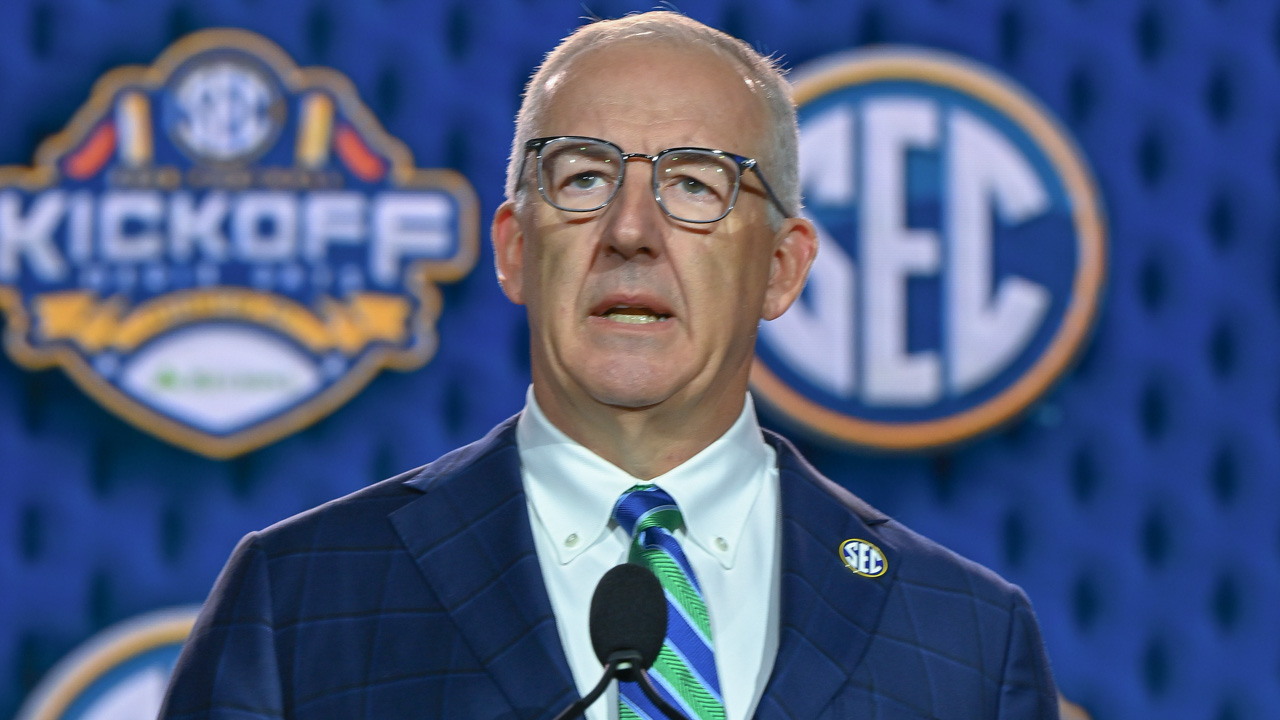
SEC Commissioner Greg Sankey didn’t break news at SEC Media Days, but he did say something that needed to be said out loud.
Something coaches usually dance around. Something I’ve been pointing out since the moment Dabo Swinney stood at a podium in January and accused Ole Miss of “blatant tampering.”
Sankey called it the glass house problem.
“We all live in a glass house,” Sankey told Sports Talk Mississippi on Tuesday. “… And I respect that frustrations boil over from time to time, but the environment that we’re in (with player) representatives, NIL representatives, agents making phone calls, we’re in a very different environment, which puts us into the glass houses. So, we all have to be careful about throwing stones – including me.”
"We. All. Live in a glass house"
Greg Sankey weighs in on Dabo Swinney's calling out of Pete Golding and Ole Miss pic.twitter.com/rcrps6fbO5
— SportsTalk Mississippi (@SportsTalkMiss) July 21, 2026
That’s the truth of the situation.
Tampering is everywhere. It’s baked into the sport now. With agents, NIL reps, third‑party handlers and a transfer portal that never really stops spinning, it’s almost impossible for any program to claim it’s completely clean.
And that’s why Swinney’s public accusation toward Ole Miss always rang hollow.
Not because Ferrelli’s recruitment was simple or clean, but because it’s hard to believe Clemson hasn’t benefited from the same gray‑area conversations everyone else swims in.
The Ferrelli timeline is familiar by now. The former Cal linebacker committed to Clemson on Jan. 6 and signed financial paperwork the next day. He was attending classes in mid‑January when, according to Swinney, Ole Miss head coach Pete Golding and other representatives made impermissible contact.
Swinney said Golding even sent Ferrelli a photo of a million‑dollar contract and asked about his buyout. After back‑and‑forth conversations between Ole Miss and Ferrelli’s agent, Ferrelli re‑entered the portal on Jan. 22 and committed to the Rebels immediately.
The NCAA opened an investigation. The Big Ten asked the NCAA to pause all tampering cases. The NCAA said no. And since then, nothing public has happened.
Sankey didn’t comment on the Ole Miss case specifically, but he made it clear the system itself is broken.
“You’re not just going to stop this stuff,” Sankey said. “The NCAA model is you get a committee together and they say we need stronger penalties. I don’t think that’s true. I think we need to define what it is we want, which fundamentally is: we don’t want coaches calling kids at a different school saying, ‘Jump in the portal.’ Or setting up deals with representatives so that you go in the portal at 6 pm on a Friday at 8 am you have a new place and a scholarship. That means tampering has taken place.”
He’s right. Stronger penalties won’t fix anything. A legal tampering period won’t fix anything either. All that does is push the illegal conversations earlier in the calendar.
Tampering isn’t a faucet you can shut off. It’s a river that’s already carved its path.
Sankey even laid out what accountability should look like.
“Those things should be defined. And then when issues occur, I don’t think stronger penalties are the answer right now. I think (it should be) more timely oversight and accountability,” he said. “And it may be a lesser penalty, it may be just a warning … what is perceived as a slap on the wrist. But do something in an orderly fashion, in a timely fashion. And then if it happens again involving the same individuals, that penalty should be elevated.”
That’s the part that matters. Not the severity. The consistency. The acknowledgment that the sport has changed and the rulebook hasn’t kept up.
Sankey also noted that SEC representatives met with NCAA president Charlie Baker the day after the Big Ten tried to freeze all tampering investigations. The SEC walked away hoping the NCAA would adjust to the new reality instead of pretending the old one still exists.
It’s refreshing to hear someone in Sankey’s position say it plainly.
Everyone lives in a glass house. Everyone knows tampering is happening.
And until the NCAA stops pretending it can legislate human nature, the best anyone can hope for is timely oversight and a little honesty about how the sport actually works.
Swinney threw the first stone in January. Sankey reminded everyone that the walls around him aren’t exactly made of brick.