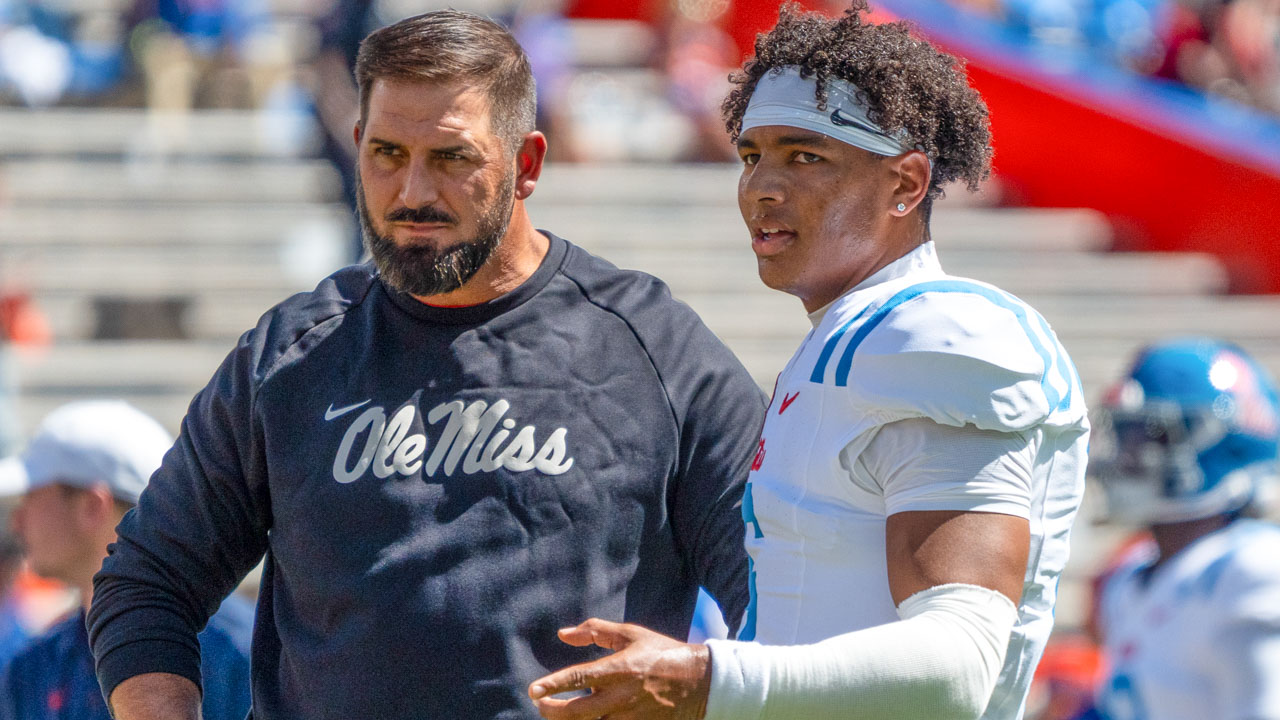
Ole Miss didn’t just spend the bye week healing up and correcting mistakes.
It spent the bye week getting very real about accountability. And yes, that included fines.
Not performance‑based fines (that’s not allowed) but the kind of corrective tool that actually makes sense in today’s version of college football, where multi‑million‑dollar NIL deals are normal and players negotiate contracts like professionals.
Pete Golding didn’t shy away from explaining why the system exists.
“Obviously, you can’t make them performance-based from that standpoint,” he said at his Monday press conference. “But there’s a cycle coming in December and January when everybody wants to renegotiate their contract, and it’s very black and white based on, ‘This is good enough. This isn’t good enough.’”
He compared it to any job. Before someone gets fired, you call them in, explain the expectations and make sure they understand what has to change. That’s the point of the fines. Not punishment. Clarity.
“I think it’s my responsibility before you fire somebody to make sure you call them in and say, ‘Hey, man, this is not OK. This is the expectation. This is how we want it done,’ and clearly define it for them.”
And after a humbling 52-28 loss to Florida, Ole Miss needed clarity. Golding said the players responded the right way.
“I think they came back and responded the right way,” he said. “Accountability and ownership come from everyone, and it started with me first. You can’t watch the tape, see certain things and be OK with it. You just can’t.”
The bye week schedule reflected that.
The Rebels came in Sunday, took Monday off, then spent Tuesday watching every series of the game against Florida on offense, defense and special teams together. No hiding. No sugarcoating. Then they practiced Tuesday and Wednesday, went light Thursday and returned Sunday.
“A lot of people have looked in the mirror and asked whether we’re doing everything we can control.” Golding said. “That’s all my concern is. Are we going to work our butt off and control the things we can control?”
Golding said the response wasn’t just emotional. It was behavioral. And that’s where leadership started to show up.
“I think you saw several guys respond emotionally afterward,” he said. “It makes sense when you get hit in the face and it’s, ‘All right, man, come on,’ and all that type of stuff. But that has to be consistent.”
He wasn’t talking about yelling or rah‑rah speeches. He was talking about the quiet stuff, showing up early, staying locked in during meetings, holding teammates accountable when they don’t touch the line or start drifting.
“When your buddy is falling asleep in the meeting, are you getting on his ass then?” Golding said. “When a dude doesn’t touch the line, are you getting on his ass then? There’s so much to that.”
Golding said several players have stepped up by setting the example first, then holding others accountable. That’s the kind of leadership Ole Miss needs if it wants the Florida loss to be a turning point instead of a warning.
“But until you change your behavior and change what you do leading up to that point, you’re not going to get a different result.”
The bye week didn’t erase the loss. It wasn’t supposed to.
It was supposed to force Ole Miss to confront it, learn from it and respond.
Based on Golding’s tone, the Rebels did exactly that.
Now they have to prove it on Saturday.