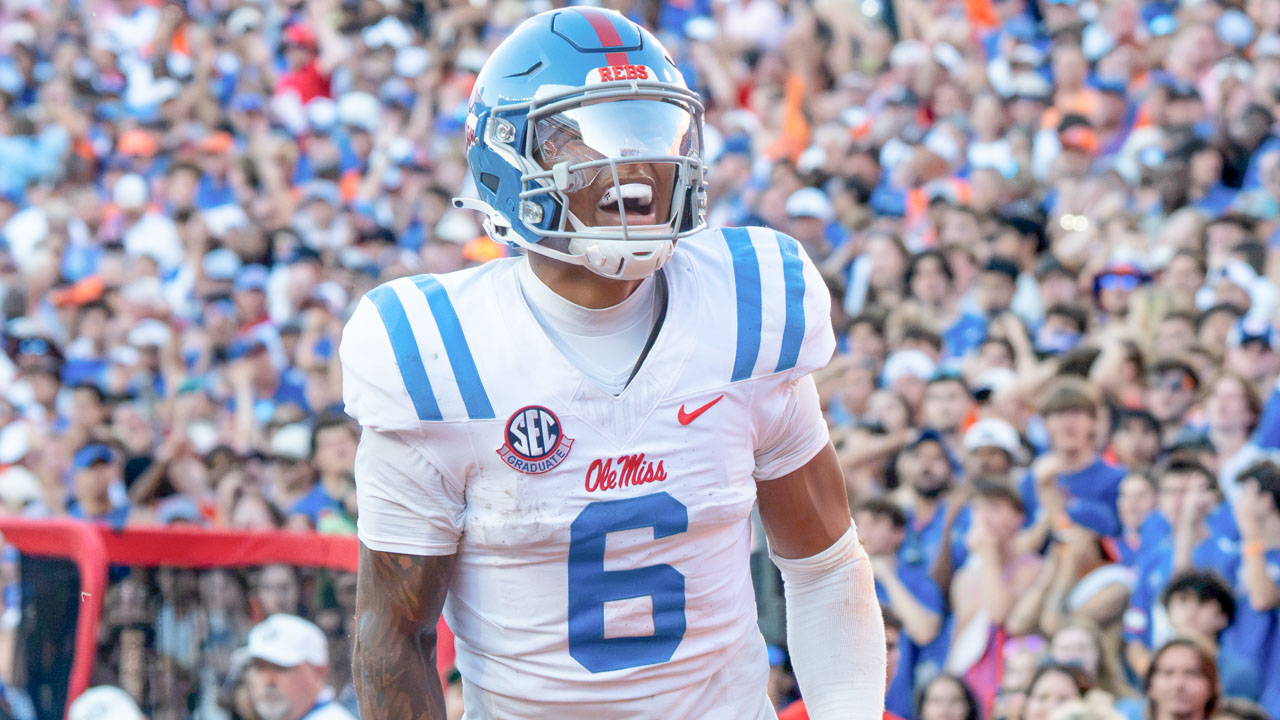
One of the most memorable moments of Trinidad Chambliss’ time at Ole Miss came in the fourth quarter of last season’s CFP quarterfinal game against Georgia.
Every Ole Miss fan is probably already picturing the moment on third-and-seven, Chambliss escaped a Georgia pass rush. He scrambled around all the way to his own goal line with two defenders giving chase and completed a pass to Kewan Lacy for a first down.
It’s the highlight moment of a game that saw Chambliss channel his inner Houdini and magically escape a blitz or pass rusher. Those moments continue to show up in each game.
And that should cause a lot of concern in Nashville.
Vanderbilt’s defense is the definition of a boom-or-bust defense. The Commodores don’t want sit back and let an offense go on a 12-play drive. They attack. They attack from different levels, creating negative plays and forcing quarterbacks into decisions before they’re ready.
There’s evidence it works. Vanderbilt’s 3.25 sacks per game is 12th most in the nation and fourth in the SEC. Linebacker Nick Rinaldi leads with 3.5 sacks and safety CJ Heard and defensive lineman Issa Ouattara have two each. The Commodores have recorded 22 tackles for a loss, averaging 4.4 per game.
The defense has also forced four interceptions and seven fumbles. One of those fumbles epitomizes the boom-or-bust potential of Vanderbilt’s defense.
Again, almost every college football fan knows what play that was. It was the game-winning play against NC State where the Wolfpack’s CJ Bailey fumble in his own endzone while trying to run off the final six seconds of the game. That came after NC State racked up 446 yards and 31 points.
That is the appeal of the scheme.
Vanderbilt can lose several plays and still win the defensive possession if one pressure produces a sack, turnover or third-and-12.
Chambliss, though, could be the Freddy Krueger to Vanderbilt’s dreams.
One of the best traits about Chambliss is his legs and his uncanny ability to scramble away from pressure and produce a positive play.
Remember the shovel pass for a first down against LSU? That’s Freddy suddenly pushing through the wall above Nancy’s bed. The play looks dead, and then something that shouldn’t be possible happens anyway.
That ability has helped fuel a hot(ish) start to the season for him.
Through four games, Chambliss is completing 70.8% of his passes for 1,222 yards, eight touchdowns and three interceptions, averaging 8.5 yards per attempt. Ole Miss has allowed only four sacks in 153 team pass attempts.
He’s officially at 108 rushing yards on 28 attempts, but he has already produced seven runs of 10-plus yards and 12 rushing first downs.
Against LSU, Chambliss threw for 363 yards, but the defining offensive play was a 14-yard fourth-quarter touchdown run. The Tigers even had a defender on the outside that Chambliss, as Lane Kiffin put it, simply outran to the endzone.
At Florida, even in a loss, he threw for 298 and added 64 rushing yards with two rushing touchdowns.
So, yes, Chambliss could potentially be a nightmare for Vanderbilt.
If the Commodores rush six and there’s only five blockers, someone has a free path to Chambliss. Against a stationary quarterback, that’s a sack.
Against Chambliss, he could take off running for a 20-yard gain. Or rollout to the side and keep his eyes downfield where an array of pass catchers are running to get open.
That’s the paradox of blitzing Chambliss. Getting pressure isn’t the same thing as getting him down.
Vanderbilt knows this. It was one of the first things head coach Clark Lea talked about Tuesday.
“Trinidad Chambliss is, as advertised, a dynamic player,” Lea said. “What you want to do is defend the backfield with structure and leverage. Keep the cage on the quarterback. He’s going to get his plays, but we have to make sure the big plays don’t go for touchdowns.”
No team has truly found a cage capable of containing Chambliss and while Vanderbilt is considered a “southern Ivy League school” not even it is capable of building one to contain him.