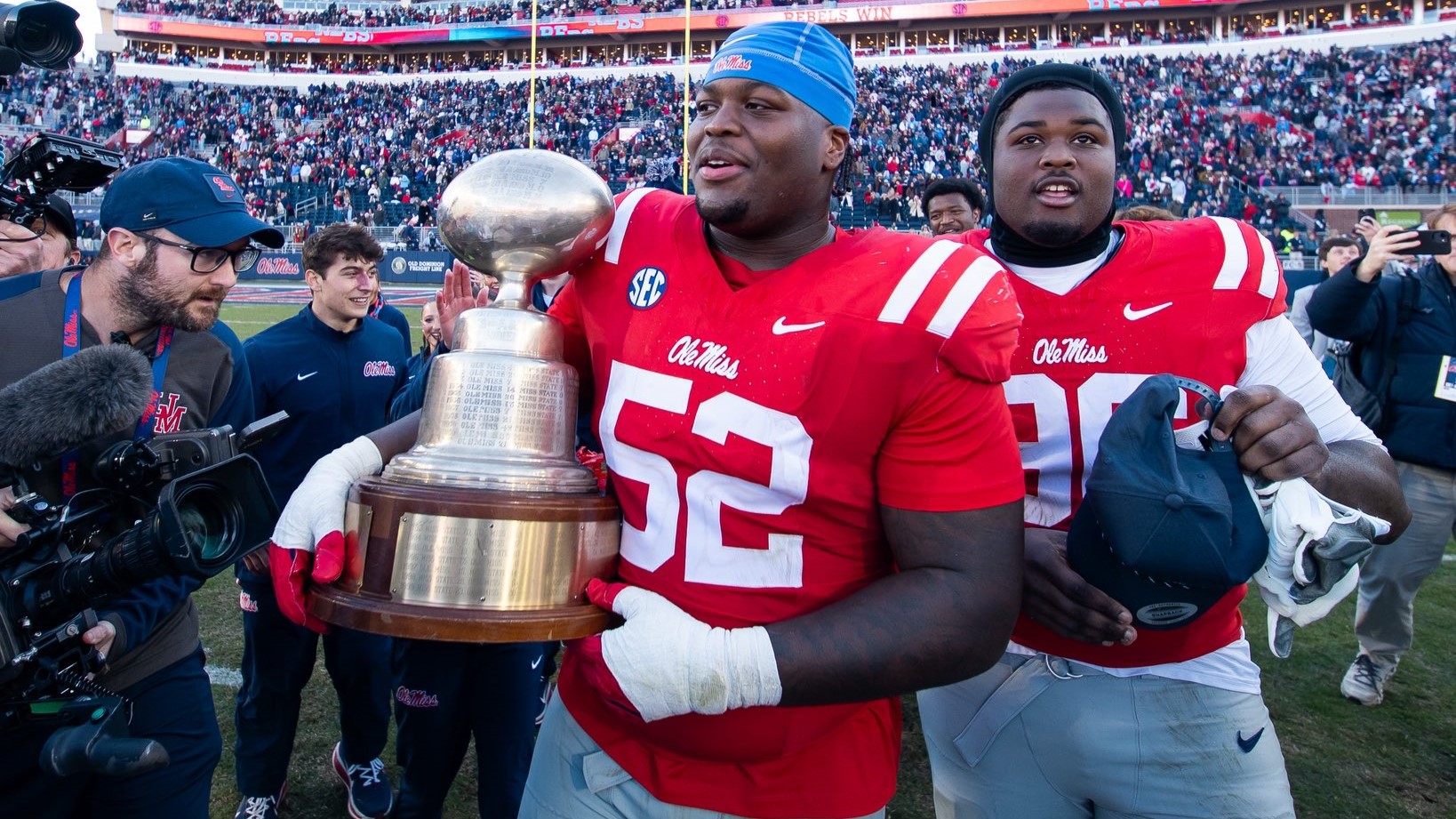
It took a little longer than most Ole Miss fans probably would’ve liked, but the Rebels eventually pulled away from Mississippi State for a 41-17 victory in the 123rd Egg Bowl.
The Rebels secured their fifth consecutive season with at least eight wins and prevented their in-state rival from becoming bowl eligible.
There were plenty of impressive statistics from Friday’s win at Vaught-Hemingway Stadium, but these five stand out the most.
35
That’s how many points Ole Miss scored in the second half after managing just six in the first half.
The Rebels scored touchdowns on five of their six second-half possessions, with the lone exception being a three-and-out to begin the fourth quarter.
Perhaps the most encouraging part of that second-half performance was how the Rebels started it. Ole Miss put together consecutive touchdown drives of 75 and 78 yards after gaining just 131 yards of offense in the entire first half.
Trinidad Chambliss averaged 14.7 yards per completion in the second half compared to just 6.9 in the first half.
7
That’s how many times Ole Miss sacked Mississippi State quarterback Parker Puckett.
Mississippi State entered the Egg Bowl having surrendered an SEC-worst 39 sacks, making Friday a great opportunity for the Rebels’ defensive front to have a productive afternoon.
Seven different Ole Miss defenders were credited with at least half a sack, led by Suntarine Perkins’ 1.5 sacks.
Three of those seven sacks came on a single fourth-quarter possession that ended with the Bulldogs turning the ball over on downs.
The Rebels also recorded 13 tackles for loss, accounting for 57 lost yards.
0
That’s how many third-down conversions Mississippi State had in the second half.
Considering how much Ole Miss’ defense has struggled to get off the field this season, holding an opponent without a third-down conversion for an entire half is noteworthy.
The Bulldogs finished the game just 3-of-11 on third down and failed to convert any of their four second-half attempts.
Conversely, Ole Miss converted four of its five second-half third downs, all four of which came on the Rebels’ two third-quarter touchdown drives. The Rebels needed an average of 7.75 yards on those four successful attempts.
0
That’s also how many rushing yards Joshua Dye lost against Mississippi State.
The running back carried the ball 20 times for 96 yards and two touchdowns, with his longest run of the afternoon going for just 12 yards.
That makes his average of 4.8 yards per carry all the more impressive because it wasn’t inflated by one particularly long run.
Without Kewan Lacy and Shekai Mills-Knight available, Dye gave Ole Miss a dependable option in the backfield and accounted for more than 81 percent of the Rebels’ net rushing yardage.
18
That’s how many combined yards Ole Miss’ offense needed to travel to score two of its three fourth-quarter touchdowns.
Blake Purchase’s interception return set up the Rebels at Mississippi State’s 1-yard line, and a turnover on downs later in the quarter set them up at the Bulldogs’ 17-yard line.
Ole Miss converted both opportunities into touchdowns, needing just five offensive plays to score 14 points.
For all the attention Ole Miss’ defensive shortcomings have received this season, Friday was a great example of how much easier the Rebels’ defense can make things for their offense.
And that complementary football is how a three-point game with less than 11 minutes remaining turned into a 24-point Ole Miss victory.