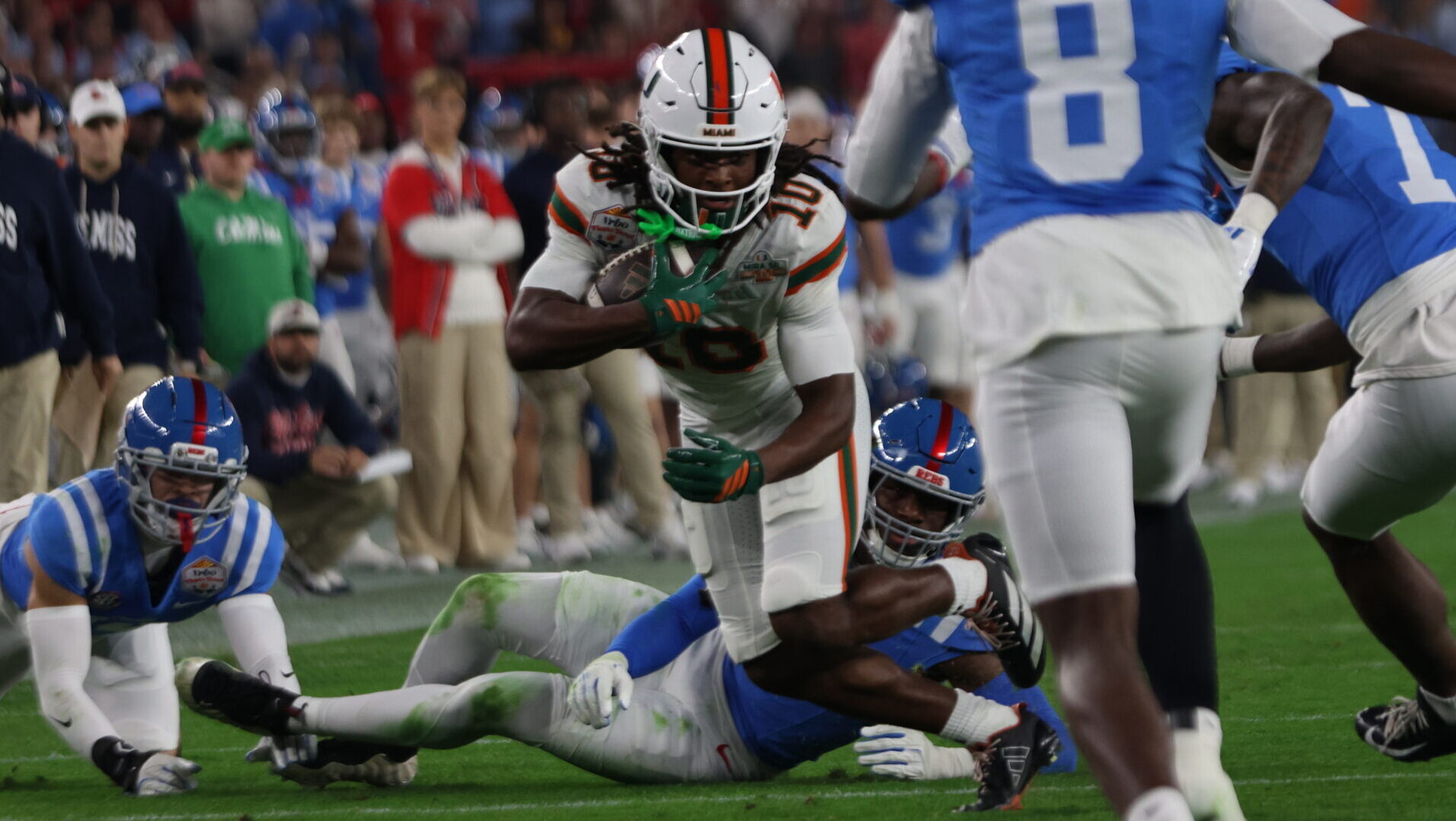
No. 6 Ole Miss has nothing to be ashamed of losing to No. 10 Miami in the Fiesta Bowl.
The last two months for the Rebels have been some of the most stressful, craziest months a playoff football team has ever experienced. You know what happened, no need to rehash all of that now.
Ole Miss deserves praise for how it performed, beating Tulane for a second time, avenging a regular season loss to Georgia and coming within 18 seconds of playing for a national championship.
Especially considering how the Rebels really didn’t deserve to be in contention to win the CFP semifinal game. For most of the game, specifically in the first half, Miami felt like it was dominating the game.
The Hurricanes were executing their offensive game plan perfectly and Ole Miss wasn’t. Several things went wrong for Ole Miss.
It’s not just the obvious stuff like if Lucas Carnerio doesn’t bounce a 54-yard field goal off an upright in the third quarter, Ole Miss only needed a field goal to win on the final drive.
The big things were game-long trends and that’s what we’re going to focus on. But remember that despite all of the bad that happened, Miami never led by more than seven points. (Translation: the Rebels could’ve won.)
Here’s what went wrong for Ole Miss against Miami:
Third Downs
Ole Miss was 0-for-7 on third down attempts headed into the fourth quarter and would go 2-for-3 in the fourth quarter. Obviously, that’s not good.
The Rebels’ miniscule time of possession can be tied directly to their inability to stay on the field and continue drives. Their first two drives of the game were three-and-outs while Miami had drives of 13, 7 and 15 play scoring drives to start.
Ole Miss managed to get Miami off the field more frequently in the middle portions of the game, but not when it mattered the most. On their game-winning drive, the Hurricanes converted four third downs, including three long distance downs (8, 6 and 10).
The Rebels’ offense, for their part, did convert third downs when it mattered most but it was too little, too late.
Miami’s run game
One of the Ole Miss defense’s flaws this season had been its struggles stopping rushing attacks. They did end the season 13th in the SEC in run defense, but did a significantly better job in the first two CFP games against Tulane and Georgia.
Unfortunately, those improvements didn’t carry over against Miami.
The Hurricanes ran the ball 51 times for 191 yards. That’s only an average of 3.7 yards per carry, but if you remove Carson Beck from the equation it jumps up to 5.2. Mark Fletcher Jr. was especially hard to stop, averaging 6.0 ypc himself.
That’s how Miami stayed on the field for 41 minutes and ran 88 total plays. It wasn’t big, explosive plays (although they did have some and should’ve had more) but a more old-school, three yards and a cloud of dust-style offense.
It also likely played a role in wearing out the Rebels’ defense on the game-winning drive that lasted 15 plays when Beck had some of his passing moments in the game.
Kewan Lacy injury
Lacy’s final stat line is impressive on the surface. He ran 11 times for 103 yards, averaging 9.4 ypc, and had a 73-yard touchdown run. What that stat line leaves out is Lacy left the game after that long touchdown run, didn’t return until after halftime and didn’t have a carry until the fourth quarter.
It was clear something was wrong with Lacy based on how he was running and now we know he injured his hamstring.
If Lacy doesn’t get hurt on that play, does Ole Miss give him more carries? And does he have more big plays?
Maybe. Nothing is guaranteed and Lacy can’t stop the other team from running with success. But a lot like how Texas likes to point towards Colt McCoy’s injury in a national title game against Alabama 15 years ago, things would’ve been different with Lacy at full strength.